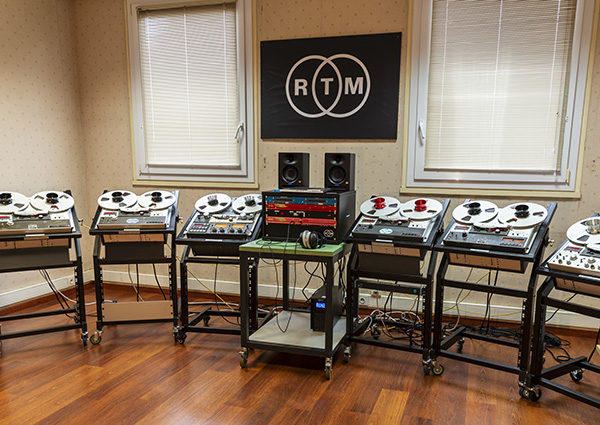
The tape duplication room at Recording The Masters, Avranches, France.
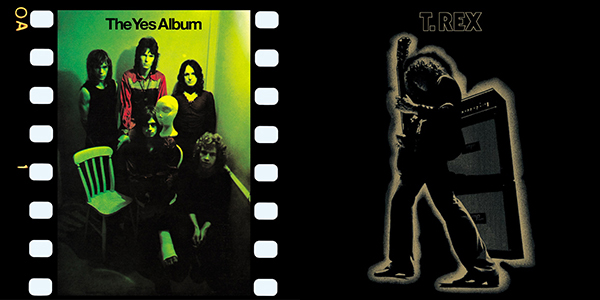
Rhino Records, Warner Music Group's back-catalog label, has jumped into the rarified niche of prerecorded reel-to-reel tapes. Under the Rhino High Fidelity brand, the first two titles were announced in October 2025: T. Rex's
Electric Warrior and
The Yes Album. Both are limited editions; no more than 500 tapes will be made and sold.
Rhino joins a surprisingly long list of companies currently producing reel tapes for sale to audiophiles. Retail prices are hundreds of dollars per album, and some are closer to $1000. Most of these labels are selling little-known music by little-known artists, but there are bigger players including Chad Kassem's Analogue Productions (AP) and The Tape Project, which licenses classical, jazz, and rock titles from Sony, Universal Music, Concord, and other copyright holders. In Europe, Horch House in Switzerland licenses classical titles from Universal, Warner Classics, and others. Smaller audiophile labels—2xHD and Chasing the Dragon to name two—sell tape versions of titles already well-regarded on vinyl and/or CD/SACD. Nowadays, there are hundreds if not thousands of albums, new and old, available on legitimately licensed reel tapes. There are also a few pirates in the business—likely known to readers with a strong interest in tapes—but we'll focus on companies with legal rights to produce and sell tapes.
How the tapes are made
Reel-to-reel tapes were an early stereo format, circa mid-1950s, with many labels in the game. Those early releases were two-track: Each channel of stereo took up approximately half the tape width, with tape playback in one direction. In the late '50s, the quarter-track format was introduced: four tracks on the tape, two channels for each direction or "side." That meant that half as much tape was required to hold an album; the tradeoffs were lower signal/noise ratio and the requirement for tighter azimuth tolerances for optimum playback.
Back then, tapes were duplicated at faster than playback speeds; 4× was typical in the mid-'50s, but by the late 1960s 16× was common. Almost all titles were recorded to be played back at 7.5 inches per second (ips), half the speed of the typical master tape of the time. Suffice to say that fast duplication has many downsides and inherently means the finished product sounds worse than the master tape.
Modern reel tapes are two-track 15ips, copied at playback speed: 1:1 duplication. Because this takes more time—fewer tape copies can be made in the same period of time—and requires more blank tape per album, today's reels cost more.
On the plus side, also today, higher quality tape is typically used. For example, AP reels are Recording The Masters (RTM) SM900, a high-output, low-noise formulation originally developed by BASF. Rhino's new tape series uses RTM LPR 90, the same oxide formula on a thinner polyester base layer. RTM, formerly Mulann, owns the tape formulations of BASF and Agfa and still uses some of the same manufacturing equipment in their Avranches, France, factory.
According to A&R head Steve Woolard, Rhino's reel tapes are duplicated at RTM's factory, overseen by RTM's Guillaume Enguehard, head of quality assurance and audio technical support. Five copies are recorded at a time, on Revox PR99 machines (footnote 1) restored by Reel Resilience of Derby in the UK, using the IEC equalization curve (footnote 2). Woolard told me that Rhino sent Enguehard four duplication masters made from the original analog flat-master tapes, dubbed "here in the WMG mastering studio onto RTM tape stock." Consequently, "the number of passes per submaster" doesn't exceed 50.
It follows that the copies sold to the public are third-generation (footnote 3), which isn't bad. The tapes are packaged in luxe-looking black cardboard boxes with reproductions of the album front and back covers glued onto the box, along with a spine label. Inside is a sharp, four-page insert similar to Rhino High Fidelity's LP inserts, with images of the master tape boxes, detailed technical and artistic information, and brief instructions on how to handle and play the tapes.
Because LPR 90 tape is 1mil thick, each reel can accommodate up to 48 minutes of music at 15ips, meaning an entire album fits on a single reel. In contrast, AP, The Tape Project, and others use 1.5mil tape, so each reel holds 32 minutes maximum; most albums require two reels. That's one reason that Rhino tapes cost less: $299.98 per album vs $450–$500 for the two-reel albums from AP.
As is customary with two-track, the tapes arrive "tails out," meaning they must be rewound before playback. Storing a tape tails out cuts down on annoying pre-echo caused by magnetic print-through. There may still be some post-echo, which is less noticeable under normal listening conditions.
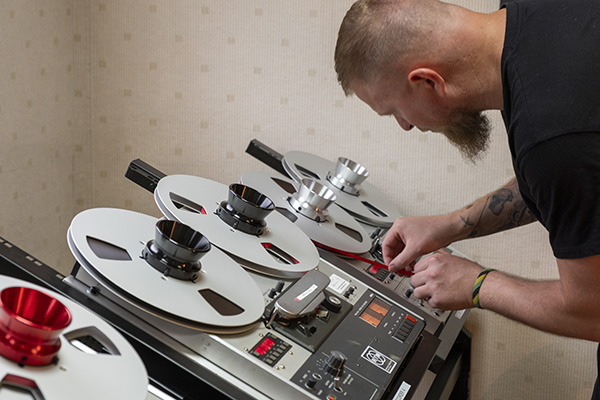
At RTM in France, studio tech Loic Lemaitre prepares a tape to be recorded.
Tim Chapman, RTM's business development manager, described the duplication setup in detail: The playback machine, a Studer A810 loaded with one of the duplication-master tapes provided by Rhino, feeds a Sonifex R8-DA6 1×6 distribution amplifier, which feeds the five Revox PR99 recording machines loaded with blank LPR 90 tape stock. Monitoring is via a pair of PreSonus Eris Studio 4 powered speakers and Beyerdynamic DT 770 Pro headphones driven by a Sonifex R8-HD1 headphone amp. (Sonifex is a British manufacturer of various pro audio and video equipment.) The rack also includes a passive switching system to select which machine is monitored and Sonifex RM-M2R106 precision LED signal-level meters. One pair of meters monitors the sixth output from the distribution amp (in other words, the audio being fed to the recorders); the other pair monitors the output being fed to the speakers and headphones (recorders 1–5 or a loop-back of the master playback).
Chapman said the machines are aligned to MRL IEC-standard tapes and setup is verified daily.
Matt Lutthans, mastering engineer for Analogue Productions, also runs the company's tape duplication facility, which is in the same building as his studio, The Mastering Lab. Last year, Lutthans took me on a tour via FaceTime. He first makes a 30ips, two-track half-inch duplication master, a dub of the album's master tape. That tape is then copied 1:1 to the ¼" two-track 15ips IEC EQ reels sold at retail. All the tape machines in AP's duplication system are Ampex ATR-100s, meticulously maintained by chief tech Brian Roth. Lutthans said he and Roth align all the machines with MRL tapes before they start a duplication run and check alignment each time the reels are changed.
Rene Laflamme of 2xHD told me he uses a row of customized Nagra tape machines, copying 1:1 onto RTM SM900 tape.
The Tape Project, based in Daly City, California, was a very early player in the revivified reel-to-reel business. Managing Director Paul Stubblebine told me that when his company first licensed titles from Concord, Reference Recordings, and others, there were two small-scale competitors, since defunct. The Tape Project began shipping to customers in 2007. Stubblebine said, "Since we have persisted since then, and now there are dozens of other outfits doing their own version, I think it's fair to say we started the current trend." He added, "We are still selling Tape Project tape albums to anyone who goes on our website and tells us they want them."
 How those Rhino tapes sound at home
Woolard sent me copies of both tapes, and I played them on my Ampex ATR-100 two-track. Both tapes were recorded hot, at a high average level; that's appropriate for LPR 90, a high-output tape. I set my reference level to +6, or 355nWb/m. At that level, the VU meters on my tape machine rarely crossed the 0 mark and never pinned in the red zone.
In my studio, over Amphion Two18 monitors,
The Yes Album sounded crisp and detailed, carrying forward from its creation the care that went into the mix and the layers of superb Steve Howe guitar playing.
Electric Warrior was boomier and more primitive, glam-rock yes but not wan or effete. It's a rocker, plain and simple, with a big beat.
I made 24/192 digital transfers direct from the Ampex ATR-100 to my Tascam DA-3000 digital recorder, loaded them into my NAS music library, and compared the tapes' sound to other releases I have of both albums. The main difference I noticed with these tapes is something I also noticed with Analogue Productions and Tape Project reels I've heard in my system: By the third generation of dubbing, the bass is not as tightly defined or in-focus as on the master source (as heard through various digital releases made from the master itself). This is what happens with magnetic recording: The noisefloor builds up, the transients get less sharp, and the low end gets a bit fuzzier with each dub. Modern tapes like this are way better than fast-duped quarter-track reels from the 1960s as far as fidelity to the source, but tape recording and playback is not transparent, and every dub puts more distance between the sound of the original source and the sound coming out of the speakers.
That said, these Rhino tapes have a big, rocking sound that scales up nicely to room-sized speakers, filling the space with sound of a pleasing kind. Like competing companies' luxury-priced tapes, they provide a different way to enjoy well-known albums. Like vinyl, tape has a "sound"; with some albums and some systems, it enhances music enjoyment.
What's next?
Given the depth of Rhino's catalog, especially as far as rock albums go (not to mention the depth of the Atlantic soul and jazz vault), the company could be a big player in the tape market, potentially bringing many beloved hits to the deluxe reel format.
"Could be" is the key phrase. Asked about future reel releases, Woolard said: "We're testing the waters with these two. Nothing is firmed up. ... Let's see how the market responds."
Footnote 1: This article provides a history and summary of the Revox PR99: soundonsound.com/reviews/golden-gear-studer-revox-pr99.
Footnote 2: IEC EQ, developed in Europe, was originally called CCIR. The NAB EQ, developed here by the National Association of Broadcasters, is now called IEC2.
Footnote 3: A duplicated tape is third generation from the final stereo master, if the actual master tape was used to make the duplication master. Fragile vintage master tapes cannot be played as many times as required with high-quality small-batch duplication, hence the need for a duplication-master tape or tapes. Each generation of tape dubbing can produce very audible changes in sound characteristics.