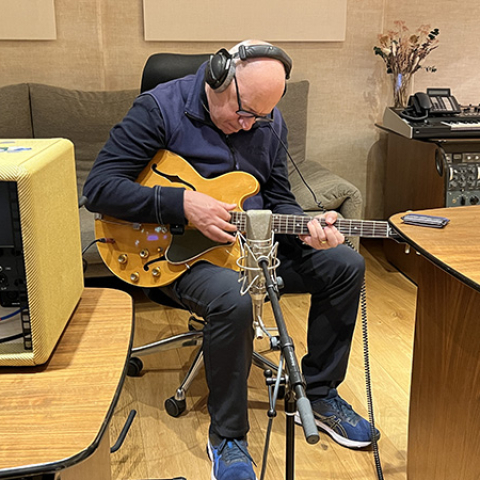
Keith Johnson is the man responsible for the records issued by Reference Recordings, from Professor Johnson's Astounding Sound Show through Tafelmusik—not to mention upcoming releases of Your Friendly Neighborhood Big Band and Respighi's Church Windows. As is frequently the case, Johnson's astounding recordings result from his intimate (molecular-level) knowledge of the process with which he deals and his ingenious adaptations to squeeze the most out of available (and not so available) technology. He is also one of the few critics of digital recording who has actually used a digital recorder, who has run tests to specifically identify digital's problems, and who would welcome a digital format that works as perfectly as the claims would have us believe the current system works.—Larry Archibald
A Note from JGH:
After a couple of scheduling foul-ups, I managed to corner Reference Recordings' Keith O. Johnson at the 1984 Winter CES in Las Vegas for an interview. Trying to find a location in the Riviera Hotel that was quiet enough for a tape-recorded interview proved to be a problem until Keith suggested a vacant automobile parked next to the Acoustic Research room. (That's right: Both the room and the car were in a vast hall.) The car was part of AR's exhibit (it contained an AR auto-sound system) so we got permission from one of AR's people to use it for the interview.
Three-quarters of the way through the interview, a group of men approached the car and peered rudely in through the window. I irritably explained that an interview was under way and instructed them to get lost, at which they all backed off, looking perplexed. Then it dawned on us: It was their car. We graciously vacated so they could lock it up for the night.
The opinions expressed here are those of the interviewee, and do not necessarily reflect those of Stereophile.—J. Gordon Holt
 J. Gordon Holt: How did you get started in recording?
Keith O. Johnson: I guess it was back in the early 1950s when I started messing with a couple of Pentron recorders. That was about the time 3M came out with their first red-oxide recording tape.
Holt: What sort of stuff did you tape back then?
Johnson: Whatever was available. Mostly school things. You know, rallies, the school band, that kind of thing.
Holt: How long did you record just for the fun of it?
Johnson: Oh, for many years. I liked to make my own tapes because I could get much better sound than anything I could get from records. And I found early on that I could get even better sound from my own recordings by modifying the equipment or rebuilding it. But I didn't think of issuing any of my recordings until just a few years ago. And it wasn't really my idea even then. Some people who heard my tapes urged me to have pressings made of some of them.
Holt: What kind of music do you most enjoy recording?
Johnson: Any kind that has an exciting sound. And you can find that kind of sound from almost any kind of music. It doesn't have to be loud and have impact to be exciting, although that seems to be the kind of recording that sells best.
Holt: That's always been the case. One of the things that has always distinguished a good system from a mediocre one is its ability to reproduce high-powered program material. And some of your recordings have been as bombastic as any ever made, although certainly more natural than most.
But I'm told that you aren't averse to multimiking, which is something audio purists hold in ultimate scorn. Is that true?
Johnson: Yes. But I don't do it the way the major record companies do, nor for the same reasons.
The smoothest, widest-range microphones are omnidirectional ones, and to get proper stereo separation they have to be placed some distance apart. When they are far enough apart for proper stereo separation, you find that the right and left instruments sound clustered around the loudspeakers, while instruments in the middle sound farther away, so I put a third microphone between them to even out the stage presentation.
Holt: That's the same technique Telarc uses, and that certainly isn't what audiophiles think of as multimiking. I'm talking about separate microphones covering separate groups of instruments. Do you ever do that?
Johnson: Not really. The only reason I can see for doing that is to compensate for the lack of detail in a poor playback system. I don't make recordings to be played on poor systems.
Holt: Then you never use more than three microphones?
Johnson: I use as many as I need to get the sound I want. I sometimes use other microphones spaced different distances from the source to produce multiple delays in the sound, to heighten the illusion of depth.
Holt: Doesn't this cause smearing due to multiple arrival times?
Johnson: Not if it's done properly.
Holt: If you're using more than two mikes, then you have to be using a mixer, and that's another no-no among audiophiles. What kind do you use, to get that clean a sound?
Johnson: It's one I built myself.
Holt: Does it have tube electronics?
Johnson: Oh no, it has no active circuitry at all. It's a passive device. All it has are pots and resistors.
Holt: You mix at microphone level? How come you don't run into hiss problems?
Johnson: The microphones have much higher output than the usual condensers. Since I'm only making them for my own use, they don't...
Holt: Now wait a minute. You built your own microphones? From scratch?
Johnson: Well, not from scratch. I used Schoeps and other capsules. I put lighter diaphragms in, and changed the interfacing circuitry. And because my own mikes don't have to conform to any industry standard for output, I made that as high as was practical without having to worry about standard line levels, phantom power requirements, and other standardized microphone parameters.
Holt: You mean they're about halfway between a typical mike and a typical line source?
Johnson: They're about ¼ volt out on the average, and up to 30 volts when things are really loud.
Holt: Then they must be FM-type microphones, like the old Stevens condenser mikes from the '50s.
Johnson: They are in many ways very similar.
Holt: Ah, so with that much signal output, you don't need preamp stages, and you're able to use passive mixing without running into noise problems.
Johnson: Exactly. And that gets rid of two sources of distortion in most mixers: the microphone preamplifers and the overall mixer electronics.
Holt: A lot of serious tape recordists will be eager to learn something about the ways in which you modified your famous tape recorder. How much can you tell us about this?
Johnson: Unfortunately, not too much. Except that my recorder isn't a modified machine. It was built from the ground up, including the heads and the transport.
Holt: Can you tell us what you've done to get such a high level of performance from it?
Johnson: There isn't much I can say about that because most of it is proprietary. But it is well known that analog tape has a lot of things the matter with it. Time smearing, for one, takes the edges off transients and gives the tape a soft, subdued high end.
Holt: You mean the smearing due to the frequency-dependent length of the magnetic gap? (footnote 1)
Johnson: Fortunately, that behavior is fixed in time and can be electronically compensated. More serious, though, is "presence-edge smear," which is literally a particle-to-particle creeping or print-through of steep-transient information. Another problem is the way a playback head distorts a steep wavefront by anticipating its arrival at the gap.
Holt: Would you explain that?
Johnson: Well, suppose you record a steep wavefront on the tape and then play it back. Because the head's pole faces are extremely long in comparison with the gap width, that steep wavefront will start inducing magnetism into the head a fraction of a second before the wavefront actually passes across the gap. A complex phase shift occurs because the short and long wavelengths are reproduced at slightly different times.
Holt: That would only affect high-frequency transients though, wouldn't it?
Johnson: Mainly, yes.
Holt: Doesn't increasing tape speed improve matters?
Johnson: Not really, because the lower the frequency, the longer the recorded wavelength on the tape. And as you increase the tape speed, the low-frequency wavelengths get even longer, and the problem with low frequencies gets worse and worse.
Holt: Have you found a way of getting around this?
Johnson: Yes. As I said, I can't discuss details. But that problem can be addressed. Electronic and mechanical time-phase correction can make the low-frequency characteristics very, very good indeed. The second problem, which contributes even more to analog tape's soft, washed-out sound, is the presence-edge smear I mentioned a while back. That problem is a result of our industry standards and practices, which require that we make tapes on today's machines which conform to playback standards established 30 years ago. The early Ampexes, for instance, were workhorses. There are still thousands of them in radio stations and recording studios. Back in the '50s, Ampex was the leading tape-recorder manufacturer, and they established the standards for tape recording and playback equalization. Other tape recorder manufacturers had to conform to those standards in order to break into the market. Professional equipment stays around a lot longer than audiophile stuff, and a lot of that professional equipment, which is still in use, is geared to the early tapes that had low bias-current requirements. So recording tapes are still being made to be compatible with recorder designs from the '50s.
It's possible to make magnetic coatings that have greatly different characteristics—superior characteristics in many ways. But these tapes wouldn't be usable on most machines. Yet recorders can be built which could take advantage of the superior properties of those tapes.
Holt: Is anyone making these supertapes?
Johnson: That is starting to happen in Europe. They're making some of what they call high-MOL tapes, which...
Holt: MOL standing for maximum-output-level.
Johnson: Right. They're very high-energy tapes.
See, we fell into a trap here in the States, of thinking that the best way to reduce tape noise was to make the oxide particles finer. Each oxide particle holds a certain amount of energy, even when there is no recorded signal. This magnetism is random in distribution, and for the lowest noise, the randomness should always be canceling out to zero. But the fewer particles you have passing the head at any instant, the less averaging of this randomness takes place and the more tape hiss you get.
So the first thing you think of is, let's grind the particles up more and make them smaller, and we'll have less noise. And with more particles in a given space, we'll get more signal output because there is more total potential magnetic energy. But the problem with this is that, when you scrunch all these things closer to each other, their opposing magnetic fields are so close together they tend to erase each other. So to get around that problem you do other things, like doping the oxide with cobalt for instance.
Holt: What does the doping actually do?
Johnson: I'm not sure what it does on a chemical basis. What it does to the magnetic properties is tend to square off the hysteresis loop (footnote 2) or retentivity characteristic of the tape, so the magnetism recorded on the tape more closely tracks the audio signal fed to the record head.
Because of hysteresis you have to use more than a 50% magnetic-field change to change the tape's magnetism by 50%. When you plot the relationship between the strength of the applied field and the actual magnetic state of the iron oxide particles, you don't get a neat, straight line. You get sort of a loop. It's sometimes called a box-shaped curve.
Holt: And cobalt doping reduces this disparity?
Johnson: It makes the tape's magnetic properties more energetic and the hysteresis loop more rectangular, more linear. But unfortunately, some of those magnetic domains are not terrifically stable. In time, or as a result of elevated room temperatures, you have something that might be called longitudinal print-through.
If we take the same pulse we were talking about earlier...
Holt: The steep wavefront.
Johnson: Yes. If you start with that, and then bend the tape around a sharp curve or expose it to high temperature, or otherwise shake up the molecules of the coating, and then play back the pulse, you'll find it's wider.
Now try the same thing with a high-frequency tone on the tape and you'll find there's been very little change. The tone is hardly affected, yet the pulse is. That's because the tone is symmetrical. The magnetic forces that tend to change adjacent domains are tending to cancel each other out, and what tries to migrate in one direction gets pushed in the other direction. So everything stays pretty much as it was, but only with tones—not steep-wavefront transients.
Holt: I thought tape smearing occurred because the magnetic field around the record head's pole pieces has a different length at different frequencies.
Johnson: Yes, that it does. But this one's really insidious because it gets worse with time. That initial pulse could have been so narrow that you would have hardly heard it, because all the spectral sidebands would be those of high frequencies and would be spread out, But once the base-line of that pulse becomes wider, then those sidebands start moving closer together and become more audible. So what happens is, you make a recording in which sideband distortions are inaudible, and then in time they do become audible. Magnetic tape's reputation for stability of the recorded signal isn't entirely justified.
That is the predominant reason why analog recordings will tend to sound soft and washed out, particularly so with time. And it's a virtual crime as far as I'm concerned, because people will spend tremendous amounts of money and time making a superb tape, and then two years later much of its original aliveness may be gone. In some cases the deterioration is so bad that when you go back and play the record that was mastered from it, the record will have more life to it than the master tape.
Again, there's a simple solution to this: Use a tape that requires large amounts of magnetism to change its magnetic state. Then the adjacent particles won't be able to demagnetize each other so easily. But then that tape won't be usable on most machines; the record head's pole-piece tips would saturate from bias and record-amplifier current before they could pass enough current to change the tape's magnetic state.
Holt: You said that some high-performance tapes are available in Europe. Are any such made in the US?
Johnson: Not to my knowledge. A lot of nudging from Doug Sax, myself, and others has started at least one domestic tape manufacturer investigating the problem. But most of them are aware of the problem and won't do anything about it, while the others deny that there's anything wrong with what they're producing now. I've mentioned the same thing to the Japanese and they're far more responsive and interested in pursuing research along these lines. But the Europeans, in making low-speed reel-to-reel machines, are already doing something about it, and I find it just makes the most sense to get my tapes there. Some of those tapes have very fine signal/noise ratios too.
Holt: Are those special tapes readily available in Europe? They're brandnames, that people can walk into a store and buy? Or are they more or less experimental tapes available only to industry insiders?
J. Gordon Holt: How did you get started in recording?
Keith O. Johnson: I guess it was back in the early 1950s when I started messing with a couple of Pentron recorders. That was about the time 3M came out with their first red-oxide recording tape.
Holt: What sort of stuff did you tape back then?
Johnson: Whatever was available. Mostly school things. You know, rallies, the school band, that kind of thing.
Holt: How long did you record just for the fun of it?
Johnson: Oh, for many years. I liked to make my own tapes because I could get much better sound than anything I could get from records. And I found early on that I could get even better sound from my own recordings by modifying the equipment or rebuilding it. But I didn't think of issuing any of my recordings until just a few years ago. And it wasn't really my idea even then. Some people who heard my tapes urged me to have pressings made of some of them.
Holt: What kind of music do you most enjoy recording?
Johnson: Any kind that has an exciting sound. And you can find that kind of sound from almost any kind of music. It doesn't have to be loud and have impact to be exciting, although that seems to be the kind of recording that sells best.
Holt: That's always been the case. One of the things that has always distinguished a good system from a mediocre one is its ability to reproduce high-powered program material. And some of your recordings have been as bombastic as any ever made, although certainly more natural than most.
But I'm told that you aren't averse to multimiking, which is something audio purists hold in ultimate scorn. Is that true?
Johnson: Yes. But I don't do it the way the major record companies do, nor for the same reasons.
The smoothest, widest-range microphones are omnidirectional ones, and to get proper stereo separation they have to be placed some distance apart. When they are far enough apart for proper stereo separation, you find that the right and left instruments sound clustered around the loudspeakers, while instruments in the middle sound farther away, so I put a third microphone between them to even out the stage presentation.
Holt: That's the same technique Telarc uses, and that certainly isn't what audiophiles think of as multimiking. I'm talking about separate microphones covering separate groups of instruments. Do you ever do that?
Johnson: Not really. The only reason I can see for doing that is to compensate for the lack of detail in a poor playback system. I don't make recordings to be played on poor systems.
Holt: Then you never use more than three microphones?
Johnson: I use as many as I need to get the sound I want. I sometimes use other microphones spaced different distances from the source to produce multiple delays in the sound, to heighten the illusion of depth.
Holt: Doesn't this cause smearing due to multiple arrival times?
Johnson: Not if it's done properly.
Holt: If you're using more than two mikes, then you have to be using a mixer, and that's another no-no among audiophiles. What kind do you use, to get that clean a sound?
Johnson: It's one I built myself.
Holt: Does it have tube electronics?
Johnson: Oh no, it has no active circuitry at all. It's a passive device. All it has are pots and resistors.
Holt: You mix at microphone level? How come you don't run into hiss problems?
Johnson: The microphones have much higher output than the usual condensers. Since I'm only making them for my own use, they don't...
Holt: Now wait a minute. You built your own microphones? From scratch?
Johnson: Well, not from scratch. I used Schoeps and other capsules. I put lighter diaphragms in, and changed the interfacing circuitry. And because my own mikes don't have to conform to any industry standard for output, I made that as high as was practical without having to worry about standard line levels, phantom power requirements, and other standardized microphone parameters.
Holt: You mean they're about halfway between a typical mike and a typical line source?
Johnson: They're about ¼ volt out on the average, and up to 30 volts when things are really loud.
Holt: Then they must be FM-type microphones, like the old Stevens condenser mikes from the '50s.
Johnson: They are in many ways very similar.
Holt: Ah, so with that much signal output, you don't need preamp stages, and you're able to use passive mixing without running into noise problems.
Johnson: Exactly. And that gets rid of two sources of distortion in most mixers: the microphone preamplifers and the overall mixer electronics.
Holt: A lot of serious tape recordists will be eager to learn something about the ways in which you modified your famous tape recorder. How much can you tell us about this?
Johnson: Unfortunately, not too much. Except that my recorder isn't a modified machine. It was built from the ground up, including the heads and the transport.
Holt: Can you tell us what you've done to get such a high level of performance from it?
Johnson: There isn't much I can say about that because most of it is proprietary. But it is well known that analog tape has a lot of things the matter with it. Time smearing, for one, takes the edges off transients and gives the tape a soft, subdued high end.
Holt: You mean the smearing due to the frequency-dependent length of the magnetic gap? (footnote 1)
Johnson: Fortunately, that behavior is fixed in time and can be electronically compensated. More serious, though, is "presence-edge smear," which is literally a particle-to-particle creeping or print-through of steep-transient information. Another problem is the way a playback head distorts a steep wavefront by anticipating its arrival at the gap.
Holt: Would you explain that?
Johnson: Well, suppose you record a steep wavefront on the tape and then play it back. Because the head's pole faces are extremely long in comparison with the gap width, that steep wavefront will start inducing magnetism into the head a fraction of a second before the wavefront actually passes across the gap. A complex phase shift occurs because the short and long wavelengths are reproduced at slightly different times.
Holt: That would only affect high-frequency transients though, wouldn't it?
Johnson: Mainly, yes.
Holt: Doesn't increasing tape speed improve matters?
Johnson: Not really, because the lower the frequency, the longer the recorded wavelength on the tape. And as you increase the tape speed, the low-frequency wavelengths get even longer, and the problem with low frequencies gets worse and worse.
Holt: Have you found a way of getting around this?
Johnson: Yes. As I said, I can't discuss details. But that problem can be addressed. Electronic and mechanical time-phase correction can make the low-frequency characteristics very, very good indeed. The second problem, which contributes even more to analog tape's soft, washed-out sound, is the presence-edge smear I mentioned a while back. That problem is a result of our industry standards and practices, which require that we make tapes on today's machines which conform to playback standards established 30 years ago. The early Ampexes, for instance, were workhorses. There are still thousands of them in radio stations and recording studios. Back in the '50s, Ampex was the leading tape-recorder manufacturer, and they established the standards for tape recording and playback equalization. Other tape recorder manufacturers had to conform to those standards in order to break into the market. Professional equipment stays around a lot longer than audiophile stuff, and a lot of that professional equipment, which is still in use, is geared to the early tapes that had low bias-current requirements. So recording tapes are still being made to be compatible with recorder designs from the '50s.
It's possible to make magnetic coatings that have greatly different characteristics—superior characteristics in many ways. But these tapes wouldn't be usable on most machines. Yet recorders can be built which could take advantage of the superior properties of those tapes.
Holt: Is anyone making these supertapes?
Johnson: That is starting to happen in Europe. They're making some of what they call high-MOL tapes, which...
Holt: MOL standing for maximum-output-level.
Johnson: Right. They're very high-energy tapes.
See, we fell into a trap here in the States, of thinking that the best way to reduce tape noise was to make the oxide particles finer. Each oxide particle holds a certain amount of energy, even when there is no recorded signal. This magnetism is random in distribution, and for the lowest noise, the randomness should always be canceling out to zero. But the fewer particles you have passing the head at any instant, the less averaging of this randomness takes place and the more tape hiss you get.
So the first thing you think of is, let's grind the particles up more and make them smaller, and we'll have less noise. And with more particles in a given space, we'll get more signal output because there is more total potential magnetic energy. But the problem with this is that, when you scrunch all these things closer to each other, their opposing magnetic fields are so close together they tend to erase each other. So to get around that problem you do other things, like doping the oxide with cobalt for instance.
Holt: What does the doping actually do?
Johnson: I'm not sure what it does on a chemical basis. What it does to the magnetic properties is tend to square off the hysteresis loop (footnote 2) or retentivity characteristic of the tape, so the magnetism recorded on the tape more closely tracks the audio signal fed to the record head.
Because of hysteresis you have to use more than a 50% magnetic-field change to change the tape's magnetism by 50%. When you plot the relationship between the strength of the applied field and the actual magnetic state of the iron oxide particles, you don't get a neat, straight line. You get sort of a loop. It's sometimes called a box-shaped curve.
Holt: And cobalt doping reduces this disparity?
Johnson: It makes the tape's magnetic properties more energetic and the hysteresis loop more rectangular, more linear. But unfortunately, some of those magnetic domains are not terrifically stable. In time, or as a result of elevated room temperatures, you have something that might be called longitudinal print-through.
If we take the same pulse we were talking about earlier...
Holt: The steep wavefront.
Johnson: Yes. If you start with that, and then bend the tape around a sharp curve or expose it to high temperature, or otherwise shake up the molecules of the coating, and then play back the pulse, you'll find it's wider.
Now try the same thing with a high-frequency tone on the tape and you'll find there's been very little change. The tone is hardly affected, yet the pulse is. That's because the tone is symmetrical. The magnetic forces that tend to change adjacent domains are tending to cancel each other out, and what tries to migrate in one direction gets pushed in the other direction. So everything stays pretty much as it was, but only with tones—not steep-wavefront transients.
Holt: I thought tape smearing occurred because the magnetic field around the record head's pole pieces has a different length at different frequencies.
Johnson: Yes, that it does. But this one's really insidious because it gets worse with time. That initial pulse could have been so narrow that you would have hardly heard it, because all the spectral sidebands would be those of high frequencies and would be spread out, But once the base-line of that pulse becomes wider, then those sidebands start moving closer together and become more audible. So what happens is, you make a recording in which sideband distortions are inaudible, and then in time they do become audible. Magnetic tape's reputation for stability of the recorded signal isn't entirely justified.
That is the predominant reason why analog recordings will tend to sound soft and washed out, particularly so with time. And it's a virtual crime as far as I'm concerned, because people will spend tremendous amounts of money and time making a superb tape, and then two years later much of its original aliveness may be gone. In some cases the deterioration is so bad that when you go back and play the record that was mastered from it, the record will have more life to it than the master tape.
Again, there's a simple solution to this: Use a tape that requires large amounts of magnetism to change its magnetic state. Then the adjacent particles won't be able to demagnetize each other so easily. But then that tape won't be usable on most machines; the record head's pole-piece tips would saturate from bias and record-amplifier current before they could pass enough current to change the tape's magnetic state.
Holt: You said that some high-performance tapes are available in Europe. Are any such made in the US?
Johnson: Not to my knowledge. A lot of nudging from Doug Sax, myself, and others has started at least one domestic tape manufacturer investigating the problem. But most of them are aware of the problem and won't do anything about it, while the others deny that there's anything wrong with what they're producing now. I've mentioned the same thing to the Japanese and they're far more responsive and interested in pursuing research along these lines. But the Europeans, in making low-speed reel-to-reel machines, are already doing something about it, and I find it just makes the most sense to get my tapes there. Some of those tapes have very fine signal/noise ratios too.
Holt: Are those special tapes readily available in Europe? They're brandnames, that people can walk into a store and buy? Or are they more or less experimental tapes available only to industry insiders?
Footnote 1: JGH gives a good explanation of some of the problems with analog tape in Volume 6, Number 1.—Ed.
Footnote 2: "Hysteresis loop distortion" refers to the lag between a changing magnetizing force and the magnetic state of the ferrous material to be magnetized. If hysteresis did not exist, a graph of this relationship would be a straight diagonal line, indicating that magnetization changes in exact correspondence with the applied magnetic field. Because of hysteresis the graph appears as two S-shaped curves whose coordinates describe a rectangular box.—J. Gordon Holt
J. Gordon Holt: How did you get started in recording?
Keith O. Johnson: I guess it was back in the early 1950s when I started messing with a couple of Pentron recorders. That was about the time 3M came out with their first red-oxide recording tape.
Holt: What sort of stuff did you tape back then?
Johnson: Whatever was available. Mostly school things. You know, rallies, the school band, that kind of thing.
Footnote 1: JGH gives a good explanation of some of the problems with analog tape in Volume 6, Number 1.—Ed.