I used DRA Labs' MLSSA system and a calibrated DPA 4006 microphone to measure the Manger p1's frequency response in the farfield, and an Earthworks QTC-40 mike for the nearfield responses. When I picked up the Manger speakers from Herb Reichert, he told me that he suspected that the p1's sensitivity was lower than the specified 89dB/W/m. My estimate was indeed lower, at 85.6dB/2.83V/m. Manger specifies the impedance as 4 ohms, which would mean that the p1 is actually drawing 2W from the amplifier with a 2.83V signal. The solid trace in fig.1 shows that the impedance is close to 4 ohms in the bass and lower midrange, but is greater than 6 ohms in the upper midrange and treble. The minimum magnitude is 3 ohms between 200Hz and 250Hz, where music can have high levels of energy, and there is also a combination of 4.4 ohms magnitude and 38° electrical phase angle (dotted trace) at 400Hz. The amplifiers used with the Manger speakers need to be comfortable driving 4 ohms and below.

The impedance magnitude trace doesn't have the expected peak in the bass that would indicate the sealed-box tuning frequency of the woofer. Concerned that there might have been something wrong with this sample (serial number p16150), I checked the impedance of the other speaker of the pair (p16149)—it was identical. It appears that the p1 uses conjugate load matching in the bass to reduce variations in impedance magnitude and phase angle.
I suspect that the ripples in the impedance traces between 600Hz and 4kHz are associated with the unique bending-wave drive-unit rather than with panel resonances. When I investigated the enclosure's vibrational behavior with a plastic-tape accelerometer, I found moderately high resonant modes at 215Hz and 328Hz on the back panel and sidewalls (fig.2). However, these modes have a high Q and the affected areas are small, meaning that they might not give rise to audible congestion in the midrange.

The blue trace below 350Hz in fig.3 shows the woofer's output, measured in the nearfield. It shows that the woofer rolls off below 50Hz with the expected second-order slope, but there is no sign of the exaggerated upper-bass output that is usually associated with a nearfield measurement. The sealed box's in-room output will be greater below the woofer's tuning frequency than with a comparable reflex alignment.

The woofer's farfield output (blue trace above 350Hz) crosses over to the bending-wave driver (red trace) a little higher than the specified 360Hz, but its high-frequency rolloff is smooth. The high-frequency drive-unit's output is disturbed by small peaks and suckouts, but it looks as if a basically even response consists of two plateaus, one in the upper midrange and low treble and the other 2dB higher in the upper octaves. By contrast, the Mangers' farfield response, averaged across a 30° horizontal window centered on the HF unit axis (fig.4), starts to slope down above 8kHz.

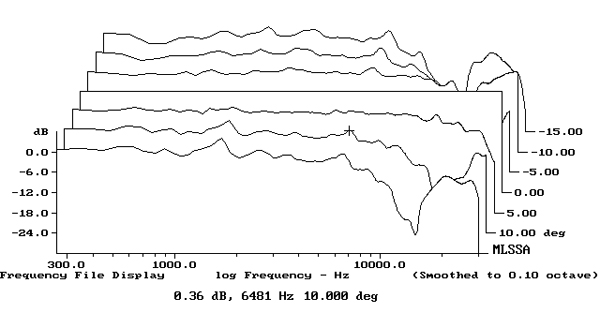
Herb did mention to me that he found the Mangers' balance to be on the mellow side, and looking at the p1's horizontal dispersion, with each trace normalized to the HF-axis response (fig.5), it can be seen that the p1's treble drops rapidly to the speaker's sides. There is also a significant lack of presence-region energy off-axis, though the on-axis suckout between 1kHz and 2kHz does fill in to some extent. The same lack of top-octave energy as you move away from the central axis can also be seen in the plot of vertical dispersion (fig.6). The listener needs to toe-in the p1s to the listening position and sit with his ears level with the center of the bending-wave driver, which is 37.5" from the floor, to get sufficient high-treble energy.

In the time domain, the p1's step response (fig.7) indicates that the upper-frequency driver is connected in positive acoustic polarity, the woofer in inverted polarity. The start of the woofer's step blends smoothly with the decay of the high-frequency drive-unit's step, which indicates optimal crossover implementation. The Mangers' cumulative spectral-decay plot (fig.8) has ridges of delayed energy associated with the on-axis response peaks in the low treble, and the decay is generally not as clean as you see with more conventional drive-units. (Ignore the ridge at 15.75kHz, which is due to interference from the MLSSA host computer's video circuitry.)


I was intrigued by the p1's use of a bending-wave drive-unit to cover most of the audioband. The p1's measured performance nicely correlates with its sonic character.—John Atkinson