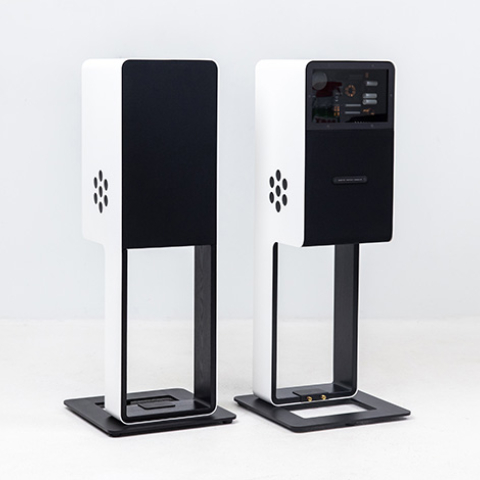
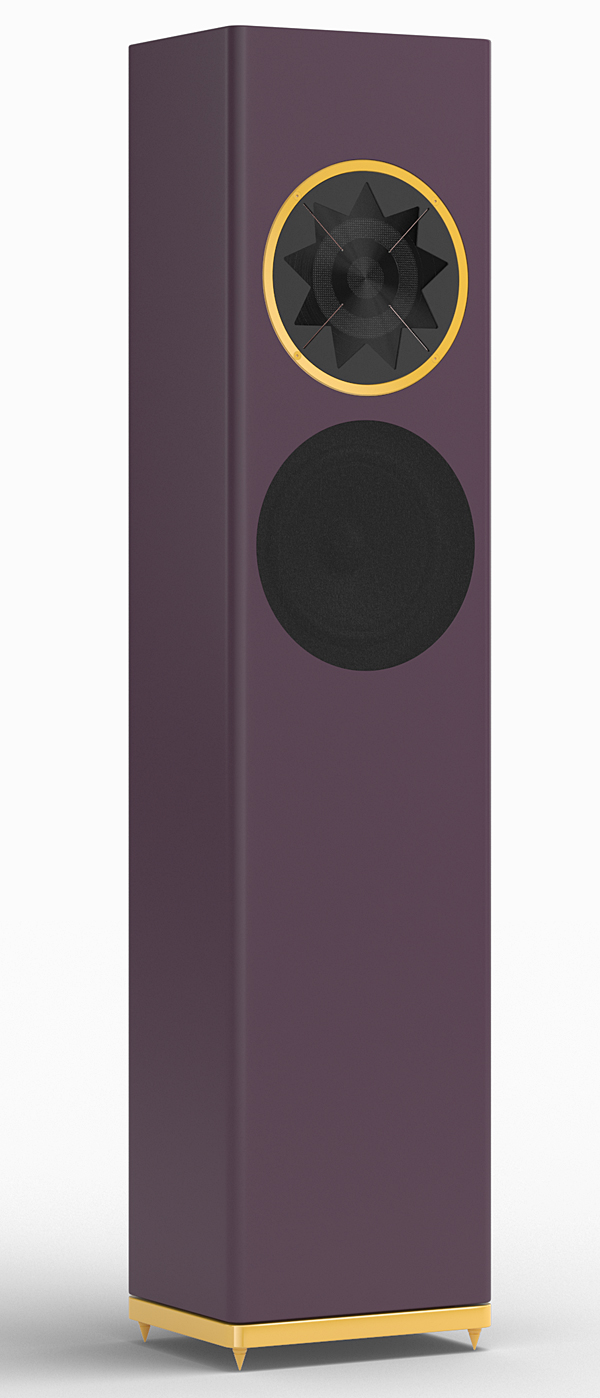
I spent my entire first day with the p1s playing KMFDM, Can, and Faust's signature album j US t (44.1/16 FLAC, Bureau B/Tidal). The Mangers did this way better than my Brit-boxes: The p1s delivered exquisite high-energy, high-tactility soundfields that flaunted these bands' potency and intelligence.
KMFDM and Faust led me naturally to I Put A Record On (44.1 FLAC, Monica Enterprise/Tidal), the 2007 debut album by Gudrun Gut, Germany's art-music counterpart to America's Laurie Anderson. I Put a Record On is a record about liking records; beyond its art-school roots, the album employs danceable Roland TR-808-type beats and catchy, almost hummable melodies. But! Gut's keen intellect avoids any type of pop/electronic dance music pandering. On "Pleasuretrain," the Manger p1s did a fine job portraying the complexity of layered synth tones, rolling force, and theatrical scale of Gudrun's exquisite Kunst(t)räume.
With the Rogue Stereo 100 amplifier, I played this album louder than I have ever played any music in this room, with no distracting distortions. At the highest volumes, sound stayed clear and easy on the ears, with full, naturally damped bass.
A visiting audiophile friend saw the Manger p1s and asked how they sounded. I told him: "Like Quad ESL-63s—with more bass and dynamics!"
Listening with the Pass Labs XA25
The first thing I noticed when I installed the 50Wpc Pass Labs XA25 amplifier ($4900) was how quiet the Manger p1s sounded. This quiet I experienced was not about the signal-to-noise ratio of the Pass Labs amp, nor was it about the Mangers' lack of cabinet vibrations or port noise. It was about the Manger p1's conspicuous absence of that scratchy, tinnitus-like "cone noise" that shadows the upper-midrange and presence region of most two-way dynamic speakers. This lack of cone noise is more of a normal state in planar magnetic speakers. But, to my surprise, the Manger Sound Transducer was even quieter than my Magnepan .7s, which are my in-house reference for quiet.
When scratched or struck by a drumstick, every material generates its own resonant sound. (Think cast bronze bell vs molded clay bell.) Therefore it stands to reason: The material composition of the Manger Sound Transducer is likely the prime cause of its conspicuous quiet. The MST's plastic sandwich does not ring or resonate like hard paper, Kevlar, or aluminum; consequently, it does not impart a false liveliness. Instead, in my room, it did the inverse: The Manger driver contributed a barely noticeable dull or damped-sounding undertone that imparted a sense of restrained refinement to every recording I played.

The second thing I noticed with the Pass Labs XA25 driving the p1s was a touch of solid-state dryness exposed by the profound transparency of the Manger-Pass alliance. Transparency is the XA25's greatest virtue, and never was said trait more obvious than when coupled to a speaker that disappeared the way the Mangers did. (The XA25 made the Mangers sound even more like Quad 63s than the Rogue tube amp.)
The full nature of this Pass Labs XA25/Manger p1 transparency was exposed when I played two versions—one vocal, the other instrumental—of Carlos Gardel's "Malena" and the epic "Nublado" from Será una Noche 45 rpm (45rpm EP, MA Recordings MO52AV). This disc is surely one of recordist/record producer Todd Garfinkle's finest accomplishments. "Nublado" was recorded in the Gándara Monasterio church in the Argentine countryside, approximately two hours outside Buenos Aires.
The space inside that Argentine church and Todd's group of six performers were captured to perfection with a spaced pair of Brüel & Kjër 4006 omni microphones. This hauntingly pure recording was reproduced in vivid 70mm CinemaScope by the Manger transducers. Think saturated tone-colors and precisely outlined, near-life-size images. Performers on the soundstage were more specifically positioned than with my reference image mappers, the Harbeth P3ESR and Falcon LS3/5a.
Interestingly, on this recording, my reference Harbeth M30.2 loudspeakers generated a starker sound and a more conspicuous presence in the room. Their box and tweeter flagged their locations.
Compared to the Mangers, the Harbeths' description of the church acoustic was drier, less airy and sensual. With the 30.2s, performers seemed closer to the microphones. With the Mangers, I did not sense the microphones at all. I was aware only of the vast, resonant church space they had captured.
With the 30.2 monitors, bass on Será una Noche was tight, bright, rhythmic, and 100% clear—but less generous and extended than the Mangers'. The p1's bass felt darker, denser, higher-Q, but more emotionally satisfying.
Listening with Bel Canto e.One REF600Ms
To start, I used a high-power class-AB tube amp (the Rogue Stereo 100). Then I switched to a low-power class-A solid-state amp (the Pass Labs XA25). Now it's time to see how the Manger p1s respond to 600W (into 4 ohms) of class-D power, from the Bel Canto e.One REF600M monoblocks.
In less than a minute, I realized the Manger p1s had been thirsting for power. (I am not buying Manger's 89dB/W/m sensitivity rating. I am guessing 87dB at best.) With the Bel Canto monoblocks, Será una Noche 45rpm felt superalive and well-sorted, but also less three-dimensional, textured, and easy flowing than with the Pass Labs XA25. The Bel Cantos made the p1s more dynamic but less radiant than with the Rogue Stereo 100.
Bass beats and plucked rhythms were more noticeable and enjoyable in class-D. With the REF600Ms, the Mangers' giant soundstage was reduced in volume but clearer and more brightly lit. With the Mangers, the Bel Canto's brilliance was especially notable when compared to the Rogue amp, which in Ultralinear mode was distinctly dark. Overall, the Bel Canto REF600M seemed to enhance the Mangers' inherent quietude and propensity for dynamic expression.
Manger (with Schiit Aegir)
I did not see this coming: I had just tried the 22Wpc Line Magnetic LM-518IA amplifier ($4450), and it made the Manger p1s sound like a stretch limo with a 4-cylinder engine. Likewise, the Stereo 100 in triode mode produced a kind of underpowered meh effect. Therefore, I had small hopes for what the 40Wpc (into 4 ohms) Schiit Aegir amplifier ($799) might do. But dang me over and over if the two did not dance like Fred and Ginger. The Mangers sounded positively luxurious with the "class-A–like" Aegir, to borrow Schiit Audio's Jason Stoddard's phrase. The $15k Mangers made the $800 Schiit amp sound more refined and sophisticated than it had with any other speakers. In turn, the Schiit amp made the Mangers sound rich and flavorful. Unfortunately, the Aegir-Manger combo was a little short on headroom. Therefore, I'd probably need two Aegirs (each operating in mono) to enjoy the pairing.
Now that they are gone
. . . I miss how they played big music in my small room. The Manger Audio p1s did a lot of that all that I described at the beginning.
From my chair in the sweet spot, the p1s appear to be an audio-engineering breakthrough that eliminates a multitude of cone-generated noise and time-domain irregularities still present in many of today's highly regarded loudspeakers. The result of all Manger's technological veil-lifting and detail excavation is a loudspeaker that comes preternaturally close to disappearing—while reproducing recordings in a manner that felt uniquely unmolested.
Thank you, Josef and Daniela.