


Recently, I received an email from Editor Jim Austin. "Larry, do you still use your Day Sequerra FM Reference tuner1 to listen to FM radio?" he asked.
"Jim, yes, I still listen to FM classical music in the Bay area. Why?"
"I had kind of a crazy idea. McIntosh has lots of good new stuff coming out now, but I want you to review the MAC7200 receiver, which isn't new. I like FM radio. I'd listen to FM a lot more, except that I'm stuck on the first floor in a neighborhood full of very tall brick and stone buildings. I am literally a 3-minute walk from Columbia, but I cannot receive Columbia's powerful radio station—WKCR—in decent quality due to multipath. So, unless we move up in the world, literally, I won't be listening to terrestrial radio much anytime soon."
I was intrigued. This would be my first review of an FM tuner in decades and Stereophile's first review of a stereo receiver since Herb Reichert reviewed the Outlaw Audio RR2160 "retro receiver" and loved its sonics and low price. Still in production, the RR2160 is the only stereo receiver still listed on the spring 2020 Recommended Components list. Is it time to add another?
Design
During its 71-year history, McIntosh has produced some classic stereo receivers, including the MAC1500, MAC4100, and MAC6700. The MAC7200 is the company's newest, bundling into one huge chassis a 200Wpc stereo amplifier, a preamplifier with 14 inputs, a sophisticated FM/AM tuner, a 32-bit/192kHz DAC, and line-level and MM/MC phono preamplification. Inputs to its DA1 digital audio module (footnote 2) include two coaxial (S/PDIF), two TosLink, one USB, and one proprietary MCT DIN input that allows DSD to stream from a McIntosh SACD/CD Transport. The MAC7200 shares many design features with the McIntosh 450Wpc MC462 stereo amplifier reviewed by Sasha Matson, including single-winding output-stage Autoformers to optimize impedance match between the MAC7200's "ThermalTrak" output power transistors and the attached loudspeakers. McIntosh's Ron Cornelius explained to me that solid-state amplifiers operate best—with the best sonics, lowest noise, lowest distortion, and least heat—into an optimal impedance, "say 2.7 ohms." The Autoformer matches the amplifier's "best load" impedance, while the 2, 4, or 8 ohm output taps match the loudspeaker, allowing the amplifier to deliver the same 200Wpc to different loudspeaker impedances. The MC462 and MAC7200 employ rugged heatsinks, which are shaped to form the letters "MC" when viewed from above. Their output Autoformers and the power supply transformer are potted in black housings and sit exposed just behind the front panel, adorned by their circuit diagrams in old-school McIntosh fashion. Both have black chassis, blue watt meters, a black glass front panel, rotary control knobs, a green-lit "Olde English" McIntosh logo, and aluminum end caps. The MAC7200, though, is 2" shorter and 43lb lighter, and lacks the amplifier's front-panel aluminum handles. That means that, despite its lower weight, the receiver is harder to manage. Its meters are smaller, measuring 1" tall by 4.5" wide. The MAC7200's FM circuitry and performance are said to match the company's flagship MR87 FM tuner, minus its balanced outputs, stereo-blend/de-emphasis switch, and variable scan sensitivity. This tuner design is intended to provide reception of strong signals without distortion and also noise-free reception of distant, weak stations. Up to 20 stations for each band—FM and AM—can be stored as presets. DSP FM tuning circuitry minimizes multipath tuning noise. The front panel's multipurpose display shows the noise level and multipath of the incoming RF signal, facilitating optimal positioning of the FM antenna for optimal reception.
 The information display sits below and in between the watt meters and changes with each input selected, showing trim-control adjustments, FM and AM presets, and AM and FM tuner settings. To the left of this display is the rotary input selector knob and a Preset Control knob. To the right is the tuning knob and a large volume-control knob. The lowest row on the panel, moving left to right, includes the headphone connector for dynamic headphones, selector pushbuttons for two sets of stereo speakers, an IR sensor, a tone control/bypass toggle, a mute button, and Standby/On. All the front-panel control functions are duplicated on the MAC7200's slim, well-designed remote. The MAC7200's rear panel (footnote 3) is divided into upper and lower portions. The upper portion contains the DA1 digital audio connections: 2 S/PDIF coaxial and 2 TosLink optical inputs, the MCT DIN connector, and a USB-B digital audio input. Next to the DA1 module is a 75 ohm antenna input, an RJ45 jack for the AM antenna, and various control ports.
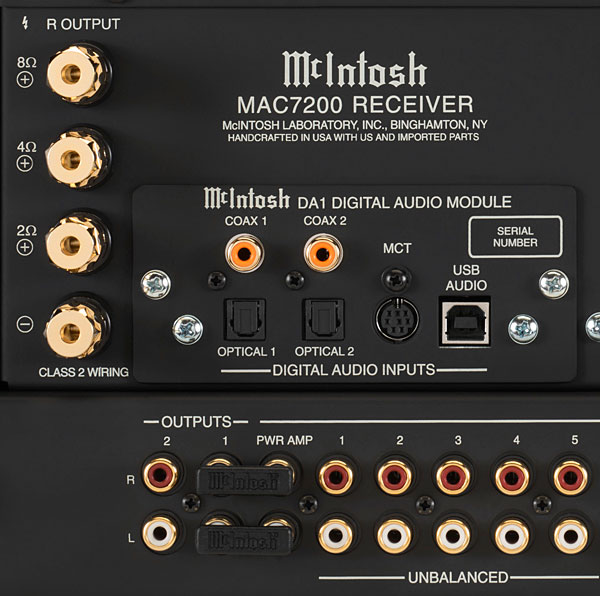 Flanking these upper-portion connectors are the four gold-plated speaker terminals for each channel. I connected the spade lug from one of my R50 Pure Silver Speaker Cables to the bottom unmarked speaker terminal and the other to either the 2, 4, or 8 ohm terminal. I slid the spade lugs on the terminals and tightened the nut with my fingers and then with a small plastic wrench that came in the box.
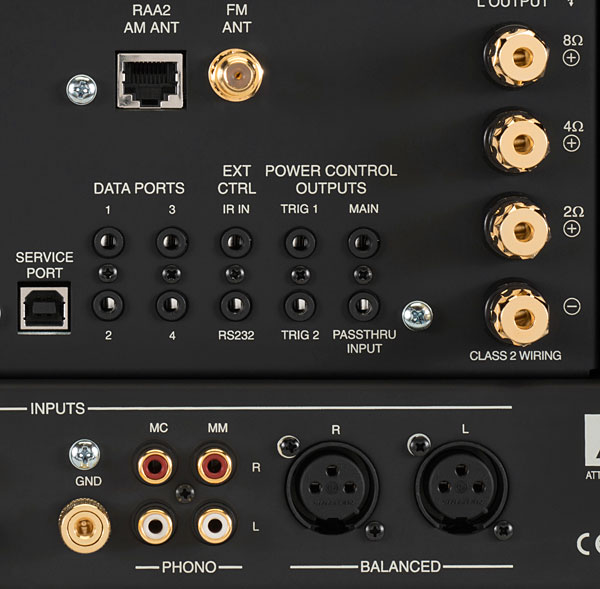 The lower panel, moving left to right, offers a socket for a detachable AC cord, the main fuse holder, two preamplifier outputs (one has a jumper plug to the MAC7200's amplifier input), five pairs of unbalanced RCA connectors, a ground terminal, the two phono inputs (MM and MC), and a pair of unbalanced inputs. HDMI and AES/ EBU digital input connectors are not included on the rear panel. Ron Cornelius explained that both AES/EBU and HDMI connectors and their associated circuitry occupy large portions of the rear panel and internal circuit boards, so McIntosh decided not to include them. He finds that AES/EBU digital are better suited to recording studios than home settings.
Readers patient enough to read through this description will appreciate the MAC7200's complexity. Fortunately, its 39-page printed owner's manual—with 132 diagrams and large, clearly written foldout illustrations—lists the name and function of every connector, control, display panel, and speaker terminal. For someone who struggles with PDF manuals, the MAC7200's printed and well-illustrated instructions were a blessing. Thank you, McIntosh!
Setup
The lower panel, moving left to right, offers a socket for a detachable AC cord, the main fuse holder, two preamplifier outputs (one has a jumper plug to the MAC7200's amplifier input), five pairs of unbalanced RCA connectors, a ground terminal, the two phono inputs (MM and MC), and a pair of unbalanced inputs. HDMI and AES/ EBU digital input connectors are not included on the rear panel. Ron Cornelius explained that both AES/EBU and HDMI connectors and their associated circuitry occupy large portions of the rear panel and internal circuit boards, so McIntosh decided not to include them. He finds that AES/EBU digital are better suited to recording studios than home settings.
Readers patient enough to read through this description will appreciate the MAC7200's complexity. Fortunately, its 39-page printed owner's manual—with 132 diagrams and large, clearly written foldout illustrations—lists the name and function of every connector, control, display panel, and speaker terminal. For someone who struggles with PDF manuals, the MAC7200's printed and well-illustrated instructions were a blessing. Thank you, McIntosh!
Setup
The 75lb MAC7200 measures 17.5" wide by 7.6" high by 22" deep. It shipped to me in a sturdy cardboard package weighing an additional 18lb, strapped to a wooden pallet with metal bands, bringing the total shipping weight to 142lb. After the trucker moved the pallet into my garage on a hydraulic dolly, I cut the metal bands with Wiss Aviation Snips, then "walked" the 93lb box into my condo. Cutting away the packing tape, I opened the outside carton to reveal a second internal box suspended on Styrofoam blocks. I walked this inner carton up the stairs to my listening room, as its weight and size made it impossible for me to lift it off the floor. The MAC7200 is shipped with the owner's manual, a warranty card, a McIntosh HR085 remote, an RAA2 AM antenna, a detachable AC mains cord, a black plastic speaker terminal wrench, and a 20' coaxial cable with JR45 connectors for the AM antenna.
Footnote 1: Day Sequerra Reference Monitor FM tuner, Vol.21, No.6; 25th Anniversary Edition, Vol.36, No.11. My original review of the FM Reference Monitor appeared in the December 1991 issue of Stereophile (Vol.14, No.12). Although this review has not been posted to the Stereophile website, it can be seen in full at allegrosound.com/DaySequerra-FMR.html. Footnote 2: The DA1 Digital Audio Module can be dealer-upgraded to the DA2 version to extend DSD native playback from DSD256 to DSD512 and DXD up to 394kHz. The DA2 includes an HDMI connector (not found on the current MAC7200's DA1 rear panel), which supports Audio Return Channel (ARC) functionality. This enables the MAC7200 to play the TV's audio through the stereo system and for the TV's remote to control the MAC7200. Footnote 3: The layout and functions of the rear-panel connectors can be best understood using the large 8.5" by 22" quick-setup diagram folded into the manual. It contains a life-size drawing of the receiver with arrows for each connector with an explanation.
During its 71-year history, McIntosh has produced some classic stereo receivers, including the MAC1500, MAC4100, and MAC6700. The MAC7200 is the company's newest, bundling into one huge chassis a 200Wpc stereo amplifier, a preamplifier with 14 inputs, a sophisticated FM/AM tuner, a 32-bit/192kHz DAC, and line-level and MM/MC phono preamplification. Inputs to its DA1 digital audio module (footnote 2) include two coaxial (S/PDIF), two TosLink, one USB, and one proprietary MCT DIN input that allows DSD to stream from a McIntosh SACD/CD Transport. The MAC7200 shares many design features with the McIntosh 450Wpc MC462 stereo amplifier reviewed by Sasha Matson, including single-winding output-stage Autoformers to optimize impedance match between the MAC7200's "ThermalTrak" output power transistors and the attached loudspeakers. McIntosh's Ron Cornelius explained to me that solid-state amplifiers operate best—with the best sonics, lowest noise, lowest distortion, and least heat—into an optimal impedance, "say 2.7 ohms." The Autoformer matches the amplifier's "best load" impedance, while the 2, 4, or 8 ohm output taps match the loudspeaker, allowing the amplifier to deliver the same 200Wpc to different loudspeaker impedances. The MC462 and MAC7200 employ rugged heatsinks, which are shaped to form the letters "MC" when viewed from above. Their output Autoformers and the power supply transformer are potted in black housings and sit exposed just behind the front panel, adorned by their circuit diagrams in old-school McIntosh fashion. Both have black chassis, blue watt meters, a black glass front panel, rotary control knobs, a green-lit "Olde English" McIntosh logo, and aluminum end caps. The MAC7200, though, is 2" shorter and 43lb lighter, and lacks the amplifier's front-panel aluminum handles. That means that, despite its lower weight, the receiver is harder to manage. Its meters are smaller, measuring 1" tall by 4.5" wide. The MAC7200's FM circuitry and performance are said to match the company's flagship MR87 FM tuner, minus its balanced outputs, stereo-blend/de-emphasis switch, and variable scan sensitivity. This tuner design is intended to provide reception of strong signals without distortion and also noise-free reception of distant, weak stations. Up to 20 stations for each band—FM and AM—can be stored as presets. DSP FM tuning circuitry minimizes multipath tuning noise. The front panel's multipurpose display shows the noise level and multipath of the incoming RF signal, facilitating optimal positioning of the FM antenna for optimal reception.
The information display sits below and in between the watt meters and changes with each input selected, showing trim-control adjustments, FM and AM presets, and AM and FM tuner settings. To the left of this display is the rotary input selector knob and a Preset Control knob. To the right is the tuning knob and a large volume-control knob. The lowest row on the panel, moving left to right, includes the headphone connector for dynamic headphones, selector pushbuttons for two sets of stereo speakers, an IR sensor, a tone control/bypass toggle, a mute button, and Standby/On. All the front-panel control functions are duplicated on the MAC7200's slim, well-designed remote. The MAC7200's rear panel (footnote 3) is divided into upper and lower portions. The upper portion contains the DA1 digital audio connections: 2 S/PDIF coaxial and 2 TosLink optical inputs, the MCT DIN connector, and a USB-B digital audio input. Next to the DA1 module is a 75 ohm antenna input, an RJ45 jack for the AM antenna, and various control ports.
Flanking these upper-portion connectors are the four gold-plated speaker terminals for each channel. I connected the spade lug from one of my R50 Pure Silver Speaker Cables to the bottom unmarked speaker terminal and the other to either the 2, 4, or 8 ohm terminal. I slid the spade lugs on the terminals and tightened the nut with my fingers and then with a small plastic wrench that came in the box.
The lower panel, moving left to right, offers a socket for a detachable AC cord, the main fuse holder, two preamplifier outputs (one has a jumper plug to the MAC7200's amplifier input), five pairs of unbalanced RCA connectors, a ground terminal, the two phono inputs (MM and MC), and a pair of unbalanced inputs. HDMI and AES/ EBU digital input connectors are not included on the rear panel. Ron Cornelius explained that both AES/EBU and HDMI connectors and their associated circuitry occupy large portions of the rear panel and internal circuit boards, so McIntosh decided not to include them. He finds that AES/EBU digital are better suited to recording studios than home settings.
The 75lb MAC7200 measures 17.5" wide by 7.6" high by 22" deep. It shipped to me in a sturdy cardboard package weighing an additional 18lb, strapped to a wooden pallet with metal bands, bringing the total shipping weight to 142lb. After the trucker moved the pallet into my garage on a hydraulic dolly, I cut the metal bands with Wiss Aviation Snips, then "walked" the 93lb box into my condo. Cutting away the packing tape, I opened the outside carton to reveal a second internal box suspended on Styrofoam blocks. I walked this inner carton up the stairs to my listening room, as its weight and size made it impossible for me to lift it off the floor. The MAC7200 is shipped with the owner's manual, a warranty card, a McIntosh HR085 remote, an RAA2 AM antenna, a detachable AC mains cord, a black plastic speaker terminal wrench, and a 20' coaxial cable with JR45 connectors for the AM antenna.
Footnote 1: Day Sequerra Reference Monitor FM tuner, Vol.21, No.6; 25th Anniversary Edition, Vol.36, No.11. My original review of the FM Reference Monitor appeared in the December 1991 issue of Stereophile (Vol.14, No.12). Although this review has not been posted to the Stereophile website, it can be seen in full at allegrosound.com/DaySequerra-FMR.html. Footnote 2: The DA1 Digital Audio Module can be dealer-upgraded to the DA2 version to extend DSD native playback from DSD256 to DSD512 and DXD up to 394kHz. The DA2 includes an HDMI connector (not found on the current MAC7200's DA1 rear panel), which supports Audio Return Channel (ARC) functionality. This enables the MAC7200 to play the TV's audio through the stereo system and for the TV's remote to control the MAC7200. Footnote 3: The layout and functions of the rear-panel connectors can be best understood using the large 8.5" by 22" quick-setup diagram folded into the manual. It contains a life-size drawing of the receiver with arrows for each connector with an explanation.















