


My first girlfriend was a hopeless kleptomaniac. Once, just before sunrise, as I helped her bury a few hot items in the woods, she asked from which direction the sun would rise. Always the smart-aleck, I told her: "It rarely fails to rise in the east."
She frowned and stared quizzically into the darkness. After a long moment, she said, in a low, sad voice, "Really . . . ?"
September 23, 2015: In his response to and defense of Elizabeth Newton's wildly insightful essay "The Lossless Self" (footnote 1), Michael Lavorgna wrote, on Stereophile's sibling website AudioStream.com: "My idea of hi-fi is to make the possibility of losing oneself in the music happen as often as I choose with the least amount of brain processing as possible." He continued: "Here's my preachy dogma in a nutshell (something I've been saying for years): the best hi-fi is the one that's used to discover and enjoy music most often." (footnote 2) When I read this, I thought, Right on, brother Mike!
One of ML's readers responded: "All I want is faithful reproduction of the recorded signal. Accuracy to the recording source as best I can . . . and I believe that standard can be achieved and objectively verified."
Recording source? Objectively verified?
Another reader philosophically stated: "But the meaning of 'high fidelity' is about accuracy; or at least as 'faithful' as we can achieve. . . . One can achieve enjoyment with 'euphonia' as well, which does not necessarily mean accuracy."
Suddenly, I was channeling the Klepto. I frowned, thought for a long moment, and whispered aloud to no one: "Really . . . ?"
Every time I hear that annoying phrase objectively verified, I reach for the humanist cosmologies of Plato and Duchamp. Nothing makes me madder. My sensitive, self-centered mind translates the words into a smug objectivist audioperson gazing down at me and smirking as he says, "I am an enlightened man, in control of my emotions, who specializes in science and reason, and you, my weak-minded inferior, are just a silly girl!" (I knew I should have hid my stickers and tiara!)
Then I remembered: Such folks feel certain that if the racket streaming from their audiophile superspeakers resembles in some way the noises that they imagine came out of some headphones or studio monitors (typically desktop or wall-mounted Altec 604s or Yamaha NS10s), they will be experiencing "faithful reproduction of the recorded signal" and "accuracy to the recording source." Does that mean they want to hear what some stoned, sleep-deprived recording, mixing, and/or mastering engineer heard? Or does it mean that they just want to hear what's actually encoded on a CD or pressed on an LP? I assume they mean the latter; therefore, I am forced to wonder: Which DAC, phono cartridge, or loudspeaker will objectively verify what is on their discs?
Now that you've spotted my Barbie collection, I might as well admit: I am totally with Michael Lavorgna. My idea of a great hi-fi is one that actively enables me to lose myself in the music. One that requires the least psychic effort or brain processing on my part to hook me in. One that takes my hand, looks me in the eye, and leads me to the intentions of the artist(s). What other purpose should a hi-fi serve?
With that rant off my chest, I can begin . . .
Description
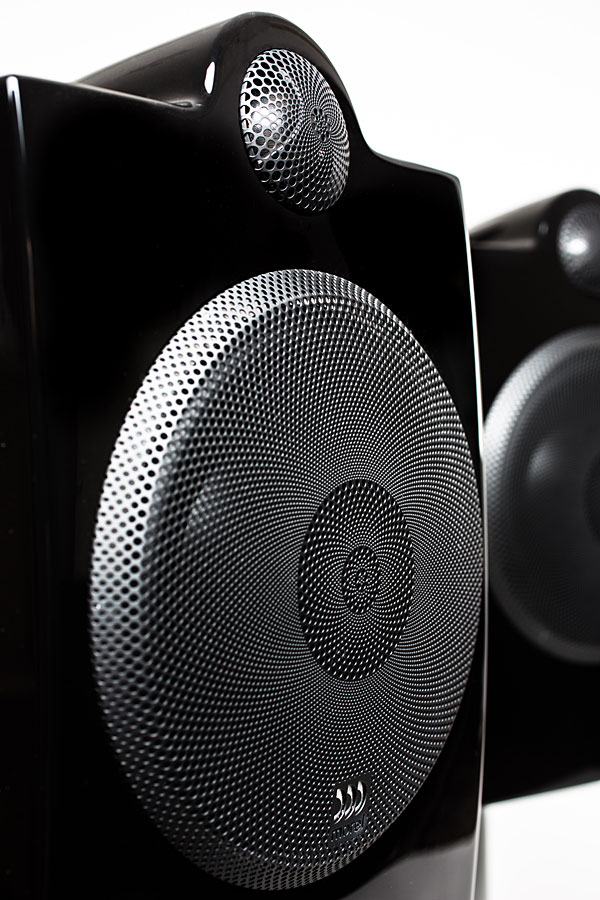
The Morel Octave 6 Limited Edition loudspeaker is made in two versions: a 37.4"-tall floorstanding model, and the stand-mounted bookshelf version reviewed here. At 11.6" high by 7.3" wide by 13.3" deep, the latter is deeper than it is tall, and has a 11/8" (28mm) Acuflex soft-dome tweeter and a 6" (130mm) mid/woofer with a one-piece polypropylene cone. Both drivers are manufactured in-house at the Morel factory in Ness Ziona, Israel. On the rear panel of the Octave 6's polymer-coated MDF enclosure are a modestly sized port and a pair of high-quality binding posts. Overall, the Morel Octave 6 looks and feels as if it should cost more than its asking price of $2799/pair (plus $399 for 27"-tall stands).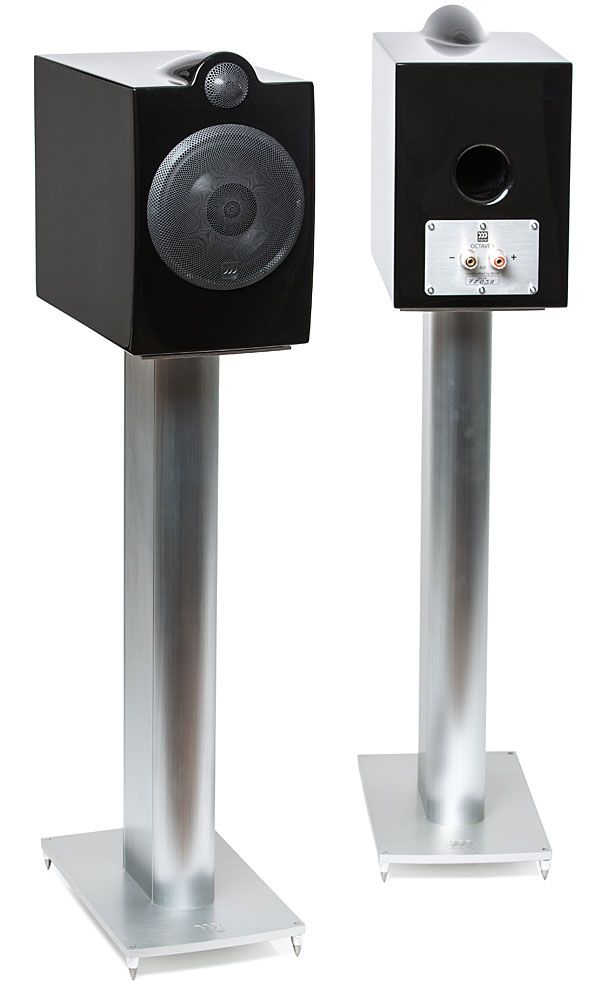 Des basses profondes
Ever walk into a room at a hi-fi show where two little speakers are making more than their rightful amount of bass? The roomkeeper looks at you and smiles: "I bet you're wondering where the subwoofer is." Then, with a fiendish grin, he blurts, "There is none!" I hate when that happens. For the rest of the audition, my mind is stuck not on the music but the bass response. That's a bit what it was like last January, at the 2015 Consumer Electronics Show, when first I heard the Octave 6 Limited Edition Bookshelf: Even without being asked the Ritual Rhetorical Subwoofer Question, I immediately noticed the speaker's bass energy. Nir Paz, of Morel America, had the Octave 6es about 3' out from the front wall, sitting on those 27"-high Morel speaker stands and driven by a Hegel Music Systems H300 integrated amplifier (430Wpc into 4 ohms). I asked Paz to play some orchestral music. I didn't see a subwoofer, but occasionally, as I listened, a French horn or timpani would surprise me with their fullness. Strings were extraordinarily sweet. Texture and tone color were vivid. I soon forgot all about bass energy. Of all the rooms I visited at that CES, this was the one where it took virtually zero effort to lose myself in the music. It felt so satisfying to shut off my critical mind, close my eyes, and enjoy a large orchestra. I exhaled and relaxed.
Paz then played a recording of a female singer whose voice had a seductive, liquid fullness that drew me in even further. I sensed the moisture on her tongue. I told Paz I was deeply impressed by the power and naturalness of his speakers' sound, and confessed my love for their tweeters. I told him I thought his speakers played music in an exceptionally non-audiophile way. Finally, I asked him how he might feel about my reviewing the Octave 6.
I had to beg a little, but ultimately my loaner pair arrived. Soon enough I had them sitting atop my 24"-tall Sound Anchor stands (I didn't receive Morel's own stands for this review), connected to a Hegel H160 integrated amp and playing Willie Nelson's To All the Girls . . . (CD, Columbia/Legacy 88765425862). This charmer of an album, produced by Buddy Cannon, comprises one duet each with 18 different women singers, including Dolly Parton, Loretta Lynn, Emmylou Harris, Mavis Staples, Alison Krauss, and Nelson's daughter, Paula Nelson.
I listened to every singer on this tastefully engineered CD. By track 4—Nelson and Rosanne Cash singing "Please Don't Tell Me How the Story Ends"—I was fully aware that the Octave 6 had a special way with singers and songs. I realized that I was sitting more focused and still than usual. My head nodded, and my body pulsed with each forward step of the call and response of Nelson and Cash. Musical impetus was driving the show: My mind and body were locked in on the pauses, the resumptions, and the empty spaces in between. The textures of Cash's and Nelson's resonant voices were prime evidence of the soulful beauty of old-school country music. This song played with so much rueful expression that I had to play it thrice before I could work up the courage to let track 5 have its way with me.
 By track 16, I was sunk low and teary-eyed in my seat. Still, I was not prepared for track 17: Willie and Paula Nelson singing John Fogerty's "Have You Ever Seen the Rain." As of today, I've heard this cover, and Creedence Clearwater Revival's original recording (7" 45rpm, Fantasy 655), more than 20 times through the Morels. Sonically, CCR's 1971 single smokes Nelson's 2013 CD: Fogerty's voice never sounded better, and the beautiful tone and artistry of what is surely CCR's most poetic song seemed to leap from the Morel boxes.
With these and numerous other recordings, the Octave 6es drew me into my music and held me there. Very much like headphones, the Morels showed me the feelings in and behind these songs . . . but in ways I cannot now explain.
I played the same Willie record for a sophisticated (but jaded) audiophile friend and asked him why it was that, through the Morels, the music affected me so emotionally. I played him the Willie and CCR versions of "Have You Ever Seen the Rain" through the KEF LS50, the Technics SB-C700 that I reviewed in January, and Octave 6 speakers, and asked him to explain his feelings in comparison with mine. After an hour of listening, he spoke: "The Morels are extracting more music than the others."
I asked him what he meant. He thought for a moment: "Something in the Morels' overall sound makes me pay attention. The other speakers are more accurate—they don't have big bass energy like the Morels—but they also don't show you as much of the music part."
"What about the Technics and the KEFs?"
"The LS50s are a little stiff through the midrange. The Morels are fat and loose on the bottom. And the Technics . . . they seem just about right up and down."
I asked if maybe it was the extra bass that was causing my hormones to surge. He shook his head: "Maybe . . . but I doubt it."
Then I blurted, "So tell me—why am I having such an emotional connection with music played through the Morels?"
He smirked sarcastically. "Herb, you know the answer: Our test instruments measure quantities, not qualities!"
Okay. The Morel Octave 6 obviously catered to my poetic enthusiasms. But what about my objective audio standards? And yours?
Speakers & Rooms
By track 16, I was sunk low and teary-eyed in my seat. Still, I was not prepared for track 17: Willie and Paula Nelson singing John Fogerty's "Have You Ever Seen the Rain." As of today, I've heard this cover, and Creedence Clearwater Revival's original recording (7" 45rpm, Fantasy 655), more than 20 times through the Morels. Sonically, CCR's 1971 single smokes Nelson's 2013 CD: Fogerty's voice never sounded better, and the beautiful tone and artistry of what is surely CCR's most poetic song seemed to leap from the Morel boxes.
With these and numerous other recordings, the Octave 6es drew me into my music and held me there. Very much like headphones, the Morels showed me the feelings in and behind these songs . . . but in ways I cannot now explain.
I played the same Willie record for a sophisticated (but jaded) audiophile friend and asked him why it was that, through the Morels, the music affected me so emotionally. I played him the Willie and CCR versions of "Have You Ever Seen the Rain" through the KEF LS50, the Technics SB-C700 that I reviewed in January, and Octave 6 speakers, and asked him to explain his feelings in comparison with mine. After an hour of listening, he spoke: "The Morels are extracting more music than the others."
I asked him what he meant. He thought for a moment: "Something in the Morels' overall sound makes me pay attention. The other speakers are more accurate—they don't have big bass energy like the Morels—but they also don't show you as much of the music part."
"What about the Technics and the KEFs?"
"The LS50s are a little stiff through the midrange. The Morels are fat and loose on the bottom. And the Technics . . . they seem just about right up and down."
I asked if maybe it was the extra bass that was causing my hormones to surge. He shook his head: "Maybe . . . but I doubt it."
Then I blurted, "So tell me—why am I having such an emotional connection with music played through the Morels?"
He smirked sarcastically. "Herb, you know the answer: Our test instruments measure quantities, not qualities!"
Okay. The Morel Octave 6 obviously catered to my poetic enthusiasms. But what about my objective audio standards? And yours?
Speakers & Rooms
I didn't tell you that the Morels sounded quite different in my tiny refuge (13' long by 11' wide by 9.5' high) than they had in Nir Paz's considerably larger room at the 2015 CES. All of my dinner guests noticed it: "Is all that bass coming from those little speakers?" I heard that a few times. It seems my salle d'écoute is just the right size to excite a room mode right around 80Hz. Because of this obvious bass reinforcement, virtually every note below 100Hz had a noticeable loss of leading-edge definition. Not infrequently, bass notes would jump right out. With some recordings, a dark, soup-like density would rob bass information of its detail and contrast structure. Objectively speaking, what I heard in my room was not entirely "faithful reproduction," and likely not "accuracy to the recording source."
Footnote 1: Elizabeth Newton's essay was published in The New Inquiry on September 21, 2015. Footnote 2: Read ML's and AudioStream.com readers' responses to Newton's essay here.
The Morel Octave 6 Limited Edition loudspeaker is made in two versions: a 37.4"-tall floorstanding model, and the stand-mounted bookshelf version reviewed here. At 11.6" high by 7.3" wide by 13.3" deep, the latter is deeper than it is tall, and has a 11/8" (28mm) Acuflex soft-dome tweeter and a 6" (130mm) mid/woofer with a one-piece polypropylene cone. Both drivers are manufactured in-house at the Morel factory in Ness Ziona, Israel. On the rear panel of the Octave 6's polymer-coated MDF enclosure are a modestly sized port and a pair of high-quality binding posts. Overall, the Morel Octave 6 looks and feels as if it should cost more than its asking price of $2799/pair (plus $399 for 27"-tall stands).
Des basses profondesEver walk into a room at a hi-fi show where two little speakers are making more than their rightful amount of bass? The roomkeeper looks at you and smiles: "I bet you're wondering where the subwoofer is." Then, with a fiendish grin, he blurts, "There is none!" I hate when that happens. For the rest of the audition, my mind is stuck not on the music but the bass response. That's a bit what it was like last January, at the 2015 Consumer Electronics Show, when first I heard the Octave 6 Limited Edition Bookshelf: Even without being asked the Ritual Rhetorical Subwoofer Question, I immediately noticed the speaker's bass energy. Nir Paz, of Morel America, had the Octave 6es about 3' out from the front wall, sitting on those 27"-high Morel speaker stands and driven by a Hegel Music Systems H300 integrated amplifier (430Wpc into 4 ohms). I asked Paz to play some orchestral music. I didn't see a subwoofer, but occasionally, as I listened, a French horn or timpani would surprise me with their fullness. Strings were extraordinarily sweet. Texture and tone color were vivid. I soon forgot all about bass energy. Of all the rooms I visited at that CES, this was the one where it took virtually zero effort to lose myself in the music. It felt so satisfying to shut off my critical mind, close my eyes, and enjoy a large orchestra. I exhaled and relaxed.
By track 16, I was sunk low and teary-eyed in my seat. Still, I was not prepared for track 17: Willie and Paula Nelson singing John Fogerty's "Have You Ever Seen the Rain." As of today, I've heard this cover, and Creedence Clearwater Revival's original recording (7" 45rpm, Fantasy 655), more than 20 times through the Morels. Sonically, CCR's 1971 single smokes Nelson's 2013 CD: Fogerty's voice never sounded better, and the beautiful tone and artistry of what is surely CCR's most poetic song seemed to leap from the Morel boxes.
With these and numerous other recordings, the Octave 6es drew me into my music and held me there. Very much like headphones, the Morels showed me the feelings in and behind these songs . . . but in ways I cannot now explain.
I played the same Willie record for a sophisticated (but jaded) audiophile friend and asked him why it was that, through the Morels, the music affected me so emotionally. I played him the Willie and CCR versions of "Have You Ever Seen the Rain" through the KEF LS50, the Technics SB-C700 that I reviewed in January, and Octave 6 speakers, and asked him to explain his feelings in comparison with mine. After an hour of listening, he spoke: "The Morels are extracting more music than the others."
I didn't tell you that the Morels sounded quite different in my tiny refuge (13' long by 11' wide by 9.5' high) than they had in Nir Paz's considerably larger room at the 2015 CES. All of my dinner guests noticed it: "Is all that bass coming from those little speakers?" I heard that a few times. It seems my salle d'écoute is just the right size to excite a room mode right around 80Hz. Because of this obvious bass reinforcement, virtually every note below 100Hz had a noticeable loss of leading-edge definition. Not infrequently, bass notes would jump right out. With some recordings, a dark, soup-like density would rob bass information of its detail and contrast structure. Objectively speaking, what I heard in my room was not entirely "faithful reproduction," and likely not "accuracy to the recording source."
Footnote 1: Elizabeth Newton's essay was published in The New Inquiry on September 21, 2015. Footnote 2: Read ML's and AudioStream.com readers' responses to Newton's essay here.















