Sidebar 3: Measurements
I used DRA Labs' MLSSA system and a calibrated DPA 4006 microphone to measure the Morel Octave 6 Bookshelf's frequency response in the farfield; for the nearfield frequency response, I used an Earthworks QTC-40, which has a ¼" capsule and thus doesn't present a significant obstacle to the sound.
My estimate of the Octave 6's voltage sensitivity was 85.1dB/2.83V/m. Though this is what I would have expected from a small two-way speaker having a 6" mid/woofer, it's significantly lower than the specified 88dB/2.83V/m. The speaker's nominal impedance is 4 ohms; its impedance magnitude (fig.1, solid trace) indicates that the Octave 6 actually remains above 8 ohms for almost the entire upper midrange and treble, dropping below 6 ohms only in the lower midrange. Although the minimum impedance is 4.2 ohms at 165Hz, the combination of 6 ohms magnitude and –44° electrical phase angle at 103Hz suggests that tube amplifiers will work best when used from their 4 ohm output-transformer taps.


 Higher in frequency in fig.3, the Octave 6's response, averaged across a 30° horizontal window centered on the tweeter axis, slopes upward in the midrange, reaching a peak between 1 and 2kHz. Above that region the speaker's output is impressively even, before dropping off above 17kHz or so. Fig.4 reveals that the Morel's horizontal dispersion is wide and even, with the small suckout at 12kHz filling in to the speaker's sides. However, the tweeter becomes quite directional in the top audio octave. This suggests that the Morel will sound a little too mellow in large rooms when used well away from boundaries, though that is when the speaker's bass will sound best. In the vertical plane (fig.5), a major suckout in the crossover region develops more than 5° above the tweeter axis, which confirms HR's finding that the speakers' sound is optimally balanced when they sit on high stands.

 Turning to the time domain, the Octave 6's step response on the tweeter axis (fig.6) reveals that the tweeter's output arrives a little earlier at the microphone than the woofer's, but the fact that the decay of the tweeter's step smoothly blends with the start of the woofer's step indicates optimal crossover design, as shown in fig.3. The decay of the woofer's step has some ripples with a period of around 0.75 millisecond. These correlate with a ridge of delayed energy in the cumulative spectral-decay plot (fig.7) at the frequency of the on-axis response peak. Other than that, however, the Octave's 6's waterfall plot is impressively clean, especially in the region covered by the tweeter.
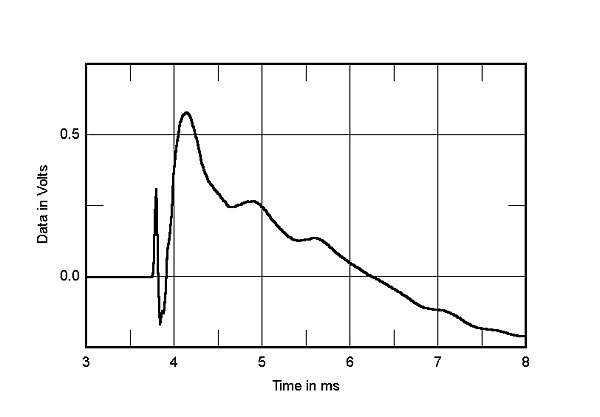

Fig.1 Morel Octave 6 Bookshelf, electrical impedance (solid) and phase (dashed) (2 ohms/vertical div.).
The sharply defined discontinuity between 380 and 400Hz in the impedance traces indicates the presence of some kind of resonance in that region. Investigating the enclosure panels' vibrational behavior with a plastic-tape accelerometer, I did find a series of resonances, the lowest in frequency lying at 395Hz (fig.2). This graph was taken on the top panel; the side panel (not shown) behaved similarly. However, when I examined the behavior of the rear-panel port, I found two high-amplitude resonant peaks in its output, at 400 and 800Hz (fig.3, red trace). The effect of this behavior on music will be unpredictable, because the port faces away from the listener and because, as these resonances are of very high Q (Quality Factor), music will have to have sustained content at precisely these frequencies for the resonances to become fully excited. Nevertheless, these peaks could be easily heard on the noise-like MLS signal as a hollow-sounding coloration.
Fig.2 Morel Octave 6 Bookshelf, cumulative spectral-decay plot calculated from output of accelerometer fastened to center of top panel (MLS driving voltage to speaker, 7.55V; measurement bandwidth, 2kHz).
Fig.3 Morel Octave 6 Bookshelf, anechoic response on tweeter axis at 50", averaged across 30° horizontal window and corrected for microphone response, with nearfield responses of woofer (blue), port (red), and their complex sum (black), respectively plotted below 300Hz, 620Hz, and 300Hz.
The saddle centered on 53Hz in the impedance-magnitude trace suggests that this is the port's tuning frequency; the woofer's output does indeed have a sharp notch at that frequency (fig.3, blue trace), at which the back pressure from the port's tuning resonance holds the cone stationary. Other than the midrange peaks discussed above, the port's output covers a well-defined bandpass from 40 to 100Hz. The complex sum of the woofer and port outputs (fig.3, black trace below 300Hz) peaks at 80Hz. Some of this peak will be an artifact of the nearfield measurement technique, but the shape of the trace does suggest that the Octave 6's low-frequency alignment is underdamped, which correlates with the trouble HR had getting the speaker's bass to speak in balance with its upper ranges.
Fig.4 Morel Octave 6 Bookshelf, lateral response family at 50", normalized to response on tweeter axis, from back to front: differences in response 90–5° off axis, reference response, differences in response 5–90° off axis.
Fig.5 Morel Octave 6 Bookshelf, vertical response family at 50", normalized to response on tweeter axis, from back to front: differences in response 45–5° above axis, reference response, differences in response 5–45° below axis.
Fig.6 Morel Octave 6 Bookshelf, step response on tweeter axis at 50" (5ms time window, 30kHz bandwidth).
Fig.7 Morel Octave 6 Bookshelf, cumulative spectral-decay plot on tweeter axis at 50" (0.15ms risetime).
I have been impressed by the performance of Morel's tweeters ever since I first measured one, the soft-dome MDT33, 25 years ago. But I was disappointed by the Octave 6 Limited Edition Bookshelf's measured performance, in particular the high-Q port resonances and the response peak at the top of the midrange (though Morel says that this peak is due to the grille). These spoil what would otherwise be an excellent report card.—John Atkinson