The AV7005 is Marantz's second multichannel preamplifier-processor and, at $1499.99, the least expensive pre-pro I've used or reviewed. The Integra DTC-9.8, which has been resident in my stable since 2007, when it cost $1600, and its successors, have since then steadily risen in price. The Marantz's predecessor, the AV8003 ($2599.99), was highly praised in many quarters. I never got my hands on one because, like a churlish child, I felt it lacked features I considered essential. Other reviewers didn't seem bothered by those limitations, or were unaware of them. The AV7005, however, looks and feels like a winner for music and home theater. I see no evidence of skimping—the AV7005 sports such high-end features as balanced outputs, network controllability and streaming, and, of course, HDMI v1.4a for compatibility with 3D and all audio codecs.
It's a Marantz, so its graceful styling is no surprise. The three-part front panel has only two large knobs, Volume and Input, flanking an illuminated, blue-rimmed porthole through which are displayed the customized source name and volume level. An unobtrusive On/Standby button with status LED is at the lower left. Couldn't be simpler and still be useful. Below the porthole, a large panel drops down to reveal connectors and additional controls, as well as a large two-line display surrounded by multiple indicators for the AV7005's many options and functions. I left this panel open most of the time, which let me read the display from my seat, but not everyone will want to know or be distracted by all the gory details all the time.
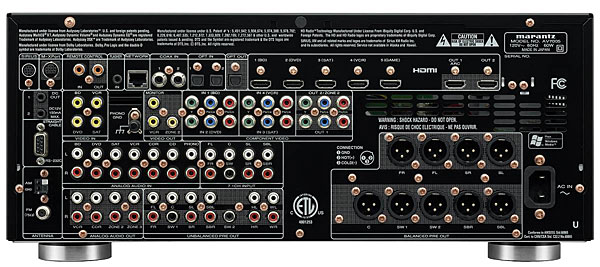
The rear panel is surprisingly uncluttered for a modern pre-pro. Marantz has accomplished this, in part, by leaving behind some legacy connections (no S-video). Still, there are five HDMI inputs (and a sixth on the front), two HDMI outputs, four composite inputs, three composite outputs, four component inputs, two component outputs, four digital audio inputs, one digital output, seven stereo analog audio inputs (including one for phono), and four stereo RCA outputs for Zones 2 and 3, VDR, and CDR. In addition, there's a 7.1-channel analog RCA input, and the audio outputs include RCA jacks for 7.1 plus Subwoofer 2, L/R height and L/R wide, and balanced XLR outputs for 7.1 plus a second subwoofer. (Obviously, users of the height and/or wide channels will have to use the RCAs, regardless of how they connect the main channels.) There are also connectors for AM/FM antennas, Sirius satellite radio, Ethernet, RS-232, Marantz's MX port for wireless control/streaming, and trigger and flasher terminals. The backlit remote control was easy to use and functionally comprehensive; I quickly learned to double-click to select an input source.
 Connection and setup were a breeze, and the AV7005 provided some welcome surprises. I hooked up a few HDMI sources as well as a stereo source (Sony XA5400ES SACD player via analog and S/PDIF) and the 5.1 analog output (Oppo BDP-83 universal Blu-ray player). I discovered that, with HDMI in/out, OSD menus could be superimposed on the active display, and that audio remained active as well. This may not seem like a biggie, but it makes setting lip-sync a piece of cake, and it lets you hear and evaluate, almost immediately, any changes you make in audio processing. In addition, anything you can do onscreen you can also do from the Ethernet interface without any overlay at all. I simply plugged a network cable into the Marantz's Ethernet port, typed the network address of the Marantz into my laptop (it had been assigned the same address in my network as that of the McIntosh pre-pro it replaced), and all was wirelessly under control.
I won't reiterate all the setup steps, which were numbingly similar to those common among today's pre-pros. Even before running Audyssey's MultEQ room-correction software (I was lazy), I listened to the AV7005 for a couple of weekends and heard nothing out of place—it sounded sweet with both digital and analog sources. In fact, I was struck by how far we've come if the fundamental sound qualities of a $1500 pre-pro can be so enjoyable. Heck, $1500 doesn't come even close to the price of a high-end two-channel analog preamp in the 21st century, and yet I could happily listen to CDs through the Marantz via its analog or digital inputs—something I was loath to do with the early Integra DTC-9.8.
Soon enough, though, it was Audyssey time. I decided to use the AV7500's built-in Audyssey MultEQ XT (footnote 1) before hauling out the heavy artillery of MultEQ Pro. I mounted the provided calibration microphone on my camera tripod and took my standard suite of eight measurements. It didn't surprise me that the Marantz recommended "Full Range" for all five speakers, which is unfortunate but common. Do A/V manufacturers want to validate their customers' speaker selections ("Excellent choice, sir!") rather than urge them to properly manage the system's bass response? When so few speakers these days are truly capable of powerful, fully extended low bass, they would certainly benefit from bass management and being partnered by a competent subwoofer. Although the AV7005 makes possible individual speaker settings, I took the easy way out and set them all for an 80Hz crossover to the subwoofer. Distance and level settings were spot-on identical to what I'd gotten in the past. Audyssey's new enhancement options, DSX, DynamicEQ, and DynamicVolume, were turned off, at least to start.
Connection and setup were a breeze, and the AV7005 provided some welcome surprises. I hooked up a few HDMI sources as well as a stereo source (Sony XA5400ES SACD player via analog and S/PDIF) and the 5.1 analog output (Oppo BDP-83 universal Blu-ray player). I discovered that, with HDMI in/out, OSD menus could be superimposed on the active display, and that audio remained active as well. This may not seem like a biggie, but it makes setting lip-sync a piece of cake, and it lets you hear and evaluate, almost immediately, any changes you make in audio processing. In addition, anything you can do onscreen you can also do from the Ethernet interface without any overlay at all. I simply plugged a network cable into the Marantz's Ethernet port, typed the network address of the Marantz into my laptop (it had been assigned the same address in my network as that of the McIntosh pre-pro it replaced), and all was wirelessly under control.
I won't reiterate all the setup steps, which were numbingly similar to those common among today's pre-pros. Even before running Audyssey's MultEQ room-correction software (I was lazy), I listened to the AV7005 for a couple of weekends and heard nothing out of place—it sounded sweet with both digital and analog sources. In fact, I was struck by how far we've come if the fundamental sound qualities of a $1500 pre-pro can be so enjoyable. Heck, $1500 doesn't come even close to the price of a high-end two-channel analog preamp in the 21st century, and yet I could happily listen to CDs through the Marantz via its analog or digital inputs—something I was loath to do with the early Integra DTC-9.8.
Soon enough, though, it was Audyssey time. I decided to use the AV7500's built-in Audyssey MultEQ XT (footnote 1) before hauling out the heavy artillery of MultEQ Pro. I mounted the provided calibration microphone on my camera tripod and took my standard suite of eight measurements. It didn't surprise me that the Marantz recommended "Full Range" for all five speakers, which is unfortunate but common. Do A/V manufacturers want to validate their customers' speaker selections ("Excellent choice, sir!") rather than urge them to properly manage the system's bass response? When so few speakers these days are truly capable of powerful, fully extended low bass, they would certainly benefit from bass management and being partnered by a competent subwoofer. Although the AV7005 makes possible individual speaker settings, I took the easy way out and set them all for an 80Hz crossover to the subwoofer. Distance and level settings were spot-on identical to what I'd gotten in the past. Audyssey's new enhancement options, DSX, DynamicEQ, and DynamicVolume, were turned off, at least to start.
Footnote 1: At the time of the release of the Marantz AV7005 with MultEQ XT, some competing products were already offering MultiEQ XT32. The latter's advantages are the ability to independently set up multiple subwoofers, and increased filter resolution at lower frequencies for the main channels. The Marantz AV7005 treats multiple subs as if they are one sub—but if you have just one, this is not an issue.
Connection and setup were a breeze, and the AV7005 provided some welcome surprises. I hooked up a few HDMI sources as well as a stereo source (Sony XA5400ES SACD player via analog and S/PDIF) and the 5.1 analog output (Oppo BDP-83 universal Blu-ray player). I discovered that, with HDMI in/out, OSD menus could be superimposed on the active display, and that audio remained active as well. This may not seem like a biggie, but it makes setting lip-sync a piece of cake, and it lets you hear and evaluate, almost immediately, any changes you make in audio processing. In addition, anything you can do onscreen you can also do from the Ethernet interface without any overlay at all. I simply plugged a network cable into the Marantz's Ethernet port, typed the network address of the Marantz into my laptop (it had been assigned the same address in my network as that of the McIntosh pre-pro it replaced), and all was wirelessly under control.
I won't reiterate all the setup steps, which were numbingly similar to those common among today's pre-pros. Even before running Audyssey's MultEQ room-correction software (I was lazy), I listened to the AV7005 for a couple of weekends and heard nothing out of place—it sounded sweet with both digital and analog sources. In fact, I was struck by how far we've come if the fundamental sound qualities of a $1500 pre-pro can be so enjoyable. Heck, $1500 doesn't come even close to the price of a high-end two-channel analog preamp in the 21st century, and yet I could happily listen to CDs through the Marantz via its analog or digital inputs—something I was loath to do with the early Integra DTC-9.8.
Soon enough, though, it was Audyssey time. I decided to use the AV7500's built-in Audyssey MultEQ XT (footnote 1) before hauling out the heavy artillery of MultEQ Pro. I mounted the provided calibration microphone on my camera tripod and took my standard suite of eight measurements. It didn't surprise me that the Marantz recommended "Full Range" for all five speakers, which is unfortunate but common. Do A/V manufacturers want to validate their customers' speaker selections ("Excellent choice, sir!") rather than urge them to properly manage the system's bass response? When so few speakers these days are truly capable of powerful, fully extended low bass, they would certainly benefit from bass management and being partnered by a competent subwoofer. Although the AV7005 makes possible individual speaker settings, I took the easy way out and set them all for an 80Hz crossover to the subwoofer. Distance and level settings were spot-on identical to what I'd gotten in the past. Audyssey's new enhancement options, DSX, DynamicEQ, and DynamicVolume, were turned off, at least to start.
Footnote 1: At the time of the release of the Marantz AV7005 with MultEQ XT, some competing products were already offering MultiEQ XT32. The latter's advantages are the ability to independently set up multiple subwoofers, and increased filter resolution at lower frequencies for the main channels. The Marantz AV7005 treats multiple subs as if they are one sub—but if you have just one, this is not an issue.