Straight-through sonics
The straight-through sound of the XMC-1, from both analog and digital sources, was clean and open—not bright, accented, or distorted in any way, and with no added warmth. Overall, it was more neutral than friendly, which I count as a plus. With all its options for tweaking the sound—including tone controls, parametric EQ, and Dirac Live—it was reassuring that the XMC-1 begins with a clean palette. I played a wide array of sources through many inputs, and the XMC-1 handled everything with aplomb, including PCM up to 24-bit/192kHz and DSD.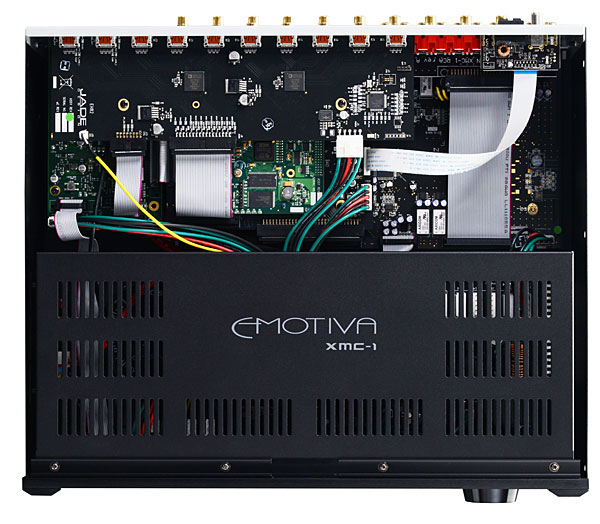 Dirac Live
It was then time to look at what most makes the XMC-1 special: It's the first affordable pre-pro to include Dirac Live room correction. As standard kit, the XMC-1 includes Dirac Live LE (for Limited Edition?) and the necessary calibrated USB microphone. About two weeks before I sent this copy to Ye Editor, Emotiva finally released what the call the Dirac Live option ($99), and I was able to compare them. On paper, the differences are simple: 1) Dirac Live LE has only the default target equalization curve, while full DL permits the use of custom target curves. 2) LE has a default frequency range for application of EQ to each speaker, while full DL allows the creating, editing, and storing of the range as part of the target. 3) LE supports only the supplied microphone; full DL also supports third-party calibrated mikes. 4) Full DL includes individual channel-level controls for the test signals, to help when gain and sensitivity vary greatly between channels; LE does not. With either version, the user first needs to set up the Dirac configuration preset, including the sizes and crossover settings for the speakers—but with all levels set at 0dB. Note that there is no option or display of speaker distance and channel delay—both will be set by Dirac Live's calibration, but those results will not be reported to the user (footnote 2). Also, with the distinctions noted above, the actual procedure, on your personal PC/laptop is identical with my laptop readily connecting with the XMC-1 over the network and with the USB mike.
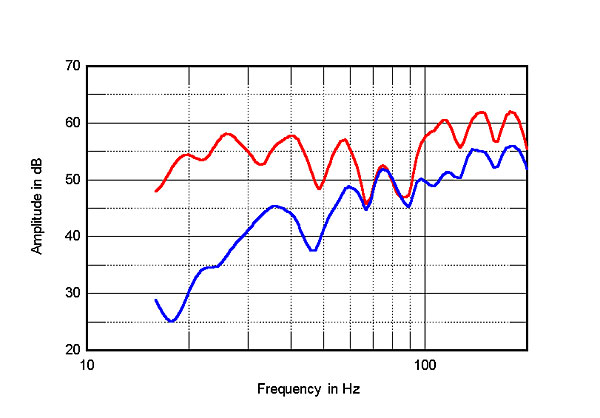
My run of Dirac Live LE was not a great success: It sharply reduced the subwoofers' outputs (fig.1), and produced little change in sound for the other speakers—all of which I confirmed by measuring using XTZ Room Analyzer II. Clearly, along with the reduced subwoofer contribution, there was a correction of room modes; as a result, I didn't have a preference between my system's sounds before and after Dirac Live LE: Both were okay, and each had some advantages over the other. I didn't repeat Dirac Live LE, but did gain insight into it when I tried the full version of Dirac Live. I recommend that users not pressed to meet a publication deadline work seriously with LE before forking over $99 for the full Dirac Live.
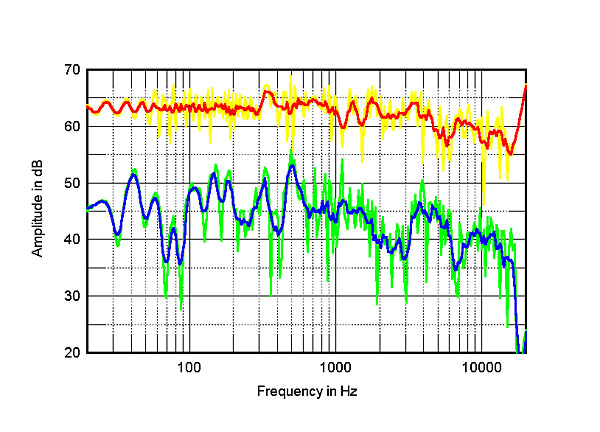
 The audible and measured results (fig.2) were much, much better than with my first run. My wife and I had no trouble distinguishing between the Config 1 preset (normal level and distance settings) and the Dirac Live preset (corrected but unknown level and distance settings). The Dirac preset easily sounded more smoothly balanced, with a deeper, wider soundstage, and bass that was both more powerful and better defined. It also gave voices a greater sense of presence through the slightly reticent B&Ws. Between it and the uncorrected preset there was simply no contest.
 Quibbles
This returns us to a thread that runs throughout this review: The Emotiva XMC-1 did everything one could ask of a modern pre-pro and did it very well, but with some surprising eccentricities: 1) Some users have posted on Internet forums that their XMC-1s often make an annoying splat of noise between tracks, or at the end of DSD tracks played from a disc spinner. That happened with my review sample, too. Emotiva is aware of the problem, and has told me that it has "shortened the muting times in our latest firmware. . . . We are continuing to refine the way our muting works to reach a solution that is ideal for everyone." Strangely, there was much less "digital garbage noise" when I streamed the same DSD tracks through the XMC-1. 2) Although the XMC-1 displays the volume level as "xx.0," the decimal place is never used: the volume is changed only in steps of 1dB.
3) The invisibility of settings for speaker distance and channel delay when using either version of Dirac Live makes it impossible for persnickety users to carefully integrate the outputs of multiple subwoofers with those of each other and the main channels. Like many other EQ systems, Dirac Live tests and corrects each speaker channel independently, but never tests their simultaneous acoustic interaction with the room. Particularly in the bass, this interaction can be tweaked with cut-and-try adjustments of delay, but this is not possible with the XMC-1.
In summary
Despite the quibbles I've scattered throughout this column, the Emotiva XMC-1 is a powerful and flexible preamplifier-processor that is beyond any serious criticism, especially in view of its very competitive pricing and lack of bugs. Emotiva has trimmed away legacy video ins and outs, but offers the XMC-1 with a full repertoire of audio options to appeal to the music lover. The XMC-1 exceeded my expectations in every way—most important, in the way it sounded. Coming up next in the Round
On tap is the Marantz AV-8801 pre-pro, miniDSP's $299 multichannel DAC, and some cataclysmic changes in my reference systems.
Footnote 2: Both Emotiva options lack some features of the multichannel Dirac Live Room Correction Suite, which runs directly on a Windows or Mac computer ($686.76, due to the strong US dollar as of April 2015). One is the ability to see and trim levels and delays for all channels. Another is the ability to simultaneously have on tap up to four sets of correction filters, for instantaneous change and comparison. One can download any number of filter sets from one's computer to the XMC-1, but it can hold only one set at a time. Finally, the digital pipeline through Dirac on the XMC-1 is limited to 48kHz; higher bitrates will be downsampled for processing by Dirac Live. The Windows and Mac versions of Dirac Live run up to 192kHz. Footnote 3: Users of the Emotiva mike might want to try one of the independent calibrations made by other users and made available via links on Internet forums. Footnote 4: Note that this recording comes from the same source as one of my other longtime favorites, Willie Nelson's Night and Day (DVD-A, Surrounded By Entertainment SBE-1001-9). Take this as a strong recommendation to keep an eye out for any of Surrounded By's DVD-A releases, now long out of print.
The straight-through sound of the XMC-1, from both analog and digital sources, was clean and open—not bright, accented, or distorted in any way, and with no added warmth. Overall, it was more neutral than friendly, which I count as a plus. With all its options for tweaking the sound—including tone controls, parametric EQ, and Dirac Live—it was reassuring that the XMC-1 begins with a clean palette. I played a wide array of sources through many inputs, and the XMC-1 handled everything with aplomb, including PCM up to 24-bit/192kHz and DSD.
Dirac LiveIt was then time to look at what most makes the XMC-1 special: It's the first affordable pre-pro to include Dirac Live room correction. As standard kit, the XMC-1 includes Dirac Live LE (for Limited Edition?) and the necessary calibrated USB microphone. About two weeks before I sent this copy to Ye Editor, Emotiva finally released what the call the Dirac Live option ($99), and I was able to compare them. On paper, the differences are simple: 1) Dirac Live LE has only the default target equalization curve, while full DL permits the use of custom target curves. 2) LE has a default frequency range for application of EQ to each speaker, while full DL allows the creating, editing, and storing of the range as part of the target. 3) LE supports only the supplied microphone; full DL also supports third-party calibrated mikes. 4) Full DL includes individual channel-level controls for the test signals, to help when gain and sensitivity vary greatly between channels; LE does not. With either version, the user first needs to set up the Dirac configuration preset, including the sizes and crossover settings for the speakers—but with all levels set at 0dB. Note that there is no option or display of speaker distance and channel delay—both will be set by Dirac Live's calibration, but those results will not be reported to the user (footnote 2). Also, with the distinctions noted above, the actual procedure, on your personal PC/laptop is identical with my laptop readily connecting with the XMC-1 over the network and with the USB mike.
Fig.1 Measured room response, 10–200Hz, with Dirac Live LE (blue) and without Dirac Live LE (red) (5dB/vertical div.).
Installation of the full version of Dirac Live (and XMC-1 Firmware Update v3.0) was trivially easy, and will be familiar to those experienced with the original Dirac Live running on a Windows or Mac computer. To run full Dirac Live, I made these changes: 1) The front two speakers were now Bowers & Wilkins 683 v2s, in for review. 2) I replaced the Emotiva mike with a UMIK-1 and used its 90° orientation calibration file, as specified by Dirac. Presumably, the calibration file for the Emotiva mike is suitable for the 90° orientation (labeled "off-axis"), but it runs from 29Hz to 20kHz with 200 data points (footnote 3), while the UMIK-1 file runs from 10Hz to 20.01682kHz with 615 data points. 3) In Dirac Live, I trimmed the levels of the two subwoofer channels to better match them with the B&Ws. 4) I expanded the range of correction for all the main channels to 20kHz, but continued the slow rolloff of Dirac Live's default target curve. The rest of the procedure was as identical as I could make it to the first pass, with Dirac Live LE, using the same nine mike positions specified by Dirac.
Fig.2 Measured room response, 20–20kHz, without Dirac Live (blue, smoothed; green, raw data, both offset by –10dB) and with Dirac Live (red, smoothed; yellow, raw data) (5dB/vertical div.).
With the triumphant results from Dirac Live, I found the XMC-1 to be a superb-sounding pre-pro for all media. All of my usual test discs and files, not itemized here but peppered throughout my previous columns, were thrillingly communicated with great tonal beauty and impact. Old friends—eg, the Guarneri Quartet's disc of the Ravel, Debussy, and Fauré string quartets (DVD-A, Surrounded By Entertainment SBE-1004-9, footnote 4)—were richly warm and vibrant. The Ravel was used last December by Meridian principal Bob Stuart to demonstrate that company's MQA encoding in stereo, to great effect. However, I think that the added reality of ambience conveyed by this recording's 4.0-channel tracks through the XMC-1 gave MQA more than just competition; it elevated the experience. This surround experience easily scaled up to encompass a staggering representation, by Manfred Honeck leading the Pittsburgh Symphony, of Strauss's tone poems Don Juan, Death and Transfiguration, and Till Eulenspiegel's Merry Pranks (SACD/CD, Reference Fresh! FR-707SACD), one of my selections for the 2014 edition of Records to Die For."
QuibblesThis returns us to a thread that runs throughout this review: The Emotiva XMC-1 did everything one could ask of a modern pre-pro and did it very well, but with some surprising eccentricities: 1) Some users have posted on Internet forums that their XMC-1s often make an annoying splat of noise between tracks, or at the end of DSD tracks played from a disc spinner. That happened with my review sample, too. Emotiva is aware of the problem, and has told me that it has "shortened the muting times in our latest firmware. . . . We are continuing to refine the way our muting works to reach a solution that is ideal for everyone." Strangely, there was much less "digital garbage noise" when I streamed the same DSD tracks through the XMC-1. 2) Although the XMC-1 displays the volume level as "xx.0," the decimal place is never used: the volume is changed only in steps of 1dB.
Despite the quibbles I've scattered throughout this column, the Emotiva XMC-1 is a powerful and flexible preamplifier-processor that is beyond any serious criticism, especially in view of its very competitive pricing and lack of bugs. Emotiva has trimmed away legacy video ins and outs, but offers the XMC-1 with a full repertoire of audio options to appeal to the music lover. The XMC-1 exceeded my expectations in every way—most important, in the way it sounded. Coming up next in the Round
On tap is the Marantz AV-8801 pre-pro, miniDSP's $299 multichannel DAC, and some cataclysmic changes in my reference systems.
Footnote 2: Both Emotiva options lack some features of the multichannel Dirac Live Room Correction Suite, which runs directly on a Windows or Mac computer ($686.76, due to the strong US dollar as of April 2015). One is the ability to see and trim levels and delays for all channels. Another is the ability to simultaneously have on tap up to four sets of correction filters, for instantaneous change and comparison. One can download any number of filter sets from one's computer to the XMC-1, but it can hold only one set at a time. Finally, the digital pipeline through Dirac on the XMC-1 is limited to 48kHz; higher bitrates will be downsampled for processing by Dirac Live. The Windows and Mac versions of Dirac Live run up to 192kHz. Footnote 3: Users of the Emotiva mike might want to try one of the independent calibrations made by other users and made available via links on Internet forums. Footnote 4: Note that this recording comes from the same source as one of my other longtime favorites, Willie Nelson's Night and Day (DVD-A, Surrounded By Entertainment SBE-1001-9). Take this as a strong recommendation to keep an eye out for any of Surrounded By's DVD-A releases, now long out of print.