With the atomization of the playback of digital files into storage, servers, streamers, format converters, and DACs, I find that I've accumulated many miniature power supplies: small pods and wall warts. Most of these are generic switching devices made by companies other than the manufacturers of the components they power, and even those not designed for audio systems are, of necessity, at least adequate for the task. Because many of these supplies are indistinguishable from each other, I've taken to labeling them with sticky notes to remind me which goes with which component. Nonetheless, I'm concerned that they're no more than the commodity power modules available for a few bucks each on eBay. Whenever I think of the four or five of them clustered behind my equipment rack, I begin to suspect them of plotting revolt against the fancy gear they serve.
So I was immediately attracted by a press release from iFi Audio about their iPower power supplies for audio components. First, iFi claims that they produce very little noise. Second, they're compact wall warts—ie, each is contained in an enlarged plug housing, which eliminates the needs for a separate power cord and a place to hide the wart. Third, they're not pricey for an audiophile tweak: just $49 apiece. iFi promised a range of warts, with outputs of 5, 9, 12, and 15V, each with a different current capability. I ordered the 5V and 12V models. Months passed before they arrived, but at last I can tell you about them.
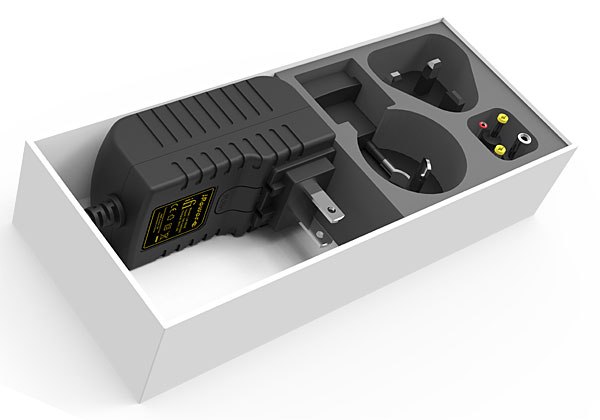
 Each iFi iPower supply is a small module with an AC power connector on one end and, on the other, a captive DC cable 2m long. The AC end accepts any of four AC plugs (supplied), so that the iPower can be used almost anywhere 100–240VAC is available. The DC cable is terminated in a 5.5 by 2.1mm DC connector, but again, iFi supplies adapters for an addition three sizes—3.5 by 1.35mm, 4.0 by 1.7mm, and 5.5 by 2.5mm—along with a polarity inverter for devices requiring a center-negative supply.
The iPowers are not linear supplies but, like the cheapies, switched-mode devices. iFi claims for them an average audioband noise floor of less than 1µV, as the result of active noise cancellation and a 12-element noise-suppression circuit. That claim, which iFi suggests is supported by their in-house test results, is lower than that for iFi's previous AC/DC adapters, and even lower than is claimed for most audiophile linear power supplies. Judging from the range of available iPower models, it appears that all are basically 13W switch-mode power supply (SMPS) converters, with the selected output voltage defining the current output.
I used the 5V iPower with miniDSP's U-DAC8 DAC and, using the 5.5 by 2.5mm adapter, the 12V model with the exaSound e28. iFi rates the 5V iPower at 2.1A, though my sample was labeled "2.5A"; it's slightly heavier and about a third larger than miniDSP's stock supply, which is rated at 2.0A. The 12V iPower is rated at 1.1A, which I had thought should be sufficient for the exaSound, even though the e28's stock supply has greater output, and is larger and heavier.
In the case of the miniDSP DAC, the iPower fulfilled iFi's promise. When I switched over from the stock supply, the DAC didn't seem quieter when there was no audio signal, but that's not the real test. Recordings with open, ambient soundstages sounded cleaner, and both instrumental and vocal music was more distinct. This was no major change that struck me every time I listened, but it did make all of my listening much more relaxing—perhaps because, subliminally, it required less effort to attend to individual sounds, particularly those far back on the soundstage. That the stock U-DAC8 is capable of better sound when supported by better ancillaries was revealed by the iFi iPower, as well as by UpTone Audio's USB Regen accessory. Would replacing the Regen's supply with a 9V iPower improve the sound even more? I plan to answer that question ASAP.
Each iFi iPower supply is a small module with an AC power connector on one end and, on the other, a captive DC cable 2m long. The AC end accepts any of four AC plugs (supplied), so that the iPower can be used almost anywhere 100–240VAC is available. The DC cable is terminated in a 5.5 by 2.1mm DC connector, but again, iFi supplies adapters for an addition three sizes—3.5 by 1.35mm, 4.0 by 1.7mm, and 5.5 by 2.5mm—along with a polarity inverter for devices requiring a center-negative supply.
The iPowers are not linear supplies but, like the cheapies, switched-mode devices. iFi claims for them an average audioband noise floor of less than 1µV, as the result of active noise cancellation and a 12-element noise-suppression circuit. That claim, which iFi suggests is supported by their in-house test results, is lower than that for iFi's previous AC/DC adapters, and even lower than is claimed for most audiophile linear power supplies. Judging from the range of available iPower models, it appears that all are basically 13W switch-mode power supply (SMPS) converters, with the selected output voltage defining the current output.
I used the 5V iPower with miniDSP's U-DAC8 DAC and, using the 5.5 by 2.5mm adapter, the 12V model with the exaSound e28. iFi rates the 5V iPower at 2.1A, though my sample was labeled "2.5A"; it's slightly heavier and about a third larger than miniDSP's stock supply, which is rated at 2.0A. The 12V iPower is rated at 1.1A, which I had thought should be sufficient for the exaSound, even though the e28's stock supply has greater output, and is larger and heavier.
In the case of the miniDSP DAC, the iPower fulfilled iFi's promise. When I switched over from the stock supply, the DAC didn't seem quieter when there was no audio signal, but that's not the real test. Recordings with open, ambient soundstages sounded cleaner, and both instrumental and vocal music was more distinct. This was no major change that struck me every time I listened, but it did make all of my listening much more relaxing—perhaps because, subliminally, it required less effort to attend to individual sounds, particularly those far back on the soundstage. That the stock U-DAC8 is capable of better sound when supported by better ancillaries was revealed by the iFi iPower, as well as by UpTone Audio's USB Regen accessory. Would replacing the Regen's supply with a 9V iPower improve the sound even more? I plan to answer that question ASAP.
 With the exaSound e28 DAC, the results were a bit different. The 12V iPower was at a power disadvantage here compared with the e28's stock switching supply (which is capable of providing greater current) and even more with my home-brew battery supply (ditto). exaSound's George Klissarov has maintained that the e28's sound is mostly independent of changes in power supplies, and what I've heard supports him. The insertion of the iPower made little difference compared to either the stock supply or my battery arrangement, but it was smaller and less cumbersome than the former, and cheaper and simpler than the latter. That said, it appears that the 12V iPower actually wasn't enough for the e28: Although the sound was fine, the iFi failed after a few weeks. In my judgment, that is no blot on the iPower, but the result of my using it inappropriately. My bad.
Bottom line: iFi Audio's iPower supplies are options that should appeal to anyone who suspects that a stock wall wart is less than optimal—as long as one is aware of the current required. The models I tried helped clean up the tangle of cables and supplies behind my rack, and performed well when used judiciously. Where the iPower's low noise could help, it did; where it didn't, there was reduced clutter with no harm to the sound. I intend to keep a suite of them on hand.
Merging Technologies NADAC Multichannel-8 DAC
With the exaSound e28 DAC, the results were a bit different. The 12V iPower was at a power disadvantage here compared with the e28's stock switching supply (which is capable of providing greater current) and even more with my home-brew battery supply (ditto). exaSound's George Klissarov has maintained that the e28's sound is mostly independent of changes in power supplies, and what I've heard supports him. The insertion of the iPower made little difference compared to either the stock supply or my battery arrangement, but it was smaller and less cumbersome than the former, and cheaper and simpler than the latter. That said, it appears that the 12V iPower actually wasn't enough for the e28: Although the sound was fine, the iFi failed after a few weeks. In my judgment, that is no blot on the iPower, but the result of my using it inappropriately. My bad.
Bottom line: iFi Audio's iPower supplies are options that should appeal to anyone who suspects that a stock wall wart is less than optimal—as long as one is aware of the current required. The models I tried helped clean up the tangle of cables and supplies behind my rack, and performed well when used judiciously. Where the iPower's low noise could help, it did; where it didn't, there was reduced clutter with no harm to the sound. I intend to keep a suite of them on hand.
Merging Technologies NADAC Multichannel-8 DAC
For some years now, the Swiss company Merging Technologies has been at the fore of high-resolution technologies for recording studios. Their digital-audio workstation (DAW) software, such as the Pyramix Virtual Studio and Ovation Media Sequencer, are capable of up to DSD256 and DXD, and have been adopted by cutting-edge recordists and studios worldwide. The backbone of the Pyramix and Ovation packages is their adoption of Ravenna IP Audio technology, an Ethernet-based subset of the AES67 Audio over Internet Protocol (AoIP), which permits the precisely timed, error-free transfer of audio data among multiple devices, regardless of the number of participating devices. Although this is essential to large studio operations, it's also desirable for home networks with multiple zones, as it can accommodate access to all resources from multiple zones. With Ravenna as the native connection technology, runs of Cat5e and Cat6 cable can be as long as 100 meters.
 More recently, Merging Technologies introduced the Horus and the Hapi, two Ravenna-powered networked audio interfaces—hardware amenable to a number of chores, including D/A and A/D conversion—aimed at professional users. And in October 2015, at the Rocky Mountain Audio Fest, Merging Technologies introduced a pair of Ravenna-compatible products designed for the consumer market: the Merging+NADAC Stereo ($10,500) and Merging+NADAC Multichannel-8 ($11,500) DACs. As NADAC stands for Network Attached Digital to Analogue Converter, these products should be judged not only for their performance as DACs but also for their networking capabilities.
At 17" wide by 3.7" high by 17" deep and weighing 24.2 lbs, the NADAC Multichannel-8 is one of the largest, heaviest DACs I have ever used. Unpacking it recalled my first sight of Theta Digital's awesome Generation VIII DAC, which I reviewed for the February 2004 issue. But while the NADAC is more expensive (though not in 2004 dollars), it's also more graceful and intelligent—and, most important, it has more than two channels!
It may seem strange that the difference in price between the two- and eight-channel NADACs is so small, but other than the latter's six additional output amplifiers and six more pairs of analog output jacks, the two models are almost identical. Both use an ESS9008S Sabre Reference Audio DAC chip with eight DACs, but the Stereo has four D/A outputs per channel, summed to provide better linearity, greater dynamic range, and a lower noise floor. (The Multichannel-8 can be switched to work in precisely the same manner, as Stereo DAC.) In both NADACs, the headphone output has its own converter IC.
More recently, Merging Technologies introduced the Horus and the Hapi, two Ravenna-powered networked audio interfaces—hardware amenable to a number of chores, including D/A and A/D conversion—aimed at professional users. And in October 2015, at the Rocky Mountain Audio Fest, Merging Technologies introduced a pair of Ravenna-compatible products designed for the consumer market: the Merging+NADAC Stereo ($10,500) and Merging+NADAC Multichannel-8 ($11,500) DACs. As NADAC stands for Network Attached Digital to Analogue Converter, these products should be judged not only for their performance as DACs but also for their networking capabilities.
At 17" wide by 3.7" high by 17" deep and weighing 24.2 lbs, the NADAC Multichannel-8 is one of the largest, heaviest DACs I have ever used. Unpacking it recalled my first sight of Theta Digital's awesome Generation VIII DAC, which I reviewed for the February 2004 issue. But while the NADAC is more expensive (though not in 2004 dollars), it's also more graceful and intelligent—and, most important, it has more than two channels!
It may seem strange that the difference in price between the two- and eight-channel NADACs is so small, but other than the latter's six additional output amplifiers and six more pairs of analog output jacks, the two models are almost identical. Both use an ESS9008S Sabre Reference Audio DAC chip with eight DACs, but the Stereo has four D/A outputs per channel, summed to provide better linearity, greater dynamic range, and a lower noise floor. (The Multichannel-8 can be switched to work in precisely the same manner, as Stereo DAC.) In both NADACs, the headphone output has its own converter IC.
Each iFi iPower supply is a small module with an AC power connector on one end and, on the other, a captive DC cable 2m long. The AC end accepts any of four AC plugs (supplied), so that the iPower can be used almost anywhere 100–240VAC is available. The DC cable is terminated in a 5.5 by 2.1mm DC connector, but again, iFi supplies adapters for an addition three sizes—3.5 by 1.35mm, 4.0 by 1.7mm, and 5.5 by 2.5mm—along with a polarity inverter for devices requiring a center-negative supply.
With the exaSound e28 DAC, the results were a bit different. The 12V iPower was at a power disadvantage here compared with the e28's stock switching supply (which is capable of providing greater current) and even more with my home-brew battery supply (ditto). exaSound's George Klissarov has maintained that the e28's sound is mostly independent of changes in power supplies, and what I've heard supports him. The insertion of the iPower made little difference compared to either the stock supply or my battery arrangement, but it was smaller and less cumbersome than the former, and cheaper and simpler than the latter. That said, it appears that the 12V iPower actually wasn't enough for the e28: Although the sound was fine, the iFi failed after a few weeks. In my judgment, that is no blot on the iPower, but the result of my using it inappropriately. My bad.
Bottom line: iFi Audio's iPower supplies are options that should appeal to anyone who suspects that a stock wall wart is less than optimal—as long as one is aware of the current required. The models I tried helped clean up the tangle of cables and supplies behind my rack, and performed well when used judiciously. Where the iPower's low noise could help, it did; where it didn't, there was reduced clutter with no harm to the sound. I intend to keep a suite of them on hand.
Merging Technologies NADAC Multichannel-8 DACFor some years now, the Swiss company Merging Technologies has been at the fore of high-resolution technologies for recording studios. Their digital-audio workstation (DAW) software, such as the Pyramix Virtual Studio and Ovation Media Sequencer, are capable of up to DSD256 and DXD, and have been adopted by cutting-edge recordists and studios worldwide. The backbone of the Pyramix and Ovation packages is their adoption of Ravenna IP Audio technology, an Ethernet-based subset of the AES67 Audio over Internet Protocol (AoIP), which permits the precisely timed, error-free transfer of audio data among multiple devices, regardless of the number of participating devices. Although this is essential to large studio operations, it's also desirable for home networks with multiple zones, as it can accommodate access to all resources from multiple zones. With Ravenna as the native connection technology, runs of Cat5e and Cat6 cable can be as long as 100 meters.
More recently, Merging Technologies introduced the Horus and the Hapi, two Ravenna-powered networked audio interfaces—hardware amenable to a number of chores, including D/A and A/D conversion—aimed at professional users. And in October 2015, at the Rocky Mountain Audio Fest, Merging Technologies introduced a pair of Ravenna-compatible products designed for the consumer market: the Merging+NADAC Stereo ($10,500) and Merging+NADAC Multichannel-8 ($11,500) DACs. As NADAC stands for Network Attached Digital to Analogue Converter, these products should be judged not only for their performance as DACs but also for their networking capabilities.
At 17" wide by 3.7" high by 17" deep and weighing 24.2 lbs, the NADAC Multichannel-8 is one of the largest, heaviest DACs I have ever used. Unpacking it recalled my first sight of Theta Digital's awesome Generation VIII DAC, which I reviewed for the February 2004 issue. But while the NADAC is more expensive (though not in 2004 dollars), it's also more graceful and intelligent—and, most important, it has more than two channels!
It may seem strange that the difference in price between the two- and eight-channel NADACs is so small, but other than the latter's six additional output amplifiers and six more pairs of analog output jacks, the two models are almost identical. Both use an ESS9008S Sabre Reference Audio DAC chip with eight DACs, but the Stereo has four D/A outputs per channel, summed to provide better linearity, greater dynamic range, and a lower noise floor. (The Multichannel-8 can be switched to work in precisely the same manner, as Stereo DAC.) In both NADACs, the headphone output has its own converter IC.