Sidebar: Recordings in the Round
JANÁCEK: Orchestral Works, Vol.3
Glagolitic Mass, Adagio for Orchestra, Zdrávas Maria, Otce ná?
Sara Jakubiak, soprano; Susan Bickley, mezzo-soprano; Stuart Skelton, tenor; Gábor Bretz, bass; David Stewart, violin; Johannes Wik, harp; Karstein Askeland, Thomas Trotter, organ; Choir of Collegiñm Mñsicñm, Edvard Grieg Chorus, Bergen Cathedral Choir, Bergen Philharmonic Orchestra & Chorus; Edward Gardner
Chandos CHSA 5165 (SACD/CD). 2016. Ralph Couzens, eng. DDD. That's just about the longest headnote I've ever submitted, but its length is proportionate to the massive forces involved, and to their achievement. Janácek's intense and passionate Mass setting demands a matching response from the performers, but also internalization of those emotions. Until this release, no satisfying recording had taken advantage of the ability of multichannel to contain, if barely, the demands of the Glagolitic Mass. Earlier, competent but unmemorable recordings—by Wit and the Warsaw Philharmonic (BD, Naxos NBS2006), and by Janowski and Berlin Radio Symphony Orchestra and Chorus (Pentatone PTC5186388)—had never deterred me from preferring older, classic recordings: Kubelik (on which I imprinted), Mackerras, and Ancerl's monumental reading.
No longer. From the first note, Edward Gardner's team bites into the music with a commitment that conjures the great recordings of the past, but now in hair-raising clarity and frequency range. The choirs and solo singers are all superb, but soprano Sara Jakubiak and tenor Stuart Skelton deserve special mention. Also notable is organist Thomas Trotter, whose contributions boldly underscore many of the most emphatic moments, and whose solo is grand and powerful—aided by the brilliant engineering of Ralph Couzens, who does no less for any of the performers.
But it is Gardner who most deserves praise. It's no mean feat to control the power of this Mass without blurring its edges. Especially in the Slava (Gloria), which I think is the work's emotional centerpiece, he creates momentum and passion while maintaining his grip on everything.
The accompanying early works are minor but worth hearing. The Adagio for Orchestra, Janácek's first fully orchestrated piece, is quite lovely in the late Romantic style of the 1890s. It's followed by the moving Zdrávas Maria (Ave Maria), sung in Czech, for soprano, violin, organ, and orchestra. The final work, Otce nás (Our Father), is a setting of The Lord's Prayer in Slavonic for chorus, harp, organ, and solo tenor—Skelton is again outstanding. The tone is reverential and committed, but lacks the inspirational force of the Glagolitic Mass, the centerpiece of this superb release.
DEBUSSY: Images, Jeux, La plus que lente
That's just about the longest headnote I've ever submitted, but its length is proportionate to the massive forces involved, and to their achievement. Janácek's intense and passionate Mass setting demands a matching response from the performers, but also internalization of those emotions. Until this release, no satisfying recording had taken advantage of the ability of multichannel to contain, if barely, the demands of the Glagolitic Mass. Earlier, competent but unmemorable recordings—by Wit and the Warsaw Philharmonic (BD, Naxos NBS2006), and by Janowski and Berlin Radio Symphony Orchestra and Chorus (Pentatone PTC5186388)—had never deterred me from preferring older, classic recordings: Kubelik (on which I imprinted), Mackerras, and Ancerl's monumental reading.
No longer. From the first note, Edward Gardner's team bites into the music with a commitment that conjures the great recordings of the past, but now in hair-raising clarity and frequency range. The choirs and solo singers are all superb, but soprano Sara Jakubiak and tenor Stuart Skelton deserve special mention. Also notable is organist Thomas Trotter, whose contributions boldly underscore many of the most emphatic moments, and whose solo is grand and powerful—aided by the brilliant engineering of Ralph Couzens, who does no less for any of the performers.
But it is Gardner who most deserves praise. It's no mean feat to control the power of this Mass without blurring its edges. Especially in the Slava (Gloria), which I think is the work's emotional centerpiece, he creates momentum and passion while maintaining his grip on everything.
The accompanying early works are minor but worth hearing. The Adagio for Orchestra, Janácek's first fully orchestrated piece, is quite lovely in the late Romantic style of the 1890s. It's followed by the moving Zdrávas Maria (Ave Maria), sung in Czech, for soprano, violin, organ, and orchestra. The final work, Otce nás (Our Father), is a setting of The Lord's Prayer in Slavonic for chorus, harp, organ, and solo tenor—Skelton is again outstanding. The tone is reverential and committed, but lacks the inspirational force of the Glagolitic Mass, the centerpiece of this superb release.
DEBUSSY: Images, Jeux, La plus que lente
Michael Tilson Thomas, San Francisco Symphony
SFS Media SFS 0069 (SACD/CD). 2016. DDD. TT: 60:21
Michael Tilson Thomas and the San Francisco Symphony have taken on several big SACD projects, beginning with the Mahler symphonies and continuing with an ongoing series of Beethoven symphonies and concertos. Let's hope that this disc is only the first of another: they seem to have an affinity for Debussy.
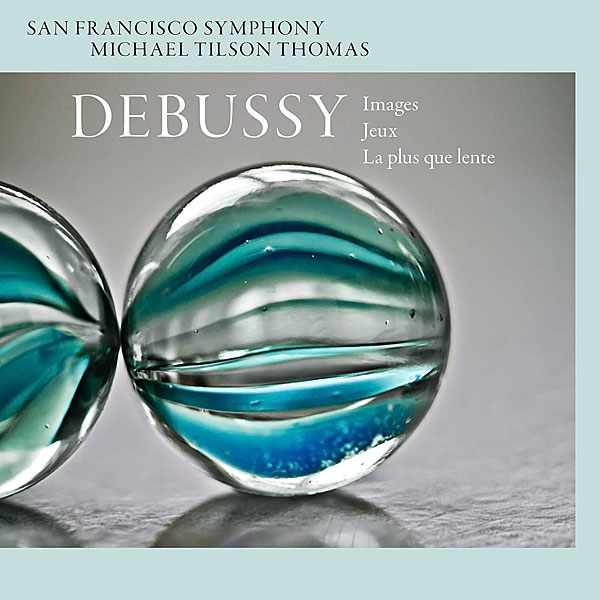 My first impressions (sic) of this music were from recordings by Leonard Bernstein, with whom Tilson Thomas worked as a much younger man. Those performances were expressive, but a bit opaque in comparison to, say, those of Ataulfo Argenta and Jean Martinon. With this new release, Tilson Thomas seems to have melded Bernstein's intensity with the older conductors' transparency and deft shaping. In Images, Ibéria, in particular, is atmospheric but carefully calibrated weight. La plus que lente has the expected grace, but, thanks partly to the excellent engineering, it is also, in the orchestration by Henri Mouton recorded here, piquant. Note the cimbalom!
This is not a long program, and there are no blockbusters, but it is the very model of sensitive, expert music making.
DEBUSSY: Six épigraphes antiques
My first impressions (sic) of this music were from recordings by Leonard Bernstein, with whom Tilson Thomas worked as a much younger man. Those performances were expressive, but a bit opaque in comparison to, say, those of Ataulfo Argenta and Jean Martinon. With this new release, Tilson Thomas seems to have melded Bernstein's intensity with the older conductors' transparency and deft shaping. In Images, Ibéria, in particular, is atmospheric but carefully calibrated weight. La plus que lente has the expected grace, but, thanks partly to the excellent engineering, it is also, in the orchestration by Henri Mouton recorded here, piquant. Note the cimbalom!
This is not a long program, and there are no blockbusters, but it is the very model of sensitive, expert music making.
DEBUSSY: Six épigraphes antiques
POULENC: Les biches: Suite
ROUSSEL: Bacchus et Ariane
Kazuki Yamada, Suisse Romande Orchestra
Pentatone PTC 5186558 (SACD/CD). 2016. DDD. Under Ernest Ansermet, the Suisse Romande Orchestra was a mainstay of Decca/London's ffrr and ffss catalogs, and their performances of Stravinsky, and of French music from the great Impressionists and later, are still prized and respected. Now, after a quiet interval, Pentatone has brought them back to recording, along with their young conductor, Kazuki Yamada (b. 1979). First was a nice disc of ballet music by Bizet, Fauré, and Gounod; this one has more substance and interest.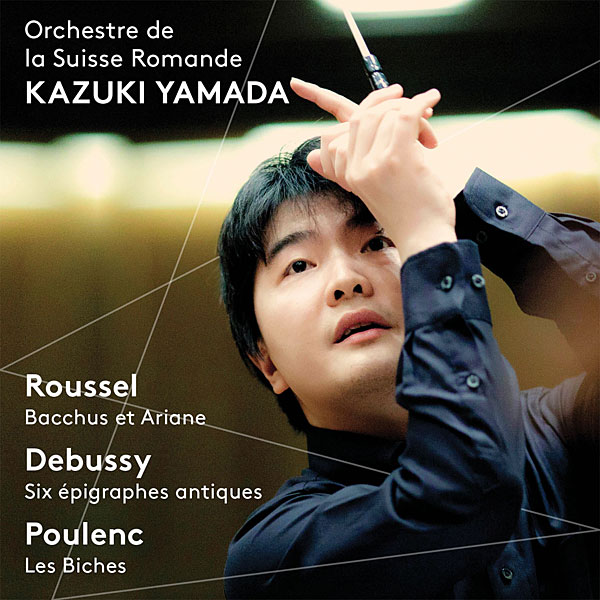 These works play to what has long been the SRO's strength—Impressionism and its heritage—but none is often performed. Debussy's Six épigraphes antiques is a series of charming miniatures that look to the past and sound as if he were writing in the style of Satie's Gymnopédies. It's classic Debussy, but with a stylized formality that sets these performances apart. Roussel's most famous work, the ballet Bacchus et Ariane (1930), looks back to Ravel's Daphnis et Chloé (1909–12), but is distinguished not only by its beauty but also a between-the-wars busyness and anxiety.
But I embrace this disc because I welcome any and all recordings of music by Poulenc, for his wit and playfulness and his ability to spoon out some of the sweetest melodies. Finally, here is a modern multichannel recording of the amiable suite from the ballet Les biches, played with élan and cleanly recorded in the SRO's famous hall, in Geneva. When can we expect their recording of Poulenc's Les animaux modäles?
BERLIOZ: Roméo et Juliette, Trojan March, Royal Hunt and Storm
These works play to what has long been the SRO's strength—Impressionism and its heritage—but none is often performed. Debussy's Six épigraphes antiques is a series of charming miniatures that look to the past and sound as if he were writing in the style of Satie's Gymnopédies. It's classic Debussy, but with a stylized formality that sets these performances apart. Roussel's most famous work, the ballet Bacchus et Ariane (1930), looks back to Ravel's Daphnis et Chloé (1909–12), but is distinguished not only by its beauty but also a between-the-wars busyness and anxiety.
But I embrace this disc because I welcome any and all recordings of music by Poulenc, for his wit and playfulness and his ability to spoon out some of the sweetest melodies. Finally, here is a modern multichannel recording of the amiable suite from the ballet Les biches, played with élan and cleanly recorded in the SRO's famous hall, in Geneva. When can we expect their recording of Poulenc's Les animaux modäles?
BERLIOZ: Roméo et Juliette, Trojan March, Royal Hunt and Storm
Michele Losier, mezzo-soprano; Samuel Boden, tenor; David Soar, bass; BBC Symphony Orchestra & Chorus, Sir Andrew Davis
Chandos CCSA 5169 2 (2 SACD/CDs). 2016. DDD. This is one of two new recordings on SACD of Berlioz's Roméo et Juliette: Symphonie dramatique, the other with Valery Gergiev conducting the London Symphony Orchestra on LSOLive. I began by listening to each in its entirety on succeeding days; then I compared them section by section. The former was rewarding—I enjoyed both, but felt that the Davis/BBC was more satisfying overall; Gergiev/LSO were, at times, a bit too brisk. The part-by-part comparison was a disaster: going from Gergiev's to Davis's recordings of the opening section's brilliant Allegro fugato, it soon became clear that I didn't want to return to Gergiev for the remaining comparisons. First, the infamously dry sound of London's Barbican Centre seemed compressed and strained next to the open, colorful sound that Davis enjoyed in Fairfield Hills, Croydon. In addition, Gergiev sounds rushed and inflexible in this music, Davis nuanced and flexible.
 Davis seems to give the music time to breathe, even in the movements for which his timings are shorter than Gergiev's. Nor do things work better for Gergiev the other way around: Although he zips through the famous Queen Mab scherzo in 7:52, his headlong pace completely stalls out before the final race to the finish. Davis comes in at 8:07, but dances through it all the way.
But enough of the latest competition (though I very slightly prefer Gergiev's vocal soloists)—Davis's performance is all that I could wish for. Pacing and timing seem entirely right all the time, and the music is never static as it dances along. Despite the length of this oddball work for soloists, chorus, and orchestra, my engagement with it never flagged. It recalled the fluency of my old LSO LPs, with Pierre Monteux or Sir Colin Davis on the podium—but Sir Andrew & Co. have the advantage of Chandos's transparent, spacious, powerful (nice bass drum!) sound.—Kalman Rubinson
Davis seems to give the music time to breathe, even in the movements for which his timings are shorter than Gergiev's. Nor do things work better for Gergiev the other way around: Although he zips through the famous Queen Mab scherzo in 7:52, his headlong pace completely stalls out before the final race to the finish. Davis comes in at 8:07, but dances through it all the way.
But enough of the latest competition (though I very slightly prefer Gergiev's vocal soloists)—Davis's performance is all that I could wish for. Pacing and timing seem entirely right all the time, and the music is never static as it dances along. Despite the length of this oddball work for soloists, chorus, and orchestra, my engagement with it never flagged. It recalled the fluency of my old LSO LPs, with Pierre Monteux or Sir Colin Davis on the podium—but Sir Andrew & Co. have the advantage of Chandos's transparent, spacious, powerful (nice bass drum!) sound.—Kalman Rubinson
Glagolitic Mass, Adagio for Orchestra, Zdrávas Maria, Otce ná?
Sara Jakubiak, soprano; Susan Bickley, mezzo-soprano; Stuart Skelton, tenor; Gábor Bretz, bass; David Stewart, violin; Johannes Wik, harp; Karstein Askeland, Thomas Trotter, organ; Choir of Collegiñm Mñsicñm, Edvard Grieg Chorus, Bergen Cathedral Choir, Bergen Philharmonic Orchestra & Chorus; Edward Gardner
Chandos CHSA 5165 (SACD/CD). 2016. Ralph Couzens, eng. DDD.
That's just about the longest headnote I've ever submitted, but its length is proportionate to the massive forces involved, and to their achievement. Janácek's intense and passionate Mass setting demands a matching response from the performers, but also internalization of those emotions. Until this release, no satisfying recording had taken advantage of the ability of multichannel to contain, if barely, the demands of the Glagolitic Mass. Earlier, competent but unmemorable recordings—by Wit and the Warsaw Philharmonic (BD, Naxos NBS2006), and by Janowski and Berlin Radio Symphony Orchestra and Chorus (Pentatone PTC5186388)—had never deterred me from preferring older, classic recordings: Kubelik (on which I imprinted), Mackerras, and Ancerl's monumental reading.
No longer. From the first note, Edward Gardner's team bites into the music with a commitment that conjures the great recordings of the past, but now in hair-raising clarity and frequency range. The choirs and solo singers are all superb, but soprano Sara Jakubiak and tenor Stuart Skelton deserve special mention. Also notable is organist Thomas Trotter, whose contributions boldly underscore many of the most emphatic moments, and whose solo is grand and powerful—aided by the brilliant engineering of Ralph Couzens, who does no less for any of the performers.
Michael Tilson Thomas, San Francisco Symphony
SFS Media SFS 0069 (SACD/CD). 2016. DDD. TT: 60:21
My first impressions (sic) of this music were from recordings by Leonard Bernstein, with whom Tilson Thomas worked as a much younger man. Those performances were expressive, but a bit opaque in comparison to, say, those of Ataulfo Argenta and Jean Martinon. With this new release, Tilson Thomas seems to have melded Bernstein's intensity with the older conductors' transparency and deft shaping. In Images, Ibéria, in particular, is atmospheric but carefully calibrated weight. La plus que lente has the expected grace, but, thanks partly to the excellent engineering, it is also, in the orchestration by Henri Mouton recorded here, piquant. Note the cimbalom!
This is not a long program, and there are no blockbusters, but it is the very model of sensitive, expert music making.
POULENC: Les biches: Suite
ROUSSEL: Bacchus et Ariane
Kazuki Yamada, Suisse Romande Orchestra
Pentatone PTC 5186558 (SACD/CD). 2016. DDD. Under Ernest Ansermet, the Suisse Romande Orchestra was a mainstay of Decca/London's ffrr and ffss catalogs, and their performances of Stravinsky, and of French music from the great Impressionists and later, are still prized and respected. Now, after a quiet interval, Pentatone has brought them back to recording, along with their young conductor, Kazuki Yamada (b. 1979). First was a nice disc of ballet music by Bizet, Fauré, and Gounod; this one has more substance and interest.
These works play to what has long been the SRO's strength—Impressionism and its heritage—but none is often performed. Debussy's Six épigraphes antiques is a series of charming miniatures that look to the past and sound as if he were writing in the style of Satie's Gymnopédies. It's classic Debussy, but with a stylized formality that sets these performances apart. Roussel's most famous work, the ballet Bacchus et Ariane (1930), looks back to Ravel's Daphnis et Chloé (1909–12), but is distinguished not only by its beauty but also a between-the-wars busyness and anxiety.
Michele Losier, mezzo-soprano; Samuel Boden, tenor; David Soar, bass; BBC Symphony Orchestra & Chorus, Sir Andrew Davis
Chandos CCSA 5169 2 (2 SACD/CDs). 2016. DDD. This is one of two new recordings on SACD of Berlioz's Roméo et Juliette: Symphonie dramatique, the other with Valery Gergiev conducting the London Symphony Orchestra on LSOLive. I began by listening to each in its entirety on succeeding days; then I compared them section by section. The former was rewarding—I enjoyed both, but felt that the Davis/BBC was more satisfying overall; Gergiev/LSO were, at times, a bit too brisk. The part-by-part comparison was a disaster: going from Gergiev's to Davis's recordings of the opening section's brilliant Allegro fugato, it soon became clear that I didn't want to return to Gergiev for the remaining comparisons. First, the infamously dry sound of London's Barbican Centre seemed compressed and strained next to the open, colorful sound that Davis enjoyed in Fairfield Hills, Croydon. In addition, Gergiev sounds rushed and inflexible in this music, Davis nuanced and flexible.
Davis seems to give the music time to breathe, even in the movements for which his timings are shorter than Gergiev's. Nor do things work better for Gergiev the other way around: Although he zips through the famous Queen Mab scherzo in 7:52, his headlong pace completely stalls out before the final race to the finish. Davis comes in at 8:07, but dances through it all the way.
But enough of the latest competition (though I very slightly prefer Gergiev's vocal soloists)—Davis's performance is all that I could wish for. Pacing and timing seem entirely right all the time, and the music is never static as it dances along. Despite the length of this oddball work for soloists, chorus, and orchestra, my engagement with it never flagged. It recalled the fluency of my old LSO LPs, with Pierre Monteux or Sir Colin Davis on the podium—but Sir Andrew & Co. have the advantage of Chandos's transparent, spacious, powerful (nice bass drum!) sound.—Kalman Rubinson