This arrangement is exactly the one I use with my other servers. The only special requirement for MQA was to make sure that all of JRiver's DSP options were turned off, including any up/downsampling, file conversion, and dither settings. It was also necessary to uncheck the box for "Open device with exclusive access."
Mmm-mmm, Good
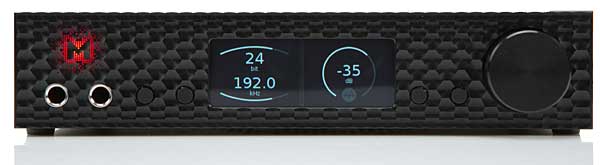
Most of the recordings I'd requested from 2L were hi-rez DXD files (24/352.8)—the MQA versions downloaded in a fraction of the time it took to download the unprocessed originals. The batch of 10 original files (5.96GB) was more than six times larger than the MQA batch (936MB)—individual tracks differed in size by factors ranging from 2 to 10. I loaded the MQA versions into JRiver, and played some of them first to ensure that my settings would permit the Mytek Brooklyn DACs to unfold MQA properly. Hot dog! Depending on the randomly selected MQA multichannel file, the MQA logos on all three Myteks lit up either bright green (MQA) or blue (MQA Studio, footnote 2); in both cases, playback was at 24/352.8. If I defeated MQA on the Myteks, the light went out and playback was at 24/44.1. I was ready to go.
To get a bit of a handle on the sound of the Mytek itself, I began with familiar non-MQA recordings. The impressive little Brooklyn includes a headphone amplifier, volume control, and enough outputs and inputs (including phono) for it to serve as the central preamp-controller of a stereo system. Jim Austin's review in the November 2016 issue covers in detail the Brooklyn's features and performance; I can echo his statements about its revelation of soundstage and texture.
 In multichannel, that soundstage opened up spectacularly; the Mac-Mytek system was fully competitive with my reference Baetis-exaSound system, which was connected to the same preamp with a matching set of Kubala-Sosna Anticipation interconnects. With careful level matching, they were nearly indistinguishable as long as I turned off the latter system's Dirac Live equalization. In rapid A/B comparisons, the Myteks were a tiny bit less sharp (read: smoother) on treble transients, and offered a slightly deeper soundstage than the exaSound e28.
Comparing the decoded MQA files with the DXD originals was fascinating because 2L's recordings are quite marvelous to begin with. They have space, transparency, detail, and impact, and are some of the best recordings available today. In fact, my only quibble is that 2L likes to employ a slightly more immersive experience than I think ideal, but we can ignore that as it is a constant in these considerations. However, when I switched from the DXD (native 24/352.8) to the MQA version (24/44.1 decoded to 24/352.8), there was a consistent improvement in the impression of transparency, and the disassociation of the soundstage from the physical positions of the speakers.
This was obvious with the first recording I tried: Et misericordia, from Kim André Arnesen's Magnificat, performed by vocal soloists, the Nidaros Cathedral Girls Choir, and the Trondheim Soloists, and conducted by Anita Brevik (BD, 2L 2L-106-SABD). With MQA, the opening strings seemed simultaneously more diaphanous and more detailed, while the voice of soprano Else Bonesronning was more plainly human and pure. While the treble was easy to appreciate, a similar improvement extended through the midrange to the low bass, as exemplified by the improved definition of the notes played by organist Magne H. Draagen in the Fecit potentiam. At first the bass sounded less full, but I soon realized that what I was hearing was tighter, more melodic bass. Similarly, from a jazz recording—Quiet Winter Night, by the Hoff Ensemble (BD, 2L 2L-087-SABD)—the bass-and-drums introduction of "Blågutten" retained more of its identifiable character, almost as if the clouding of room resonances had been erased. When the trumpet entered, it was in appropriate balance and placement—but in the MQA version, it seemed to pierce the soundstage with its presence.
I listened to all 11 multichannel recordings 2L and Bob Stuart had prepared, including two surprises. One was a recording by the Guarneri Quartet of the string quartets of Ravel and Debussy, and of Fauré's first, originally released on DVD-Audio (Surrounded-By Entertainment SBE-1004-9, footnote 3). Bob Stuart and I love this recording, and I was thrilled to hear what magic MQA might perform with it. Ah! An old friendship renewed. The Mytek Brooklyns unfolded this original 24/96 four-channel recording as 24/96, but the presence and clarity were clearly improved. The other surprise was a broadband pink-noise signal played sequentially in each of the five channels, and it, too, sounded different in MQA—the treble was finer-grained, the bass less resonant.
The capper was a two-channel track (it's available in multichannel) that's my go-to track for testing a system's balance, soundstage, and voice: Finzi's "Come Away, Death," sung by mezzo-soprano Marianne Beate Kielland accompanied by pianist Sergei Osadchuk, in a free 24/192 PCM download (SACD/CD, 2L 2L-064-SACD). I knew this one well, and now I know it better. The voice is clearer, and its place in the soundstage clearly set, and the piano has just the right balance of cabinet and room resonances. I will say no more, lest I sink into hackneyed audiophile verbiage. Gorgeous.
In multichannel, that soundstage opened up spectacularly; the Mac-Mytek system was fully competitive with my reference Baetis-exaSound system, which was connected to the same preamp with a matching set of Kubala-Sosna Anticipation interconnects. With careful level matching, they were nearly indistinguishable as long as I turned off the latter system's Dirac Live equalization. In rapid A/B comparisons, the Myteks were a tiny bit less sharp (read: smoother) on treble transients, and offered a slightly deeper soundstage than the exaSound e28.
Comparing the decoded MQA files with the DXD originals was fascinating because 2L's recordings are quite marvelous to begin with. They have space, transparency, detail, and impact, and are some of the best recordings available today. In fact, my only quibble is that 2L likes to employ a slightly more immersive experience than I think ideal, but we can ignore that as it is a constant in these considerations. However, when I switched from the DXD (native 24/352.8) to the MQA version (24/44.1 decoded to 24/352.8), there was a consistent improvement in the impression of transparency, and the disassociation of the soundstage from the physical positions of the speakers.
This was obvious with the first recording I tried: Et misericordia, from Kim André Arnesen's Magnificat, performed by vocal soloists, the Nidaros Cathedral Girls Choir, and the Trondheim Soloists, and conducted by Anita Brevik (BD, 2L 2L-106-SABD). With MQA, the opening strings seemed simultaneously more diaphanous and more detailed, while the voice of soprano Else Bonesronning was more plainly human and pure. While the treble was easy to appreciate, a similar improvement extended through the midrange to the low bass, as exemplified by the improved definition of the notes played by organist Magne H. Draagen in the Fecit potentiam. At first the bass sounded less full, but I soon realized that what I was hearing was tighter, more melodic bass. Similarly, from a jazz recording—Quiet Winter Night, by the Hoff Ensemble (BD, 2L 2L-087-SABD)—the bass-and-drums introduction of "Blågutten" retained more of its identifiable character, almost as if the clouding of room resonances had been erased. When the trumpet entered, it was in appropriate balance and placement—but in the MQA version, it seemed to pierce the soundstage with its presence.
I listened to all 11 multichannel recordings 2L and Bob Stuart had prepared, including two surprises. One was a recording by the Guarneri Quartet of the string quartets of Ravel and Debussy, and of Fauré's first, originally released on DVD-Audio (Surrounded-By Entertainment SBE-1004-9, footnote 3). Bob Stuart and I love this recording, and I was thrilled to hear what magic MQA might perform with it. Ah! An old friendship renewed. The Mytek Brooklyns unfolded this original 24/96 four-channel recording as 24/96, but the presence and clarity were clearly improved. The other surprise was a broadband pink-noise signal played sequentially in each of the five channels, and it, too, sounded different in MQA—the treble was finer-grained, the bass less resonant.
The capper was a two-channel track (it's available in multichannel) that's my go-to track for testing a system's balance, soundstage, and voice: Finzi's "Come Away, Death," sung by mezzo-soprano Marianne Beate Kielland accompanied by pianist Sergei Osadchuk, in a free 24/192 PCM download (SACD/CD, 2L 2L-064-SACD). I knew this one well, and now I know it better. The voice is clearer, and its place in the soundstage clearly set, and the piano has just the right balance of cabinet and room resonances. I will say no more, lest I sink into hackneyed audiophile verbiage. Gorgeous.
 After listening to all of the multichannel samples, as well as a few dozen stereo tracks, I am confident in saying that MQA, played through Mytek's Brooklyn DACs, made a real and consistent improvement. If MQA can recruit recording companies to offer sufficient, interesting, and new MQA-encoded recordings in multichannel, I don't see how the technology can be ignored. I'd be in with both feet.
However, the differences weren't blatant; I couldn't hear them without paying close attention. A visiting colleague said similar things, and although we agreed that MQA's improvements were of the same order that we experience from applying good speaker and room correction, we also agreed that they were a different sort of difference. It's not yet possible to integrate EQ with MQA, but it's been suggested that it might be possible to insert such DSP just after the first step of MQA unfolding. That might be another step toward Nirvana.
Coming 'Round in the Round
After listening to all of the multichannel samples, as well as a few dozen stereo tracks, I am confident in saying that MQA, played through Mytek's Brooklyn DACs, made a real and consistent improvement. If MQA can recruit recording companies to offer sufficient, interesting, and new MQA-encoded recordings in multichannel, I don't see how the technology can be ignored. I'd be in with both feet.
However, the differences weren't blatant; I couldn't hear them without paying close attention. A visiting colleague said similar things, and although we agreed that MQA's improvements were of the same order that we experience from applying good speaker and room correction, we also agreed that they were a different sort of difference. It's not yet possible to integrate EQ with MQA, but it's been suggested that it might be possible to insert such DSP just after the first step of MQA unfolding. That might be another step toward Nirvana.
Coming 'Round in the Round
Slated for my next column is exaSound's e38 eight-channel DAC, Roon 1.3 and new multichannel servers from Baetis, Fidelizer Nimitra, and Playback Designs, the last with a stack of three of Playback's Merlot DACs.
Footnote 2: Since this an experimental trial, the materials were marked MQA and MQA Studio for cross-checking the playback rather than indicating provenance.—Bob Stuart Footnote 3: This recording comes from the same label as another of my longtime favorites, Willie Nelson's Night and Day (DVD-A, Surrounded-By Entertainment SBE-1001-9)—one of my two "Records to Die For" for 2017. Keep an eye out for any of Surrounded-By's DVD-A releases, now long out of print.
Most of the recordings I'd requested from 2L were hi-rez DXD files (24/352.8)—the MQA versions downloaded in a fraction of the time it took to download the unprocessed originals. The batch of 10 original files (5.96GB) was more than six times larger than the MQA batch (936MB)—individual tracks differed in size by factors ranging from 2 to 10. I loaded the MQA versions into JRiver, and played some of them first to ensure that my settings would permit the Mytek Brooklyn DACs to unfold MQA properly. Hot dog! Depending on the randomly selected MQA multichannel file, the MQA logos on all three Myteks lit up either bright green (MQA) or blue (MQA Studio, footnote 2); in both cases, playback was at 24/352.8. If I defeated MQA on the Myteks, the light went out and playback was at 24/44.1. I was ready to go.
In multichannel, that soundstage opened up spectacularly; the Mac-Mytek system was fully competitive with my reference Baetis-exaSound system, which was connected to the same preamp with a matching set of Kubala-Sosna Anticipation interconnects. With careful level matching, they were nearly indistinguishable as long as I turned off the latter system's Dirac Live equalization. In rapid A/B comparisons, the Myteks were a tiny bit less sharp (read: smoother) on treble transients, and offered a slightly deeper soundstage than the exaSound e28.
Comparing the decoded MQA files with the DXD originals was fascinating because 2L's recordings are quite marvelous to begin with. They have space, transparency, detail, and impact, and are some of the best recordings available today. In fact, my only quibble is that 2L likes to employ a slightly more immersive experience than I think ideal, but we can ignore that as it is a constant in these considerations. However, when I switched from the DXD (native 24/352.8) to the MQA version (24/44.1 decoded to 24/352.8), there was a consistent improvement in the impression of transparency, and the disassociation of the soundstage from the physical positions of the speakers.
After listening to all of the multichannel samples, as well as a few dozen stereo tracks, I am confident in saying that MQA, played through Mytek's Brooklyn DACs, made a real and consistent improvement. If MQA can recruit recording companies to offer sufficient, interesting, and new MQA-encoded recordings in multichannel, I don't see how the technology can be ignored. I'd be in with both feet.
However, the differences weren't blatant; I couldn't hear them without paying close attention. A visiting colleague said similar things, and although we agreed that MQA's improvements were of the same order that we experience from applying good speaker and room correction, we also agreed that they were a different sort of difference. It's not yet possible to integrate EQ with MQA, but it's been suggested that it might be possible to insert such DSP just after the first step of MQA unfolding. That might be another step toward Nirvana.
Coming 'Round in the RoundSlated for my next column is exaSound's e38 eight-channel DAC, Roon 1.3 and new multichannel servers from Baetis, Fidelizer Nimitra, and Playback Designs, the last with a stack of three of Playback's Merlot DACs.
Footnote 2: Since this an experimental trial, the materials were marked MQA and MQA Studio for cross-checking the playback rather than indicating provenance.—Bob Stuart Footnote 3: This recording comes from the same label as another of my longtime favorites, Willie Nelson's Night and Day (DVD-A, Surrounded-By Entertainment SBE-1001-9)—one of my two "Records to Die For" for 2017. Keep an eye out for any of Surrounded-By's DVD-A releases, now long out of print.