

Low-level detail in the sound of the piano was well-preserved by the Concept 300s, even when Jarrett was comping at high levels with his left hand. I followed "Kyoto" with The Carnegie Concert (16/44.1k ALAC files, ripped from CD, ECM 07362), for which I had been in the audience back in 2005. Whereas the Sun Bear improvisations are unbroken stretches, sometimes lasting more than 40 minutes, Carnegie comprises shorter pieces, more akin, dare I say it, to songs. The image of the piano is wider and closer than it is on "Kyoto," and the instrument has more low-frequency power. Again, the Concept 300s offered a transparent window into the concert hall.
As I was about to start my auditioning of the Concept 300s with the Vandersteen monoblocks replacing the NAD integrated, I heard that drummer Ginger Baker had passed away. I had been a fan of this superbly inventive musician since, at the age of 18, I attended a gig in our little English town where the trio who would become Cream were trying out. I last saw him play at the 2005 Cream reunion concerts in London's Royal Albert Hall and New York's Madison Square Garden.
Roon found "Straight No Chaser" from Going Back Home, which Baker recorded in 1994 with a jazz dream team comprising guitarist Bill Frisell (footnote 2) and acoustic bassist Charlie Haden (16/44.1k ALAC file, ripped from CD, Atlantic 75678265228). This superb album was produced by Chip Stern, who wrote equipment reviews for Stereophile in this century's first decade. Played on the Q Acoustics speakers driven by the Vandersteen amplifiers, Baker's tom toms and kickdrums at the start of this track were reproduced with excellent weight and leading-edge definition. There was a good sense of space around and behind the drums, which were placed—unambiguously—across almost the entire stage. Haden's bass solo was evenly balanced across the instrument's range, the presentation acquiring greater low-frequency authority with the Vandersteens, especially when he plays a double-stopped passage in "Ginger's Blues." The lows better balanced the Q Acoustic's highs with the speaker's rear-panel jumpers set to Normal.
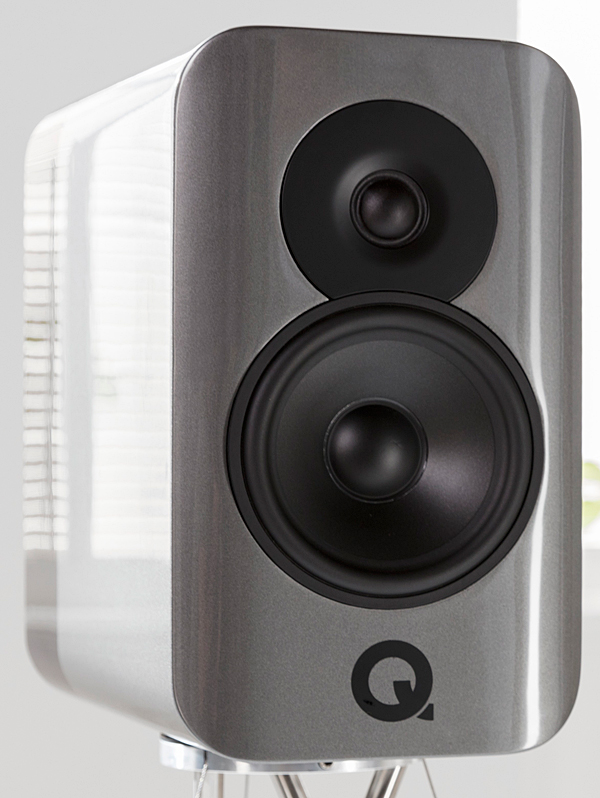 From a great-sounding jazz album to an equally great-sounding classical classic: I cued up Jacqueline du Pré's performance of Elgar's Cello Concerto with John Barbirolli conducting the London Symphony Orchestra in London's Kingsway Hall (24/96k FLAC files, EMI/HDtracks). I had attended a master class on this work's first movement given by Ms. du Pré long after MS had destroyed her ability to play. Nevertheless, as she sung and spoke the cello part in this concerto, it was perhaps the greatest performance I have experienced even if virtual. Played on the PS Audio/Vandersteen/Q Acoustics system, the bravura opening set the solo cello within a warmly supportive acoustic. And when Du Pré skitters down to her instrument's lowest register in the concerto's fourth movement, the power of her playing was reproduced in full measure, despite the Concept 300s' small size. The speakers' transparency allowed through the slightly brittle texture of the orchestral violins on this almost 55-year-old recording.
Turning to the Lamm amplifiers, the midbass sounded tubbier than it had with the Vandersteen monoblocks. Though the review samples did not have the foam port plugs, I did have a suitable pair of plugs in my spare parts box. Using these minimized the tubby quality. Whether I preferred the ports blocked or open depended on the music I played. With the speakers sealed, the balance was still surprisingly rich-sounding with "The Way Young Lovers Do," from Van Morrison and Joey de Francesco's You're Driving Me Crazy (16/44,1k ALAC file ripped from CD, Exile/Legacy 19075820041), for what is a relatively small loudspeaker. With the Keith Jarrett "Kyoto" concert recording, the piano's left-hand register lacked power—especially when, toward the end of the second part of the concert, Jarrett hammers down on bass chords—unless I left the ports open. I recently purchased the live recording of Tchaikovsky's Symphony No.6, with Kirill Petrenko conducting the Berlin Philharmonic (24/192k FLAC file, BPHR 190261). In contrast to the Jarrett, on this recording, played on the Q Acoustic speakers driven by the Lamm amplifiers, the sound was richly detailed even with the ports blocked.
A thought occurred to me when I was listening to this symphony: While many speakers accompany the sound they produce with noise—resonances of all kinds, cone break-up, cabinet vibrations, chuffing from the port—the Concept 300 didn't do that. This is a quiet loudspeaker. I had never before been made so aware, as when listening to these speakers, of the rhythmic emphasis in the first part of Tchaikovsky's 5/4 second movement: 1-2-3, 1-2, 1-2, 1-2-3, with the only linear 1-2-3-4-5 measure coming at the end of each phrase. If the Q Acoustics did anything wrong—and all loudspeakers do something wrong—it wasn't sufficiently high in level to get in the way of the music's dynamics.
A KEF komparison
From a great-sounding jazz album to an equally great-sounding classical classic: I cued up Jacqueline du Pré's performance of Elgar's Cello Concerto with John Barbirolli conducting the London Symphony Orchestra in London's Kingsway Hall (24/96k FLAC files, EMI/HDtracks). I had attended a master class on this work's first movement given by Ms. du Pré long after MS had destroyed her ability to play. Nevertheless, as she sung and spoke the cello part in this concerto, it was perhaps the greatest performance I have experienced even if virtual. Played on the PS Audio/Vandersteen/Q Acoustics system, the bravura opening set the solo cello within a warmly supportive acoustic. And when Du Pré skitters down to her instrument's lowest register in the concerto's fourth movement, the power of her playing was reproduced in full measure, despite the Concept 300s' small size. The speakers' transparency allowed through the slightly brittle texture of the orchestral violins on this almost 55-year-old recording.
Turning to the Lamm amplifiers, the midbass sounded tubbier than it had with the Vandersteen monoblocks. Though the review samples did not have the foam port plugs, I did have a suitable pair of plugs in my spare parts box. Using these minimized the tubby quality. Whether I preferred the ports blocked or open depended on the music I played. With the speakers sealed, the balance was still surprisingly rich-sounding with "The Way Young Lovers Do," from Van Morrison and Joey de Francesco's You're Driving Me Crazy (16/44,1k ALAC file ripped from CD, Exile/Legacy 19075820041), for what is a relatively small loudspeaker. With the Keith Jarrett "Kyoto" concert recording, the piano's left-hand register lacked power—especially when, toward the end of the second part of the concert, Jarrett hammers down on bass chords—unless I left the ports open. I recently purchased the live recording of Tchaikovsky's Symphony No.6, with Kirill Petrenko conducting the Berlin Philharmonic (24/192k FLAC file, BPHR 190261). In contrast to the Jarrett, on this recording, played on the Q Acoustic speakers driven by the Lamm amplifiers, the sound was richly detailed even with the ports blocked.
A thought occurred to me when I was listening to this symphony: While many speakers accompany the sound they produce with noise—resonances of all kinds, cone break-up, cabinet vibrations, chuffing from the port—the Concept 300 didn't do that. This is a quiet loudspeaker. I had never before been made so aware, as when listening to these speakers, of the rhythmic emphasis in the first part of Tchaikovsky's 5/4 second movement: 1-2-3, 1-2, 1-2, 1-2-3, with the only linear 1-2-3-4-5 measure coming at the end of each phrase. If the Q Acoustics did anything wrong—and all loudspeakers do something wrong—it wasn't sufficiently high in level to get in the way of the music's dynamics.
A KEF komparison
Even with the Concept 300s' rear-panel jumpers removed to reduce the level of their tweeters by 0.5dB, the Q Acoustics' balance had more high-treble energy than my long-term reference KEF LS50s. The KEFs and Concept 300s threw equally detailed, well-defined and stable soundstages. The speakers also sounded very similar in the midrange, though the larger Q Acoustics had more low-frequency weight. If you read my review of the NAD M10, you will note that I felt the KEFs benefited from the low-frequency correction provided by the amplifier's Dirac LE app. I didn't feel the need to use Dirac with the Concept 300s. Despite the Concept 300's woofer being only a little larger than that of the KEF—a radiating diameter of 5" vs 4"—it could play louder in the bass than the LS50 before starting to feel the strain.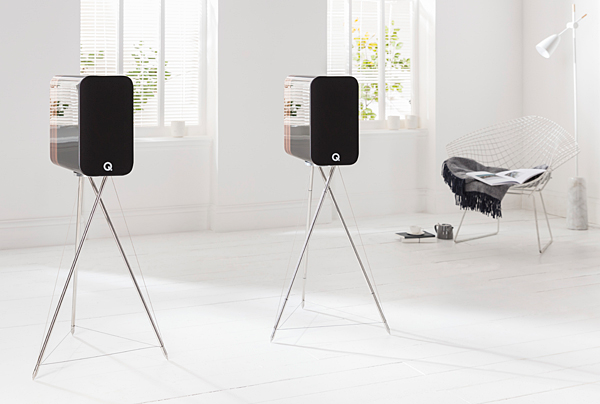 As good as the KEFs are at their price, their presentation was less dynamic, less full-range, than that of the Q Acoustics speakers.
Conclusion
As good as the KEFs are at their price, their presentation was less dynamic, less full-range, than that of the Q Acoustics speakers.
Conclusion
This is not a speaker for all systems. Even with the tweeter-level adjustments, the Concept 300 can be a touch unforgiving of bright-sounding electronics. And the appearance of the loudspeakers on their Tensegrity tripod stands will not suit all tastes or decors. However, looking back at the words I have written about the Concept 300s, I notice that I kept digressing from discussing sound quality to talking about music. This is not surprising, as these speakers stepped out of the way of the music in a manner I have only experienced from more expensive models, such as Wilson's Alexia 2, Magico's S5 Mk.II, and KEF's Blade Two, to name three speakers that I have reviewed in the past few years. Transparent and neutral-sounding, with superbly stable, well-defined stereo imaging, and more extended low frequencies than you'd expect from a loudspeaker this size, Q Acoustics' Concept 300 gets an enthusiastic recommendation from me.
From a great-sounding jazz album to an equally great-sounding classical classic: I cued up Jacqueline du Pré's performance of Elgar's Cello Concerto with John Barbirolli conducting the London Symphony Orchestra in London's Kingsway Hall (24/96k FLAC files, EMI/HDtracks). I had attended a master class on this work's first movement given by Ms. du Pré long after MS had destroyed her ability to play. Nevertheless, as she sung and spoke the cello part in this concerto, it was perhaps the greatest performance I have experienced even if virtual. Played on the PS Audio/Vandersteen/Q Acoustics system, the bravura opening set the solo cello within a warmly supportive acoustic. And when Du Pré skitters down to her instrument's lowest register in the concerto's fourth movement, the power of her playing was reproduced in full measure, despite the Concept 300s' small size. The speakers' transparency allowed through the slightly brittle texture of the orchestral violins on this almost 55-year-old recording.
Turning to the Lamm amplifiers, the midbass sounded tubbier than it had with the Vandersteen monoblocks. Though the review samples did not have the foam port plugs, I did have a suitable pair of plugs in my spare parts box. Using these minimized the tubby quality. Whether I preferred the ports blocked or open depended on the music I played. With the speakers sealed, the balance was still surprisingly rich-sounding with "The Way Young Lovers Do," from Van Morrison and Joey de Francesco's You're Driving Me Crazy (16/44,1k ALAC file ripped from CD, Exile/Legacy 19075820041), for what is a relatively small loudspeaker. With the Keith Jarrett "Kyoto" concert recording, the piano's left-hand register lacked power—especially when, toward the end of the second part of the concert, Jarrett hammers down on bass chords—unless I left the ports open. I recently purchased the live recording of Tchaikovsky's Symphony No.6, with Kirill Petrenko conducting the Berlin Philharmonic (24/192k FLAC file, BPHR 190261). In contrast to the Jarrett, on this recording, played on the Q Acoustic speakers driven by the Lamm amplifiers, the sound was richly detailed even with the ports blocked.
A thought occurred to me when I was listening to this symphony: While many speakers accompany the sound they produce with noise—resonances of all kinds, cone break-up, cabinet vibrations, chuffing from the port—the Concept 300 didn't do that. This is a quiet loudspeaker. I had never before been made so aware, as when listening to these speakers, of the rhythmic emphasis in the first part of Tchaikovsky's 5/4 second movement: 1-2-3, 1-2, 1-2, 1-2-3, with the only linear 1-2-3-4-5 measure coming at the end of each phrase. If the Q Acoustics did anything wrong—and all loudspeakers do something wrong—it wasn't sufficiently high in level to get in the way of the music's dynamics.
Even with the Concept 300s' rear-panel jumpers removed to reduce the level of their tweeters by 0.5dB, the Q Acoustics' balance had more high-treble energy than my long-term reference KEF LS50s. The KEFs and Concept 300s threw equally detailed, well-defined and stable soundstages. The speakers also sounded very similar in the midrange, though the larger Q Acoustics had more low-frequency weight. If you read my review of the NAD M10, you will note that I felt the KEFs benefited from the low-frequency correction provided by the amplifier's Dirac LE app. I didn't feel the need to use Dirac with the Concept 300s. Despite the Concept 300's woofer being only a little larger than that of the KEF—a radiating diameter of 5" vs 4"—it could play louder in the bass than the LS50 before starting to feel the strain.
As good as the KEFs are at their price, their presentation was less dynamic, less full-range, than that of the Q Acoustics speakers.
This is not a speaker for all systems. Even with the tweeter-level adjustments, the Concept 300 can be a touch unforgiving of bright-sounding electronics. And the appearance of the loudspeakers on their Tensegrity tripod stands will not suit all tastes or decors. However, looking back at the words I have written about the Concept 300s, I notice that I kept digressing from discussing sound quality to talking about music. This is not surprising, as these speakers stepped out of the way of the music in a manner I have only experienced from more expensive models, such as Wilson's Alexia 2, Magico's S5 Mk.II, and KEF's Blade Two, to name three speakers that I have reviewed in the past few years. Transparent and neutral-sounding, with superbly stable, well-defined stereo imaging, and more extended low frequencies than you'd expect from a loudspeaker this size, Q Acoustics' Concept 300 gets an enthusiastic recommendation from me.















