

Sidebar 1: A Sprung Suspension on a Loudspeaker?
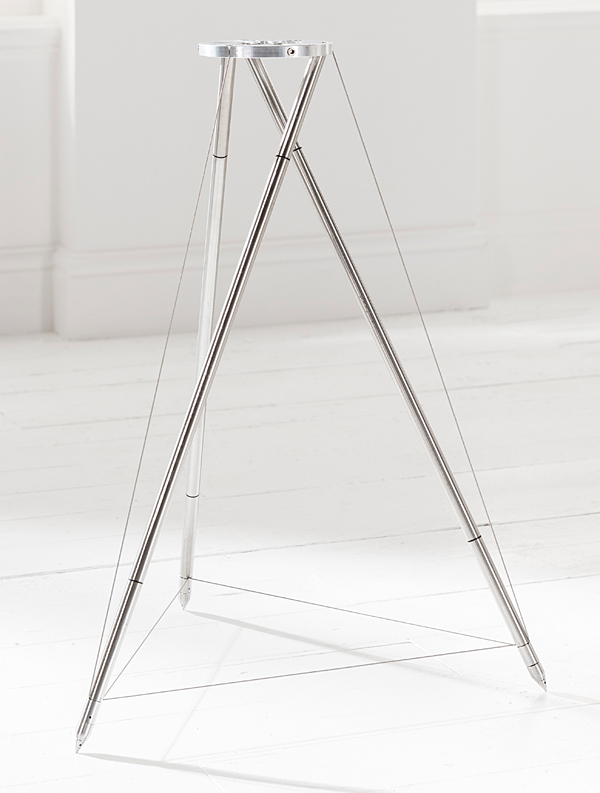
After I attended the launch event for the Q Acoustics Concept 300 with John Atkinson, I found myself interested in this speaker's unique stands—which, as JA points out in his review, incorporate a sprung, low-pass vibration filter to isolate the speaker from its surroundings, much as a suspended turntable isolates the platter from floor-borne vibrations.
It's an interesting idea—especially in the context of a dynamic loudspeaker, which has drivers moving in and out over a wide range of frequencies. When a driver cone moves, its motion imparts a reactive force on the cabinet that holds the drivers (think: Newton's First Law). With rigid spikes, that recoil energy can escape into the floor. A sprung suspension—in contrast to rigid spikes—allows the loudspeaker to move in response to those forces, the motion limited only by its own mass/inertia. Transmission of that energy to the floor isn't possible above the corner frequency of the low-pass filter formed by the speaker's mass and the compliance of the sprung suspension. According to what some Q Acoustics engineers told me, that corner frequency is likely to be around 10Hz.
 If your floors are made of wood and your loudspeakers have spikes, you may find that your floors make music, too: Turn up the volume and put your ear to the floor. Hear it? That sound is partly transmitted through the air (even so, with rigid spikes, some of that energy could make its way back into the speaker with no isolation), but it is also due to the speaker coupling directly to the floor through the spikes. The floor is now part of your loudspeaker, but not a very good part, as the energy it radiates is delayed and distorted relative to the music the speaker drivers are producing.
What if your floor is made of concrete instead of wood? Then the floor will influence the sound in a different way; as a former resident of a concrete-and-steel condo building, I can attest that concrete can transmit low frequencies exceedingly well, and over long distances.
In other words, with rigid spikes, the floor affects how the speaker sounds in ways that can't be predicted reliably by the speaker designer.
If, instead, you isolate the loudspeaker vibrations from the floor as you would isolate a suspended turntable platter from the surface the turntable sits on—employing a low-pass filter so that higher-frequency vibrations don't pass—then the loudspeaker will behave the same way no matter what kind of floor it sits on.
The following comes from the Q Acoustics engineering team: "Spikes provide a mechanical connection/coupling to the boundary that the speaker is resting on, and the boundary will impart its sound characteristic to the overall sound in the room (and surrounding structures!). With the C300, we chose to isolate the speaker from mechanically coupling to foreign structures, thus controlling/significantly reducing any colorations/delayed sounds that can alter the pure acoustic signature of the speaker."
Two other designers I talked to told me that any reactive motion of the cabinet should be prevented—ie by rigid spikes—lest the cabinet motion smear the sound, especially that coming from the tweeter. Q Acoustics says such matters are managed by using a massive cabinet: That mass imparts considerable inertia, so it doesn't move much. One oft-cited sonic problem with such an approach is smearing of the stereo image—but apparently not here, since JA found the Concept 300's images to be "superbly stable" and "well-defined."
I like the idea of isolating a loudspeaker from supporting structures that will influence its sound in unpredictable ways, but I cannot judge what other effects this will have. Ultimately, whether Q Acoustics' suspension approach is, um, sound is up to your ears to determine.—Jim Austin
If your floors are made of wood and your loudspeakers have spikes, you may find that your floors make music, too: Turn up the volume and put your ear to the floor. Hear it? That sound is partly transmitted through the air (even so, with rigid spikes, some of that energy could make its way back into the speaker with no isolation), but it is also due to the speaker coupling directly to the floor through the spikes. The floor is now part of your loudspeaker, but not a very good part, as the energy it radiates is delayed and distorted relative to the music the speaker drivers are producing.
What if your floor is made of concrete instead of wood? Then the floor will influence the sound in a different way; as a former resident of a concrete-and-steel condo building, I can attest that concrete can transmit low frequencies exceedingly well, and over long distances.
In other words, with rigid spikes, the floor affects how the speaker sounds in ways that can't be predicted reliably by the speaker designer.
If, instead, you isolate the loudspeaker vibrations from the floor as you would isolate a suspended turntable platter from the surface the turntable sits on—employing a low-pass filter so that higher-frequency vibrations don't pass—then the loudspeaker will behave the same way no matter what kind of floor it sits on.
The following comes from the Q Acoustics engineering team: "Spikes provide a mechanical connection/coupling to the boundary that the speaker is resting on, and the boundary will impart its sound characteristic to the overall sound in the room (and surrounding structures!). With the C300, we chose to isolate the speaker from mechanically coupling to foreign structures, thus controlling/significantly reducing any colorations/delayed sounds that can alter the pure acoustic signature of the speaker."
Two other designers I talked to told me that any reactive motion of the cabinet should be prevented—ie by rigid spikes—lest the cabinet motion smear the sound, especially that coming from the tweeter. Q Acoustics says such matters are managed by using a massive cabinet: That mass imparts considerable inertia, so it doesn't move much. One oft-cited sonic problem with such an approach is smearing of the stereo image—but apparently not here, since JA found the Concept 300's images to be "superbly stable" and "well-defined."
I like the idea of isolating a loudspeaker from supporting structures that will influence its sound in unpredictable ways, but I cannot judge what other effects this will have. Ultimately, whether Q Acoustics' suspension approach is, um, sound is up to your ears to determine.—Jim Austin
If your floors are made of wood and your loudspeakers have spikes, you may find that your floors make music, too: Turn up the volume and put your ear to the floor. Hear it? That sound is partly transmitted through the air (even so, with rigid spikes, some of that energy could make its way back into the speaker with no isolation), but it is also due to the speaker coupling directly to the floor through the spikes. The floor is now part of your loudspeaker, but not a very good part, as the energy it radiates is delayed and distorted relative to the music the speaker drivers are producing.















