Tonearms
A+
SAT CF1-09: €55,000 ★
SAT CF1-12: €58,000 ★
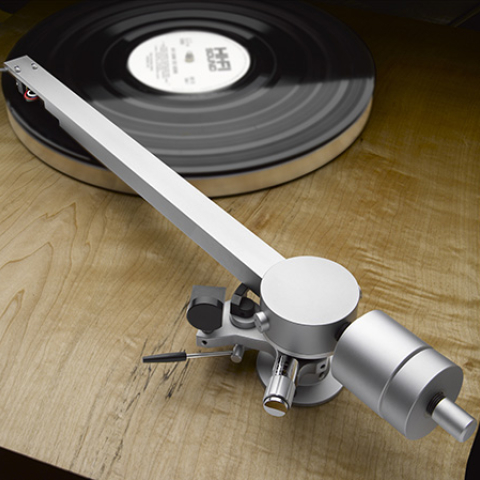
In 2018, after selling 70 of his original Swedish Analog Technologies Tonearms, designer Marc Gomez discontinued it and replaced it with two new tonearms. The more expensive, the CF1-09, is now the company's flagship. The CF1-09's tapered, hand-lapped, "naked"-carbon-fiber armtube has an effective length of 9" and incorporates a number of parts machined from solid stainless steel—including a new vertical bearing yoke that's far more massive than that of the original SAT arm and makes the CF1-09 too heavy for turntables with spring-suspended subchassis—and its newly designed hardened bearings exhibit far tighter tolerances. Also available is the 12" CF1-12. Mikey tried the CF1-12 in place of the Schröder CB arm on the OMA SP10 Plinth System and praised the SAT's "more explosive," "warmer," and "fuller" sound. (Vol.41 No.11, Vol.42 No.2 WWW) SAT CF1-9Ti: €88,000
SAT CF1-12Ti: €92,000
These two cost-no-object tonearms appear outwardly identical to the Swedish manufacturer's original CF1 arm. However, there is now a titanium tube running through the carbon-fiber armtube and the CF1's removable carbon-fiber headshell has been stiffened with a frame made from titanium. The 9" arm was auditioned, but the 12" arm should be just as good (but longer). Prices are when purchased separately; when the arms are purchased with the SAT XD-1 turntable (see "Turntables"), the prices are €50,000 ('9Ti) and €60,000 ('12Ti). (Vol.43 No.12 WWW) A Acoustic Signature TA-7000 NEO: $17,995
The TA-7000 uses a gimbaled ball/race bearing system and a damped carbon-fiber armtube. It is available with either an SME or Rega-type mount and in 9" and 12" versions. The model reviewed was the 9", which conforms to the standard Rega geometry. It pays to be cautious when adjusting arm height, advised MF, as the pillar goes, in a hair-turn of the grub screw, "from rock-solid secure to dropping like a pound and a half rock." Repeatable azimuth adjustment is also tricky as there are no reference marks. Included with the arm are a rigid, precise alignment jig set to Löfgren A geometry and AudioQuest's entry-level "Wildcat" DIN-to-RCA cable. With an Ortofon A95 phono cartridge, the lateral and vertical resonant frequencies both measured ideally, at approximately 10Hz. (Vol.45 No.1 WWW)
Acoustical Systems AXIOM Reference: $24,995
The gimbal bearing AXIOM is available in 10" or 12" versions and comes with various precision-machined-and-finished spacers of various heights. MF described the designer's goal as being to produce an infinitely adjustable "universal" tonearm "capable of precisely adjusting every setup parameter you can think of and maybe a few you haven't thought of and to place the settings where they are most effectively implemented." Setup was straightforward, a precisely machined, smoothly operating VTA tower mechanism raising or lowering the arm 1mm with each full knob turn. Mounted on the AXIOM, the X-quisite cartridge delivered clean sibilants and the expected smooth, transparent, direct (if somewhat forward, but not bright) timbral balance. MF found that the AXIOM arm delivered microdynamic shifts that helped produce the appropriate, rolling, flowing feel of the classic Cowboy Junkies album. "If it doesn't quite have the slam and excitement of the far-more-costly SAT CF1-09," concluded MF, "it makes up for that with its smooth, refined, erudite, almost academic presentation." (Vol.45 No.9 WWW) AMG 12JT: $9000
This tonearm features a unique, dual-pivot horizontal bearing system (for vertical movement) and a vertical bearing (for horizontal movement) that uses a hardened tool-steel axle with top and bottom micro ball bearings. The antiskating mechanism uses a pair of adjustable magnets that can be moved closer to or farther away from an opposing ring magnet, and azimuth is adjusted with a knurled knob. See MF's review of the AMG Viella Forte Engraved turntable ("Turntables"). (Vol.43 No.9 WWW) Graham Engineering Phantom Elite: $13,750–$14,750 depending on length. ★
Outwardly similar to the standard Graham Phantom tonearm, the Phantom Elite is said to be made from more costly materials and incorporates new Litz wiring, a refined alignment gauge, and a thicker, more rigid version of the Phantom's removable, damped titanium armtube. (The latter is available in three sizes, for effective lengths of 9", 10", and 12".) Retained from the original Phantom is Graham's patented Magneglide system, in which magnets are used to stabilize the arm's inverted-unipivot bearing. MF observed that, when used with the TechDAS Air Force Two turntable, the Phantom Elite had good texture but not the same degree of weight as the more expensive Swedish Audio Technologies arm. Like Graham's standard Phantom, the Phantom Elite is available with a circular or an SME-style arm mount; MF suggests that the latter makes it easier to adjust spindle-to-pivot distance. (Vol.38 No.11, Vol.44 No.9 WWW)
Graham Engineering Phantom III: $8300 (10" length) ★
A less expensive alternative to the Graham Phantom Elite, the new Phantom III improves on its predecessor, the Phantom II, with a titanium arm wand, a more massive bearing housing, and, inside that housing, wiring that's claimed to produce less physical resistance as the arm moves. A new counterweight permits a wider range of cartridge weights, and Graham's patented Magneglide stabilization system has been further improved. After using it with a TechDAS Air Force III turntable, which Graham distributes, MF wrote that "it was immediately clear that the Phantom III's bass reproduction was far more robust and controlled than that of the Phantom II Supreme that I owned." The Phantom III's price drops to $5000 when bundled with the Air Force III. (Vol.41 No.1, WWW) J.Sikora KV12 VTA: $8995
The oil-damped, unipivot KV12 VTA is the first tonearm to use an armtube made of Kevlar—"KV" stands for Kevlar—and features precision, on-the-fly VTA adjustment. MF noted that while the KV12's bass reproduction was clean and tight, it couldn't match the "prodigious-yet-honest bass" of the much-more-expensive SAT arm. MF concluded that while the KV12 hasn't got the Kuzma 4 Point's bottom-end "womp" and authority, its timbral balance and everything else about it produced nothing but sonic pleasure. (Vol.45 No.7 WWW) Kuzma 4Point: $9240 and up ★
Kuzma 4Point 9: $5696 and up ★
Designed by Franc Kuzma and available in 9", 11", and 14" versions, this tonearm takes its name from its four-point bearing system: Four carefully arranged points contact four cups, permitting the arm to move in both the vertical and lateral planes while avoiding the chatter of gimbaled bearings and the instability of unipivot designs. A removable headshell makes swapping cartridges painless, while adjustment of VTF, VTA, antiskating, and azimuth are relatively simple. With its outstanding immediacy, transparency, and overall coherence, the 4Point consistently exceeded Mikey's expectations. Compared to the combo of Continuum Cobra arm and Ortofon A90 cartridge, the 4Point with Lyra Titan i offered greater timbral, textural, and image solidity, said MF. Compared with the Cobra, the Kuzma sounded more natural and energetic. "The Kuzma 4Point may be the finest tonearm out there, period," said MF. The Kuzma matched the Graham Phantom II Supreme's detail retrieval and neutrality but offered greater speed and coherence, said MF. As reported in the July 2019 Stereophile, KM's review sample of the Kuzma Stabi R turntable came with a 4Point 11" ($6675 as supplied), which proved "eminently and easily adjustable." Also offered with regular phono cables/no RCA box for $6375. (Vol.34 Nos.9 & 10, Vol.35 No.7, Vol.39 Nos.3 & 11, Vol.41 No.6, Vol.42 No.7 WWW)
Linn Ekos SE: $5645 ★
Outwardly identical to the original Ekos in all but color, the Ekos SE is machined from a titanium tube in an effort to smooth out resonant peaks, while its stainless steel main pillar and bearing cradle work to maintain perfect bearing adjustment in the face of temperature extremes and user abuse. The "beautifully finished" SE comes packaged with a selection of tools, a Linn T-Kable interconnect, and a new iteration of Linns cable clamp. With its strong, tight bass and solid aural images, the Ekos SE produced a "cleaner, more dramatic, and more enjoyable" listening experience, said AD. "Other, more exotic arms may give better results in some settings, but I can't think of a more consistent—and consistently recommendable—tonearm. It's a Martin D-28, a BMW 3-series, a bottle of Bombay Sapphire: It will please any sane, reasonable person," he summed up. (Vol.30 No.10 WWW; also see HR's Linn Klimax LP12 review in Vol.45 No.6 WWW) Reed 5T: $21,500
This pivoted tonearm has a unique design that uses a servo-controlled, battery-powered motor and a laser to enable it to track tangentially and also to address antiskating. Compared to pivoted tonearms, the 5T's smaller moment of inertia allows for better tracking. Care must be taken when cueing cartridges with the Reed arm, as moving too fast will disable the servo mechanism. The 5T, mounted on the Reed Muse 1c turntable and fitted with an Ortofon MC Century cartridge, sounded "wonderful," said MF, and "excelled in soundstage stability and expansiveness, all across the record surface." (Vol.43 No.6) Schick 12" Tonearm: $1995 ★
Schick 10.5" Tonearm: $1995
Made in Germany and now distributed in the United States by Mofi Distribution, the Thomas Schick 12" tonearm is intended to combine the greater-than-average length and mass of certain vintage models with the high-quality bearings of modern arms. It offers superb fit and finish, with a clean, spare bearing cradle and a smoothly solid pickup-head socket. Though lacking the spring-loaded downforce and other refinements of the EMT 997—and, thus, some measure of the more expensive arm's performance—the Schick is characterized by a big, clean, substantial sound, with an especially colorful bottom end: "a superb performer," per AD, who also verified the correctness of the Schick's geometry with Keith Howard's ArmGeometer freeware. According to Art, "The Schick tonearm is an outstanding value and easily the most accessible transcription-length arm on the market." Thomas Schick has now added to his line a proprietary headshell ($295) machined from resin-soaked "technical" graphite, with a mass (15.2gm) that makes it more suitable than most for use with cartridges of low to moderate compliance. AD bought the new headshell for himself and reported that, compared to his wooden Yamamoto headshell, the Schick offered "far tighter, cleaner bass." He was also impressed with how "cartridges mounted in the Schick suffer less breakup during heavily modulated passages." Now with balanced cable. Reporting on the 10.5" arm, HR wrote that after hearing Schick's arms in a variety of systems, he suspected that the medium-length version "might strike a good balance between the liveliness of the 9" and the greater mass and tracing accuracy of the 12" version." He found it to be a good partner for his Dr. Feickert Blackbird turntable. (Vol.33 Nos.3 & 6, Vol.34 No.10, Vol.37 No.11, 12"; Vol.44 No.1, 10.5" WWW)
Schröder Captive Bearing (CB) tonearm: $5750 (9" version) ★
See MF's reviews of the Döhmann Helix One Mk2 turntable, which uses this arm with the carbon fiber armtube. The 11" version costs $6000. (Vol.40 No.3 WWW & Vol.43 No.4 WWW) Thales Simplicity II Tonearm: $9450
The Simplicity II occupies the middle of Thales's three-tonearm range, surpassed by the more refined Thales Statement, yet the Simplicity II shares the same basic design: It's a pivoting tangential-tracking tonearm, with two slender, elegant armtubes; a split counterweight; a ball-bearing-loaded, articulated cartridge-mounting platform; and a Cardanic main bearing. AD was taken with the Simplicity II's performance—characterized by superb momentum and flow and very good tactile qualities—as well as its ease of use (especially apparent in Thales's ingenious cartridge-alignment jig). Above all, the Simplicity II's build quality impressed AD, who called it "the most well-made tonearm" he has used. It works especially well with the vintage Thorens TD 124 turntable—a must-hear combination, Art sez—as well as Thales's own TTT Slim II ($6750, or bundled with the Simplicity II for $14,180). (Vol.42 No.8 WWW) Thales Statement: $ 20,250 to $23,630 (depending on coating)
Micha Huber, a former watchmaker and the chief designer at Swiss manufacturing firm Thales, has spent nearly 20 years perfecting the concept of a pivoting rather than straight-line tangential-tracking tonearm. The Statement is his magnum opus. Earlier Thales arms used an articulated auxiliary arm, in addition to the main armtube, to continually adjust the headshell's tangency to the record groove; the Statement is "more elegant," with its slender, two-tube arm structure, encapsulated cardanic main bearing, and a headshell articulated by means of micro ball bearings. MF praised the Statement's construction quality—"if you didn't know [it] was designed by a watchmaker, you might have guessed it anyway"—and praised its image stability, bottom-end power and grip, and "solid, well-articulated [note] attacks and convincing sustains." (Vol.42 No.5 WWW)
B
Rega RB330: $675 $$$ ★
Current version of Rega's classic tonearm. See the Rega Planar 3 entry in Turntables and Gramophone Dreams in Vol.40 No.2 WWW. The Wand Plus, 12" version: $2500
Standard 9.5" version: $1950
The Wand Plus, imported from New Zealand, is a missionary-style unipivot with a 7/8"-diameter carbon-fiber tube: both thicker and lighter in weight than the average aluminum tube, yet apparently no less rigid. AD sampled the 12" version of the Wand Plus ($1800)—also available are 9.5" ($1400) and 10.3" ($1600) versions—and praised its ability to play music with fine color, texture, presence, scale, and musical timing, noting that he was "honestly shocked at how utterly, amazingly good it sounded" and adding that "the combination of Denon DL-103 [cartridge] and 12" Wand Plus proved a relatively low-cost giant killer." AD cautions that, in its installation and adjustment, the Wand Plus is fussier than average and is best suited for users who are either comfortable with such or are fortunate to have very good dealers. (Vol.42 No.5 WWW) Editor's Note: There are currently no Class C or D tonearms listed. Deletions
EMT 997, discontinued. Klaudio KD-ARM-AG12, SAT-LM-09, Sorane ZA-12, not auditioned in a long time.
SAT CF1-12: €58,000 ★
In 2018, after selling 70 of his original Swedish Analog Technologies Tonearms, designer Marc Gomez discontinued it and replaced it with two new tonearms. The more expensive, the CF1-09, is now the company's flagship. The CF1-09's tapered, hand-lapped, "naked"-carbon-fiber armtube has an effective length of 9" and incorporates a number of parts machined from solid stainless steel—including a new vertical bearing yoke that's far more massive than that of the original SAT arm and makes the CF1-09 too heavy for turntables with spring-suspended subchassis—and its newly designed hardened bearings exhibit far tighter tolerances. Also available is the 12" CF1-12. Mikey tried the CF1-12 in place of the Schröder CB arm on the OMA SP10 Plinth System and praised the SAT's "more explosive," "warmer," and "fuller" sound. (Vol.41 No.11, Vol.42 No.2 WWW) SAT CF1-9Ti: €88,000
SAT CF1-12Ti: €92,000
These two cost-no-object tonearms appear outwardly identical to the Swedish manufacturer's original CF1 arm. However, there is now a titanium tube running through the carbon-fiber armtube and the CF1's removable carbon-fiber headshell has been stiffened with a frame made from titanium. The 9" arm was auditioned, but the 12" arm should be just as good (but longer). Prices are when purchased separately; when the arms are purchased with the SAT XD-1 turntable (see "Turntables"), the prices are €50,000 ('9Ti) and €60,000 ('12Ti). (Vol.43 No.12 WWW) A Acoustic Signature TA-7000 NEO: $17,995
The TA-7000 uses a gimbaled ball/race bearing system and a damped carbon-fiber armtube. It is available with either an SME or Rega-type mount and in 9" and 12" versions. The model reviewed was the 9", which conforms to the standard Rega geometry. It pays to be cautious when adjusting arm height, advised MF, as the pillar goes, in a hair-turn of the grub screw, "from rock-solid secure to dropping like a pound and a half rock." Repeatable azimuth adjustment is also tricky as there are no reference marks. Included with the arm are a rigid, precise alignment jig set to Löfgren A geometry and AudioQuest's entry-level "Wildcat" DIN-to-RCA cable. With an Ortofon A95 phono cartridge, the lateral and vertical resonant frequencies both measured ideally, at approximately 10Hz. (Vol.45 No.1 WWW)
The gimbal bearing AXIOM is available in 10" or 12" versions and comes with various precision-machined-and-finished spacers of various heights. MF described the designer's goal as being to produce an infinitely adjustable "universal" tonearm "capable of precisely adjusting every setup parameter you can think of and maybe a few you haven't thought of and to place the settings where they are most effectively implemented." Setup was straightforward, a precisely machined, smoothly operating VTA tower mechanism raising or lowering the arm 1mm with each full knob turn. Mounted on the AXIOM, the X-quisite cartridge delivered clean sibilants and the expected smooth, transparent, direct (if somewhat forward, but not bright) timbral balance. MF found that the AXIOM arm delivered microdynamic shifts that helped produce the appropriate, rolling, flowing feel of the classic Cowboy Junkies album. "If it doesn't quite have the slam and excitement of the far-more-costly SAT CF1-09," concluded MF, "it makes up for that with its smooth, refined, erudite, almost academic presentation." (Vol.45 No.9 WWW) AMG 12JT: $9000
This tonearm features a unique, dual-pivot horizontal bearing system (for vertical movement) and a vertical bearing (for horizontal movement) that uses a hardened tool-steel axle with top and bottom micro ball bearings. The antiskating mechanism uses a pair of adjustable magnets that can be moved closer to or farther away from an opposing ring magnet, and azimuth is adjusted with a knurled knob. See MF's review of the AMG Viella Forte Engraved turntable ("Turntables"). (Vol.43 No.9 WWW) Graham Engineering Phantom Elite: $13,750–$14,750 depending on length. ★
Outwardly similar to the standard Graham Phantom tonearm, the Phantom Elite is said to be made from more costly materials and incorporates new Litz wiring, a refined alignment gauge, and a thicker, more rigid version of the Phantom's removable, damped titanium armtube. (The latter is available in three sizes, for effective lengths of 9", 10", and 12".) Retained from the original Phantom is Graham's patented Magneglide system, in which magnets are used to stabilize the arm's inverted-unipivot bearing. MF observed that, when used with the TechDAS Air Force Two turntable, the Phantom Elite had good texture but not the same degree of weight as the more expensive Swedish Audio Technologies arm. Like Graham's standard Phantom, the Phantom Elite is available with a circular or an SME-style arm mount; MF suggests that the latter makes it easier to adjust spindle-to-pivot distance. (Vol.38 No.11, Vol.44 No.9 WWW)
A less expensive alternative to the Graham Phantom Elite, the new Phantom III improves on its predecessor, the Phantom II, with a titanium arm wand, a more massive bearing housing, and, inside that housing, wiring that's claimed to produce less physical resistance as the arm moves. A new counterweight permits a wider range of cartridge weights, and Graham's patented Magneglide stabilization system has been further improved. After using it with a TechDAS Air Force III turntable, which Graham distributes, MF wrote that "it was immediately clear that the Phantom III's bass reproduction was far more robust and controlled than that of the Phantom II Supreme that I owned." The Phantom III's price drops to $5000 when bundled with the Air Force III. (Vol.41 No.1, WWW) J.Sikora KV12 VTA: $8995
The oil-damped, unipivot KV12 VTA is the first tonearm to use an armtube made of Kevlar—"KV" stands for Kevlar—and features precision, on-the-fly VTA adjustment. MF noted that while the KV12's bass reproduction was clean and tight, it couldn't match the "prodigious-yet-honest bass" of the much-more-expensive SAT arm. MF concluded that while the KV12 hasn't got the Kuzma 4 Point's bottom-end "womp" and authority, its timbral balance and everything else about it produced nothing but sonic pleasure. (Vol.45 No.7 WWW) Kuzma 4Point: $9240 and up ★
Kuzma 4Point 9: $5696 and up ★
Designed by Franc Kuzma and available in 9", 11", and 14" versions, this tonearm takes its name from its four-point bearing system: Four carefully arranged points contact four cups, permitting the arm to move in both the vertical and lateral planes while avoiding the chatter of gimbaled bearings and the instability of unipivot designs. A removable headshell makes swapping cartridges painless, while adjustment of VTF, VTA, antiskating, and azimuth are relatively simple. With its outstanding immediacy, transparency, and overall coherence, the 4Point consistently exceeded Mikey's expectations. Compared to the combo of Continuum Cobra arm and Ortofon A90 cartridge, the 4Point with Lyra Titan i offered greater timbral, textural, and image solidity, said MF. Compared with the Cobra, the Kuzma sounded more natural and energetic. "The Kuzma 4Point may be the finest tonearm out there, period," said MF. The Kuzma matched the Graham Phantom II Supreme's detail retrieval and neutrality but offered greater speed and coherence, said MF. As reported in the July 2019 Stereophile, KM's review sample of the Kuzma Stabi R turntable came with a 4Point 11" ($6675 as supplied), which proved "eminently and easily adjustable." Also offered with regular phono cables/no RCA box for $6375. (Vol.34 Nos.9 & 10, Vol.35 No.7, Vol.39 Nos.3 & 11, Vol.41 No.6, Vol.42 No.7 WWW)
Outwardly identical to the original Ekos in all but color, the Ekos SE is machined from a titanium tube in an effort to smooth out resonant peaks, while its stainless steel main pillar and bearing cradle work to maintain perfect bearing adjustment in the face of temperature extremes and user abuse. The "beautifully finished" SE comes packaged with a selection of tools, a Linn T-Kable interconnect, and a new iteration of Linns cable clamp. With its strong, tight bass and solid aural images, the Ekos SE produced a "cleaner, more dramatic, and more enjoyable" listening experience, said AD. "Other, more exotic arms may give better results in some settings, but I can't think of a more consistent—and consistently recommendable—tonearm. It's a Martin D-28, a BMW 3-series, a bottle of Bombay Sapphire: It will please any sane, reasonable person," he summed up. (Vol.30 No.10 WWW; also see HR's Linn Klimax LP12 review in Vol.45 No.6 WWW) Reed 5T: $21,500
This pivoted tonearm has a unique design that uses a servo-controlled, battery-powered motor and a laser to enable it to track tangentially and also to address antiskating. Compared to pivoted tonearms, the 5T's smaller moment of inertia allows for better tracking. Care must be taken when cueing cartridges with the Reed arm, as moving too fast will disable the servo mechanism. The 5T, mounted on the Reed Muse 1c turntable and fitted with an Ortofon MC Century cartridge, sounded "wonderful," said MF, and "excelled in soundstage stability and expansiveness, all across the record surface." (Vol.43 No.6) Schick 12" Tonearm: $1995 ★
Schick 10.5" Tonearm: $1995
Made in Germany and now distributed in the United States by Mofi Distribution, the Thomas Schick 12" tonearm is intended to combine the greater-than-average length and mass of certain vintage models with the high-quality bearings of modern arms. It offers superb fit and finish, with a clean, spare bearing cradle and a smoothly solid pickup-head socket. Though lacking the spring-loaded downforce and other refinements of the EMT 997—and, thus, some measure of the more expensive arm's performance—the Schick is characterized by a big, clean, substantial sound, with an especially colorful bottom end: "a superb performer," per AD, who also verified the correctness of the Schick's geometry with Keith Howard's ArmGeometer freeware. According to Art, "The Schick tonearm is an outstanding value and easily the most accessible transcription-length arm on the market." Thomas Schick has now added to his line a proprietary headshell ($295) machined from resin-soaked "technical" graphite, with a mass (15.2gm) that makes it more suitable than most for use with cartridges of low to moderate compliance. AD bought the new headshell for himself and reported that, compared to his wooden Yamamoto headshell, the Schick offered "far tighter, cleaner bass." He was also impressed with how "cartridges mounted in the Schick suffer less breakup during heavily modulated passages." Now with balanced cable. Reporting on the 10.5" arm, HR wrote that after hearing Schick's arms in a variety of systems, he suspected that the medium-length version "might strike a good balance between the liveliness of the 9" and the greater mass and tracing accuracy of the 12" version." He found it to be a good partner for his Dr. Feickert Blackbird turntable. (Vol.33 Nos.3 & 6, Vol.34 No.10, Vol.37 No.11, 12"; Vol.44 No.1, 10.5" WWW)
See MF's reviews of the Döhmann Helix One Mk2 turntable, which uses this arm with the carbon fiber armtube. The 11" version costs $6000. (Vol.40 No.3 WWW & Vol.43 No.4 WWW) Thales Simplicity II Tonearm: $9450
The Simplicity II occupies the middle of Thales's three-tonearm range, surpassed by the more refined Thales Statement, yet the Simplicity II shares the same basic design: It's a pivoting tangential-tracking tonearm, with two slender, elegant armtubes; a split counterweight; a ball-bearing-loaded, articulated cartridge-mounting platform; and a Cardanic main bearing. AD was taken with the Simplicity II's performance—characterized by superb momentum and flow and very good tactile qualities—as well as its ease of use (especially apparent in Thales's ingenious cartridge-alignment jig). Above all, the Simplicity II's build quality impressed AD, who called it "the most well-made tonearm" he has used. It works especially well with the vintage Thorens TD 124 turntable—a must-hear combination, Art sez—as well as Thales's own TTT Slim II ($6750, or bundled with the Simplicity II for $14,180). (Vol.42 No.8 WWW) Thales Statement: $ 20,250 to $23,630 (depending on coating)
Micha Huber, a former watchmaker and the chief designer at Swiss manufacturing firm Thales, has spent nearly 20 years perfecting the concept of a pivoting rather than straight-line tangential-tracking tonearm. The Statement is his magnum opus. Earlier Thales arms used an articulated auxiliary arm, in addition to the main armtube, to continually adjust the headshell's tangency to the record groove; the Statement is "more elegant," with its slender, two-tube arm structure, encapsulated cardanic main bearing, and a headshell articulated by means of micro ball bearings. MF praised the Statement's construction quality—"if you didn't know [it] was designed by a watchmaker, you might have guessed it anyway"—and praised its image stability, bottom-end power and grip, and "solid, well-articulated [note] attacks and convincing sustains." (Vol.42 No.5 WWW)
Current version of Rega's classic tonearm. See the Rega Planar 3 entry in Turntables and Gramophone Dreams in Vol.40 No.2 WWW. The Wand Plus, 12" version: $2500
Standard 9.5" version: $1950
The Wand Plus, imported from New Zealand, is a missionary-style unipivot with a 7/8"-diameter carbon-fiber tube: both thicker and lighter in weight than the average aluminum tube, yet apparently no less rigid. AD sampled the 12" version of the Wand Plus ($1800)—also available are 9.5" ($1400) and 10.3" ($1600) versions—and praised its ability to play music with fine color, texture, presence, scale, and musical timing, noting that he was "honestly shocked at how utterly, amazingly good it sounded" and adding that "the combination of Denon DL-103 [cartridge] and 12" Wand Plus proved a relatively low-cost giant killer." AD cautions that, in its installation and adjustment, the Wand Plus is fussier than average and is best suited for users who are either comfortable with such or are fortunate to have very good dealers. (Vol.42 No.5 WWW) Editor's Note: There are currently no Class C or D tonearms listed. Deletions
EMT 997, discontinued. Klaudio KD-ARM-AG12, SAT-LM-09, Sorane ZA-12, not auditioned in a long time.