

In 1959, in their musical revue At the Drop of a Hat, the British musical-comedy team of Flanders and Swann sang their "Song of Reproduction." It's not about sex. The song mocks audiophiles (you thought this was something recent?) for how we spend "all of that money to get the exact effect of an orchestra actually playing in their sitting room." Before launching into the song, Flanders quips, "Personally, I can't think of anything I should hate more than having an orchestra playing in my sitting room!"
I'm here to tell you that there's nothing I love more than having the sensation of an orchestra playing in my sitting room—or, more to the point, of being transported to the venue in which the orchestra was recorded.
On the last night of the few months I had Sonus Faber's recently revised Aida loudspeakers in my own sitting room—my basement listening room—I decided to check out the boxed set of Beethoven symphonies from the Berlin Philharmonic, issued on vinyl (10 LPs, Berliner Philharmonic BPHR160092). Though released in 2017, it had arrived here only recently, and I first wanted to hear Sir Simon Rattle's interpretation of Symphony 9.
The vinyl releases (and associated high-resolution downloads) were recorded at 24-bit/192kHz with a pair of mid-side (M/S) microphones. As anyone who's heard the justly famous Satchmo Plays King Oliver (LP, Audio Fidelity AFSD 5930/Analogue Productions AAPJ5930), the M/S technique can produce intensely solid, three-dimensional imaging. The late Louis Armstrong sounds as close to being "alive" between my speakers as a recording can manage. The CD and BD editions of the Beethoven box were made from multi-miked recordings.
At around 2am, as the reverberation of the Ninth's last notes faded away, I found myself exhausted, overwhelmed, and somewhat disoriented, all in the most pleasurable way, by the most convincing illusion I've ever experienced—by a considerable margin—of having been transported from my modestly sized listening room to a concert hall (the Berlin Philharmonie).
I haven't heard the multi-miked version. I have sets of the Beethoven symphonies by Bernstein, Karajan, Klemperer, Leibowitz, Walter, and Paavo Järvi—all of them sound good, some better than others. This new one from Rattle and Berlin might be the most spatially together and believable of all, and it's digital. Of course, I think the reason for this is the minimal M/S miking. The digits are just how it's originally stored, and the software keeps getting better.
Generally speaking, the performances sound very "proper," well organized, and understatedly British. When I listen to Karajan or even Bernstein, I see dark evergreen forests. Rattle's Ninth had me seeing English countryside, rolling fields, and meadows. I'm not kidding!
The next day, when Bart LoPiccolo, regional director of sales for Sonus Faber's parent company, the McIntosh Group, and a coworker came to pack up the Aidas, they first asked to hear them. I obliged with the Ninth's final movement. I also played for them "Whole Lotta Love," from Bob Ludwig's now-famous 1969 cut of Led Zeppelin's II. Later, when John Atkinson arrived to do some measurements, I played him the Beethoven. Then the Aidas were gone.
Big, Bold, Beautiful Flagship
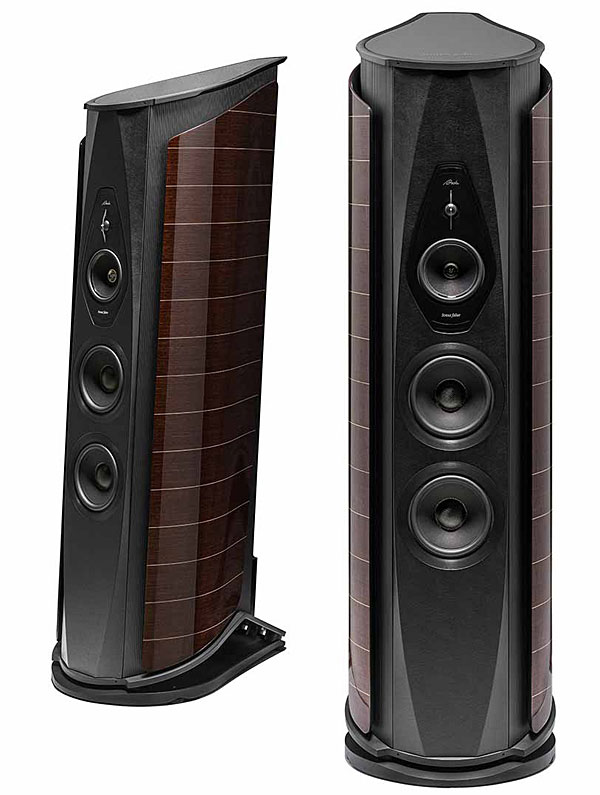
The revised Aida costs $130,000/pair, and pictures in a magazine or online don't well communicate its size or dramatic styling. It's big—5' 8" tall by 18.9" wide by 30.7" deep—and graceful looking, and in a modest-sized listening room a pair of them seem even larger, almost comically so for the space. I shot a video of their installation here and posted it to YouTube—where you can read the comments of skeptics who can't imagine that these speakers and my room could possibly work together.
Externally, the 364-lb, "3 and 2/3 way," multi-driver Aida is indistinguishable from the original, which was launched in 2011. It's available in Sonus Faber's new Wenge finish, in addition to the familiar Red. Both feature inlays of maple and glossy, hand-polished surfaces, and Sonus Faber's snazzy combination of black leather, gleaming metalwork, and their unique, top-to-bottom, stretchy stringy, licorice harp thing.
 Inside, the Aida is entirely new, including the drivers, which have neodymium magnets and were designed by Sonus Faber, then built to their specifications.
Some speaker makers—eg, Wilson Audio Specialties, YG Acoustics, Magico—seek to heroically eliminate cabinet colorations and resonances altogether. Sonus Faber has long advocated "tuning" their speaker cabinets by combining materials of different resonances. However, it's not accurate to say that SF views its loudspeakers as "musical instruments," though of course they're "tuned."
A photo on Sonus Faber's website shows an Aida II under construction. The inner cabinet is a curved structure of leather-clad wood in which at least five chambers are created by cross-braces, a few of them wedge-shaped to direct rear-radiated energy to the Aida's various ports. To those who use metal and composites to eliminate resonances, the Aida's innards probably look old-school—but the proof is in the listening and, to a lesser degree, the measuring.
Inside, the Aida is entirely new, including the drivers, which have neodymium magnets and were designed by Sonus Faber, then built to their specifications.
Some speaker makers—eg, Wilson Audio Specialties, YG Acoustics, Magico—seek to heroically eliminate cabinet colorations and resonances altogether. Sonus Faber has long advocated "tuning" their speaker cabinets by combining materials of different resonances. However, it's not accurate to say that SF views its loudspeakers as "musical instruments," though of course they're "tuned."
A photo on Sonus Faber's website shows an Aida II under construction. The inner cabinet is a curved structure of leather-clad wood in which at least five chambers are created by cross-braces, a few of them wedge-shaped to direct rear-radiated energy to the Aida's various ports. To those who use metal and composites to eliminate resonances, the Aida's innards probably look old-school—but the proof is in the listening and, to a lesser degree, the measuring.
 Mounted on the Aida's gently sloped baffle is the Voice of Sonus Faber: a tweeter-and-midrange module comprising a 1.1" (28mm) XTR-4 silk-dome Damped Apex Dome (DAD) Arrow-Point tweeter and a 7.1" (180mm) XTR-04 midrange unit with a cellulose-pulp cone. A vertical bracket holds a small damping pad against the tweeter dome's apex, to optimize top-octave dispersion. Both drivers are decoupled from the main baffle, the tweeter's rear wave loading into a natural wood "acoustic labyrinth."
Below this module are two 8.7" (220mm) W22XTR-12 woofers with neodymium magnets. Not visible is a downfiring 12.6" (320mm) SW32XTR-08 long-throw subwoofer featuring a Nano Carbon sandwich cone and a 4" voice-coil. Also not visible from the front is the Sound Field Shaper, a rear-firing, ported, midrange-tweeter-midrange array, comprising a 1.1" (29mm) silk-dome XTR2 DAD tweeter and two M8XTR 3.15" (80mm) midrange units. The Aidas are handed: the axes of the Sound Field Shaper drivers are offset from those of the front-firing drivers, so by swapping the left and right speakers, the user can opt to have the rear-firing arrays angled in toward the center of the stage or out toward the side walls. Sonus Faber suggests angling the Sound Field Shapers in when the Aidas are placed close to sidewalls, and out when the speakers are at least 2m from the sidewalls.
The Aida's massive cabinet is affixed to an arched pedestal, made of aluminum. This is designed to provide clearance for the output of the downfiring subwoofer, and the zero Vibration Transmission system decouples the cabinet from the floor with springs and elastomers, their compliances carefully calculated based on the speaker's weight.
Also used here, as in some previous big floorstanders from Sonus Faber, are their Tuned Mass Dampers (TMD)—a series of weights suspended inside the cabinet, and designed to vibrate in antiphase to "erase" cabinet vibrations. SF says that this system helps produce clearer bass and increased "cabinet silence."
Sonus Faber's patented Stealth Ultraflex para-aperiodic venting system is claimed to reduce total harmonic distortion (THD) while improving bass extension and eliminating vibrations created by the flow of air through the reflex port. The design is also said to have made possible a smaller enclosure. Also used here is SF's Anima Legata system, which features a cabinet-stiffening, "vibration collecting metal rod, here running between the speaker's upper and lower-middle inner chambers.
Mounted on the Aida's gently sloped baffle is the Voice of Sonus Faber: a tweeter-and-midrange module comprising a 1.1" (28mm) XTR-4 silk-dome Damped Apex Dome (DAD) Arrow-Point tweeter and a 7.1" (180mm) XTR-04 midrange unit with a cellulose-pulp cone. A vertical bracket holds a small damping pad against the tweeter dome's apex, to optimize top-octave dispersion. Both drivers are decoupled from the main baffle, the tweeter's rear wave loading into a natural wood "acoustic labyrinth."
Below this module are two 8.7" (220mm) W22XTR-12 woofers with neodymium magnets. Not visible is a downfiring 12.6" (320mm) SW32XTR-08 long-throw subwoofer featuring a Nano Carbon sandwich cone and a 4" voice-coil. Also not visible from the front is the Sound Field Shaper, a rear-firing, ported, midrange-tweeter-midrange array, comprising a 1.1" (29mm) silk-dome XTR2 DAD tweeter and two M8XTR 3.15" (80mm) midrange units. The Aidas are handed: the axes of the Sound Field Shaper drivers are offset from those of the front-firing drivers, so by swapping the left and right speakers, the user can opt to have the rear-firing arrays angled in toward the center of the stage or out toward the side walls. Sonus Faber suggests angling the Sound Field Shapers in when the Aidas are placed close to sidewalls, and out when the speakers are at least 2m from the sidewalls.
The Aida's massive cabinet is affixed to an arched pedestal, made of aluminum. This is designed to provide clearance for the output of the downfiring subwoofer, and the zero Vibration Transmission system decouples the cabinet from the floor with springs and elastomers, their compliances carefully calculated based on the speaker's weight.
Also used here, as in some previous big floorstanders from Sonus Faber, are their Tuned Mass Dampers (TMD)—a series of weights suspended inside the cabinet, and designed to vibrate in antiphase to "erase" cabinet vibrations. SF says that this system helps produce clearer bass and increased "cabinet silence."
Sonus Faber's patented Stealth Ultraflex para-aperiodic venting system is claimed to reduce total harmonic distortion (THD) while improving bass extension and eliminating vibrations created by the flow of air through the reflex port. The design is also said to have made possible a smaller enclosure. Also used here is SF's Anima Legata system, which features a cabinet-stiffening, "vibration collecting metal rod, here running between the speaker's upper and lower-middle inner chambers.
The revised Aida costs $130,000/pair, and pictures in a magazine or online don't well communicate its size or dramatic styling. It's big—5' 8" tall by 18.9" wide by 30.7" deep—and graceful looking, and in a modest-sized listening room a pair of them seem even larger, almost comically so for the space. I shot a video of their installation here and posted it to YouTube—where you can read the comments of skeptics who can't imagine that these speakers and my room could possibly work together.
Inside, the Aida is entirely new, including the drivers, which have neodymium magnets and were designed by Sonus Faber, then built to their specifications.
Some speaker makers—eg, Wilson Audio Specialties, YG Acoustics, Magico—seek to heroically eliminate cabinet colorations and resonances altogether. Sonus Faber has long advocated "tuning" their speaker cabinets by combining materials of different resonances. However, it's not accurate to say that SF views its loudspeakers as "musical instruments," though of course they're "tuned."
Mounted on the Aida's gently sloped baffle is the Voice of Sonus Faber: a tweeter-and-midrange module comprising a 1.1" (28mm) XTR-4 silk-dome Damped Apex Dome (DAD) Arrow-Point tweeter and a 7.1" (180mm) XTR-04 midrange unit with a cellulose-pulp cone. A vertical bracket holds a small damping pad against the tweeter dome's apex, to optimize top-octave dispersion. Both drivers are decoupled from the main baffle, the tweeter's rear wave loading into a natural wood "acoustic labyrinth."
Below this module are two 8.7" (220mm) W22XTR-12 woofers with neodymium magnets. Not visible is a downfiring 12.6" (320mm) SW32XTR-08 long-throw subwoofer featuring a Nano Carbon sandwich cone and a 4" voice-coil. Also not visible from the front is the Sound Field Shaper, a rear-firing, ported, midrange-tweeter-midrange array, comprising a 1.1" (29mm) silk-dome XTR2 DAD tweeter and two M8XTR 3.15" (80mm) midrange units. The Aidas are handed: the axes of the Sound Field Shaper drivers are offset from those of the front-firing drivers, so by swapping the left and right speakers, the user can opt to have the rear-firing arrays angled in toward the center of the stage or out toward the side walls. Sonus Faber suggests angling the Sound Field Shapers in when the Aidas are placed close to sidewalls, and out when the speakers are at least 2m from the sidewalls.















