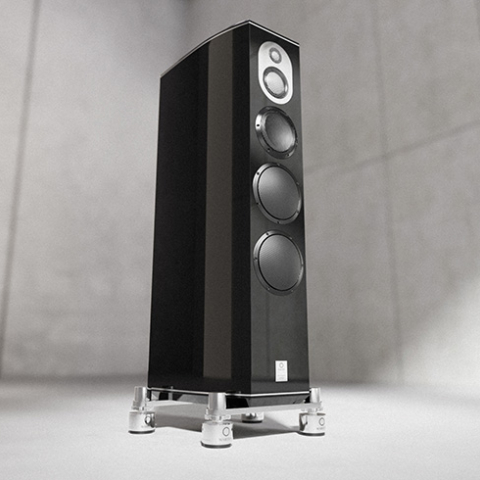
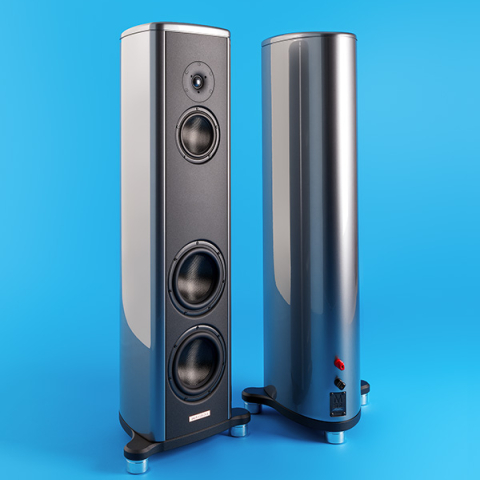
In addition to the Sound Field Shaper MTM array, the Aida II's rear panel includes three potentiometers for adjusting the output levels of various drivers: High for the front tweeter, Low Damp for the subwoofer, and Depth for the Sound Field Shaper.
Each Aida II has three pairs of binding posts and is thus tri-ampable, but I used the included jumpers and single pairs of TARA Labs Omega Evolution SP speaker cables.
There's more to this complex design, and especially to the design and construction of the drivers, but that's enough for the purposes of this review, other than Sonus Faber's basic specifications: a frequency range of 18Hz–35kHz, a sensitivity of 92dB/2.83V/m, a nominal impedance of 4 ohms, and crossover frequencies of 55, 150, 200, and 3000Hz.
 A Bit of Background
Paolo Tezzon, Sonus Faber's head of R&D, has been the company's chief designer since 2006, when founder Franco Serblin left the company (he died in 2013). Tezzon is responsible for the sound, while Livio Cucuzza handles industrial design, at Sonus Faber as well as at Audio Research and sometime McIntosh. Like most gifted speaker designers, Tezzon has created some hits and a few misses. I'm steeped in Sonus Faber. In 1999 I bought a pair of original, pre-Tezzon Sonus Faber Amati Homage speakers, and since then have reviewed numerous SF models. I've visited the factory at least four times. In fact, I turned down an invitation for another visit in preparation for this review. Turning down any trip to Italy is crazy, but I didn't feel the need to see the factory again (footnote 1). As Advertised: "Limitless Immersion"
The Wilson Alexxes were rolled out and the Sonus Fabers were wheeled in—the installers positioned the Aidas and adjusted each speaker's three level knobs. I listened.
 Immediately, I noticed that the Alexxes' intense three-dimensional imaging and image specificity had been replaced by slightly more diffuse, less-well-focused images, mitigated in great part by the immensity of the soundstage in every direction: width, height, and especially depth.
The soundstage was not only huge, it was properly proportioned, in part because the setup guys knew how to correctly adjust the Sound Field Shaper's Depth control—which obviously affected more than just the depth dimension. And the imaging was better than fine: sufficiently well-focused, and correctly sized for the generous picture. The Aidas worked perfectly well in my relatively modestly sized room.
Once I'd grown accustomed to the Aidas' spectacular reproduction of space—the first thing that hit me and every visitor—I realized that their overall frequency response must be among the flattest and most full-range of any speaker I've reviewed in this room. So much inner detail and delicacy was easily revealed by the Voice of Sonus Faber module, with all its renowned delicacy, warmth, timbral, and textural richness intact, but minus some of the much older speakers' top-end politeness and overly velvet transients—at least according to some listeners.
The Aida's reproduction of the upper octaves was ideal: neither bright and tizzy nor recessed and in need of sparkle. That's why it was possible to switch from Beethoven's Ninth directly to Bob Ludwig's noncompressed version of "Whole Lotta Love"—which has among the most spectacular cymbal strokes on a rock record—and not have to make excuses. The cymbal attacks were as clean, precise, metallic, and properly aggressive as any rocker might want, with generous sustain and ideal decay.
Immediately, I noticed that the Alexxes' intense three-dimensional imaging and image specificity had been replaced by slightly more diffuse, less-well-focused images, mitigated in great part by the immensity of the soundstage in every direction: width, height, and especially depth.
The soundstage was not only huge, it was properly proportioned, in part because the setup guys knew how to correctly adjust the Sound Field Shaper's Depth control—which obviously affected more than just the depth dimension. And the imaging was better than fine: sufficiently well-focused, and correctly sized for the generous picture. The Aidas worked perfectly well in my relatively modestly sized room.
Once I'd grown accustomed to the Aidas' spectacular reproduction of space—the first thing that hit me and every visitor—I realized that their overall frequency response must be among the flattest and most full-range of any speaker I've reviewed in this room. So much inner detail and delicacy was easily revealed by the Voice of Sonus Faber module, with all its renowned delicacy, warmth, timbral, and textural richness intact, but minus some of the much older speakers' top-end politeness and overly velvet transients—at least according to some listeners.
The Aida's reproduction of the upper octaves was ideal: neither bright and tizzy nor recessed and in need of sparkle. That's why it was possible to switch from Beethoven's Ninth directly to Bob Ludwig's noncompressed version of "Whole Lotta Love"—which has among the most spectacular cymbal strokes on a rock record—and not have to make excuses. The cymbal attacks were as clean, precise, metallic, and properly aggressive as any rocker might want, with generous sustain and ideal decay.
 If you really want to drop dead with pleasure, as in Records to Die For, listen through the Aidas to Herbert Downes and Jacqueline Du Pré's Music for Viola and Cello (LP, Parlophone CSD 1499/Electric Recording Company ERC 028), preferably while gazing at a photo of Du Pré. This 1963 recording includes a performance of Vaughan Williams's Fantasia on "Greensleeves," with harp accompaniment, that might stop your heart, and a Bach-Gounod "Ave Maria" with deep organ notes that also might do the trick. And if they don't, maybe the price will—only 300 copies have been pressed, at ú500 each. But an original will cost you considerably more.
Du Pré's cello sat between the speakers, appropriately warm, sheen-y, and three-dimensional, while the harp, at stage left, had true, precise transient attacks and was not at all soft or over-romantic.
My go-to record for transient clarity and attack precision is John Renbourn's Sir John Alot of Merrie Englandes Musyk Thyng & ye Grene Knyghte (UK LP, Transatlantic TRA 167). Don't bother with the US edition on Reprise, which has added reverb that ruins everything. Renbourn's acoustic guitar is accompanied by Terry Cox's finger cymbals, African drums and glockenspiel, and Ray Warleigh's flute, all recorded by John Wood at Sound Techniques. (I tried to get an interview with Wood when the recordings he made with Nick Drake for Island were reissued, but he insisted that he'd have nothing interesting to say. No enticement worked.)
If you really want to drop dead with pleasure, as in Records to Die For, listen through the Aidas to Herbert Downes and Jacqueline Du Pré's Music for Viola and Cello (LP, Parlophone CSD 1499/Electric Recording Company ERC 028), preferably while gazing at a photo of Du Pré. This 1963 recording includes a performance of Vaughan Williams's Fantasia on "Greensleeves," with harp accompaniment, that might stop your heart, and a Bach-Gounod "Ave Maria" with deep organ notes that also might do the trick. And if they don't, maybe the price will—only 300 copies have been pressed, at ú500 each. But an original will cost you considerably more.
Du Pré's cello sat between the speakers, appropriately warm, sheen-y, and three-dimensional, while the harp, at stage left, had true, precise transient attacks and was not at all soft or over-romantic.
My go-to record for transient clarity and attack precision is John Renbourn's Sir John Alot of Merrie Englandes Musyk Thyng & ye Grene Knyghte (UK LP, Transatlantic TRA 167). Don't bother with the US edition on Reprise, which has added reverb that ruins everything. Renbourn's acoustic guitar is accompanied by Terry Cox's finger cymbals, African drums and glockenspiel, and Ray Warleigh's flute, all recorded by John Wood at Sound Techniques. (I tried to get an interview with Wood when the recordings he made with Nick Drake for Island were reissued, but he insisted that he'd have nothing interesting to say. No enticement worked.)
 The Aida revealed everything you'd want to hear from this intimately recorded sonic gem: the precise attacks of Renbourn's guitar, the ringing transparency of the finger-cymbal attacks and sustains, the delicate texture of the drum skin that, to sound correct, must be neither too hard and cardboardy nor too soft and lacking in skin tone.
I can't imagine that any listener would find the Aida too laid-back or too aggressive, though of course associated equipment always plays a big role in a system's sound. What I heard was smooth in the best sense of the word, and not at all smoothed over.
The Aida revealed everything you'd want to hear from this intimately recorded sonic gem: the precise attacks of Renbourn's guitar, the ringing transparency of the finger-cymbal attacks and sustains, the delicate texture of the drum skin that, to sound correct, must be neither too hard and cardboardy nor too soft and lacking in skin tone.
I can't imagine that any listener would find the Aida too laid-back or too aggressive, though of course associated equipment always plays a big role in a system's sound. What I heard was smooth in the best sense of the word, and not at all smoothed over.
 No doubt my room's bass bump at around 50Hz, with a suckout between 60 and 110Hz, will show up in John Atkinson's measurements, and those who can't distinguish what they see from what they hear will "see" the bump as "boomy bass"—but what I hear in this room from well-designed speakers is deep, authoritative bass from recordings that contain such information, with no perceivable overhang. Or, as the late Siegfried Linkwitz (of Linkwitz-Riley crossover fame) recently said to me, "You get cues from the eye, but some things that look gross in the frequency response, the ear says, 'I don't care'." The Aida 's bottom end was fast, powerful, deep, and unobtrusive—it appeared only when summoned by the recording, and never during the entire listening period did it appear as "bass." It was always attached to the music, never stuck in the box.
For $130,000/pair you should get full bottom-end response delivered powerfully, without compression or mechanical aftertaste, and with a sensation of ease. The Aida did that. For electric bass, try Jaco Pastorius (LP, Epic EK 33949/ORG 114); for acoustic double bass, Ray Brown's Soular Energy (two 45rpm, 200gm LPs, Concord Jazz 4468/Analogue Productions AAPJ 268-45).
But the real bass success for this speaker happened at the bottom of the Ninth. (Haw.) Not all that conversant with classical-music terminology, I did an online search to find the best way to describe what I'm talking about. What came up was fart. That's the word British conductor Roger Norrington (now 84) used to describe a passage near the end of this symphony, just after the choir envisions God: an intervention by two bassoons, contrabassoon, and bass drum, at a new tempo and on the wrong beat of the bar, in the wrong key.
The Aidas' reproduction of this passage was as vividly believable as it was incredible. What did I just hear? I thought. How can a speaker manage that? The bass drum's tight definition, extension, and power, plus its positioning in three-dimensional space—the way it just appeared was a sensational experience, the first time and every time I played it—which was often. I played it for the Sonus Faber guys and for John Atkinson, but neither said nor telegraphed anything about what they were about to hear. John's first comment was about that bass drum and Beethoven's musical fart, that he had never heard the positioning of the instruments in the surrounding space so clearly resolved.
After the Aidas' departure, I reinstalled the Wilson Audio Alexxes and played Rattle's recording of the Ninth. I knew the soundstage wouldn't be quite as immense—I'd already given that up by swapping in the Alexxes for Wilson's Alexandria XLFs, which had indeed produced soundscapes of similarly grand size, to get the Alexxes' better bass and more transparent midrange—but I didn't expect to be so thoroughly disappointed by the far less visceral attack and loss of definition of the bass drum. It was a serious and surprising letdown—and I love the Alexxes.
Conclusions: All Romance Is Gone
No doubt my room's bass bump at around 50Hz, with a suckout between 60 and 110Hz, will show up in John Atkinson's measurements, and those who can't distinguish what they see from what they hear will "see" the bump as "boomy bass"—but what I hear in this room from well-designed speakers is deep, authoritative bass from recordings that contain such information, with no perceivable overhang. Or, as the late Siegfried Linkwitz (of Linkwitz-Riley crossover fame) recently said to me, "You get cues from the eye, but some things that look gross in the frequency response, the ear says, 'I don't care'." The Aida 's bottom end was fast, powerful, deep, and unobtrusive—it appeared only when summoned by the recording, and never during the entire listening period did it appear as "bass." It was always attached to the music, never stuck in the box.
For $130,000/pair you should get full bottom-end response delivered powerfully, without compression or mechanical aftertaste, and with a sensation of ease. The Aida did that. For electric bass, try Jaco Pastorius (LP, Epic EK 33949/ORG 114); for acoustic double bass, Ray Brown's Soular Energy (two 45rpm, 200gm LPs, Concord Jazz 4468/Analogue Productions AAPJ 268-45).
But the real bass success for this speaker happened at the bottom of the Ninth. (Haw.) Not all that conversant with classical-music terminology, I did an online search to find the best way to describe what I'm talking about. What came up was fart. That's the word British conductor Roger Norrington (now 84) used to describe a passage near the end of this symphony, just after the choir envisions God: an intervention by two bassoons, contrabassoon, and bass drum, at a new tempo and on the wrong beat of the bar, in the wrong key.
The Aidas' reproduction of this passage was as vividly believable as it was incredible. What did I just hear? I thought. How can a speaker manage that? The bass drum's tight definition, extension, and power, plus its positioning in three-dimensional space—the way it just appeared was a sensational experience, the first time and every time I played it—which was often. I played it for the Sonus Faber guys and for John Atkinson, but neither said nor telegraphed anything about what they were about to hear. John's first comment was about that bass drum and Beethoven's musical fart, that he had never heard the positioning of the instruments in the surrounding space so clearly resolved.
After the Aidas' departure, I reinstalled the Wilson Audio Alexxes and played Rattle's recording of the Ninth. I knew the soundstage wouldn't be quite as immense—I'd already given that up by swapping in the Alexxes for Wilson's Alexandria XLFs, which had indeed produced soundscapes of similarly grand size, to get the Alexxes' better bass and more transparent midrange—but I didn't expect to be so thoroughly disappointed by the far less visceral attack and loss of definition of the bass drum. It was a serious and surprising letdown—and I love the Alexxes.
Conclusions: All Romance Is Gone
The new Aida is Paolo Tezzon's most brilliant and meticulously crafted design.
Rightly or wrongly, many audio enthusiasts associate Sonus Faber speakers with a "romantic" sound, and thus feel that they're better suited to acoustic music, especially classical. That's probably more true of the company's stand-mounted than its floorstanding models. But after reviewing the original Amati Homage in June 1999, I bought a pair—and I listen to a lot of rock. I experienced no problems with rock through the Amati Homages.
In that review I described the Amati Homage's sound as being "more emotionally and physically alive" than I'd been used to hearing, and I was enticed by its ability to express "tiny volume modulations, subtle nuances of amplitude phrasing I had never been aware of."
 In his Measurements section, JA wrote: "While some of the Amati Homage's measurements are excellent, there is nothing to indicate why Michael Fremer was so enamored of the speaker's sound. Indeed, some of the measurements, such as of the speaker's bass performance, raise more questions than they answer."
I didn't take that last line seriously until, shortly after buying the Amati Homages, I moved to where I now live. I simply could not get them to work in my new room. I don't know why, but the bass was weak—as if I'd spent all that money on a small two-way speaker.
Here, in the same room, Sonus Faber's new Aida produced some of the best low-frequency response I've heard—much like that of Marten's Coltrane III, which made me realize how much better my room's bass could be than what I'd been getting from the Wilson Alexandria XLF. The Wilson Alexx fixed that. And now the Aida II—which costs 6.5 times the price of the Amati Homage in 1999—fixes it even better.
The rest of what the Aida does—especially its ability to perfectly hang together without ever revealing a sonic seam (an amazing design feat, considering its considerable complexity), and how well it performed with every type of music I played, or against any checklist of sonic parameters you might come up with—produced the kind of sonic thrills and solid, believable musical performance to which $130,000 entitles you. And my experience tells me that you needn't fear putting a pair of them in a room of relatively modest size.
Paolo Tezzon has produced a masterpiece of a loudspeaker that both honors Sonus Faber's glorious past and moves it confidently into the future. This lady isn't fat, but she sure can sing!
In his Measurements section, JA wrote: "While some of the Amati Homage's measurements are excellent, there is nothing to indicate why Michael Fremer was so enamored of the speaker's sound. Indeed, some of the measurements, such as of the speaker's bass performance, raise more questions than they answer."
I didn't take that last line seriously until, shortly after buying the Amati Homages, I moved to where I now live. I simply could not get them to work in my new room. I don't know why, but the bass was weak—as if I'd spent all that money on a small two-way speaker.
Here, in the same room, Sonus Faber's new Aida produced some of the best low-frequency response I've heard—much like that of Marten's Coltrane III, which made me realize how much better my room's bass could be than what I'd been getting from the Wilson Alexandria XLF. The Wilson Alexx fixed that. And now the Aida II—which costs 6.5 times the price of the Amati Homage in 1999—fixes it even better.
The rest of what the Aida does—especially its ability to perfectly hang together without ever revealing a sonic seam (an amazing design feat, considering its considerable complexity), and how well it performed with every type of music I played, or against any checklist of sonic parameters you might come up with—produced the kind of sonic thrills and solid, believable musical performance to which $130,000 entitles you. And my experience tells me that you needn't fear putting a pair of them in a room of relatively modest size.
Paolo Tezzon has produced a masterpiece of a loudspeaker that both honors Sonus Faber's glorious past and moves it confidently into the future. This lady isn't fat, but she sure can sing!
Footnote 1: During one such visit, to hear the limited-edition Ex3ma speaker, designed to celebrate Sonus Faber's 30th anniversary, I was asked by then-CEO Mauro Grange to pick up a sledgehammer and help him destroy a carbon-fiber mold.
A Bit of BackgroundPaolo Tezzon, Sonus Faber's head of R&D, has been the company's chief designer since 2006, when founder Franco Serblin left the company (he died in 2013). Tezzon is responsible for the sound, while Livio Cucuzza handles industrial design, at Sonus Faber as well as at Audio Research and sometime McIntosh. Like most gifted speaker designers, Tezzon has created some hits and a few misses. I'm steeped in Sonus Faber. In 1999 I bought a pair of original, pre-Tezzon Sonus Faber Amati Homage speakers, and since then have reviewed numerous SF models. I've visited the factory at least four times. In fact, I turned down an invitation for another visit in preparation for this review. Turning down any trip to Italy is crazy, but I didn't feel the need to see the factory again (footnote 1). As Advertised: "Limitless Immersion"
The Wilson Alexxes were rolled out and the Sonus Fabers were wheeled in—the installers positioned the Aidas and adjusted each speaker's three level knobs. I listened.
Immediately, I noticed that the Alexxes' intense three-dimensional imaging and image specificity had been replaced by slightly more diffuse, less-well-focused images, mitigated in great part by the immensity of the soundstage in every direction: width, height, and especially depth.
The soundstage was not only huge, it was properly proportioned, in part because the setup guys knew how to correctly adjust the Sound Field Shaper's Depth control—which obviously affected more than just the depth dimension. And the imaging was better than fine: sufficiently well-focused, and correctly sized for the generous picture. The Aidas worked perfectly well in my relatively modestly sized room.
Once I'd grown accustomed to the Aidas' spectacular reproduction of space—the first thing that hit me and every visitor—I realized that their overall frequency response must be among the flattest and most full-range of any speaker I've reviewed in this room. So much inner detail and delicacy was easily revealed by the Voice of Sonus Faber module, with all its renowned delicacy, warmth, timbral, and textural richness intact, but minus some of the much older speakers' top-end politeness and overly velvet transients—at least according to some listeners.
If you really want to drop dead with pleasure, as in Records to Die For, listen through the Aidas to Herbert Downes and Jacqueline Du Pré's Music for Viola and Cello (LP, Parlophone CSD 1499/Electric Recording Company ERC 028), preferably while gazing at a photo of Du Pré. This 1963 recording includes a performance of Vaughan Williams's Fantasia on "Greensleeves," with harp accompaniment, that might stop your heart, and a Bach-Gounod "Ave Maria" with deep organ notes that also might do the trick. And if they don't, maybe the price will—only 300 copies have been pressed, at ú500 each. But an original will cost you considerably more.
Du Pré's cello sat between the speakers, appropriately warm, sheen-y, and three-dimensional, while the harp, at stage left, had true, precise transient attacks and was not at all soft or over-romantic.
The Aida revealed everything you'd want to hear from this intimately recorded sonic gem: the precise attacks of Renbourn's guitar, the ringing transparency of the finger-cymbal attacks and sustains, the delicate texture of the drum skin that, to sound correct, must be neither too hard and cardboardy nor too soft and lacking in skin tone.
I can't imagine that any listener would find the Aida too laid-back or too aggressive, though of course associated equipment always plays a big role in a system's sound. What I heard was smooth in the best sense of the word, and not at all smoothed over.
No doubt my room's bass bump at around 50Hz, with a suckout between 60 and 110Hz, will show up in John Atkinson's measurements, and those who can't distinguish what they see from what they hear will "see" the bump as "boomy bass"—but what I hear in this room from well-designed speakers is deep, authoritative bass from recordings that contain such information, with no perceivable overhang. Or, as the late Siegfried Linkwitz (of Linkwitz-Riley crossover fame) recently said to me, "You get cues from the eye, but some things that look gross in the frequency response, the ear says, 'I don't care'." The Aida 's bottom end was fast, powerful, deep, and unobtrusive—it appeared only when summoned by the recording, and never during the entire listening period did it appear as "bass." It was always attached to the music, never stuck in the box.
For $130,000/pair you should get full bottom-end response delivered powerfully, without compression or mechanical aftertaste, and with a sensation of ease. The Aida did that. For electric bass, try Jaco Pastorius (LP, Epic EK 33949/ORG 114); for acoustic double bass, Ray Brown's Soular Energy (two 45rpm, 200gm LPs, Concord Jazz 4468/Analogue Productions AAPJ 268-45).
But the real bass success for this speaker happened at the bottom of the Ninth. (Haw.) Not all that conversant with classical-music terminology, I did an online search to find the best way to describe what I'm talking about. What came up was fart. That's the word British conductor Roger Norrington (now 84) used to describe a passage near the end of this symphony, just after the choir envisions God: an intervention by two bassoons, contrabassoon, and bass drum, at a new tempo and on the wrong beat of the bar, in the wrong key.
The new Aida is Paolo Tezzon's most brilliant and meticulously crafted design.
In his Measurements section, JA wrote: "While some of the Amati Homage's measurements are excellent, there is nothing to indicate why Michael Fremer was so enamored of the speaker's sound. Indeed, some of the measurements, such as of the speaker's bass performance, raise more questions than they answer."
Footnote 1: During one such visit, to hear the limited-edition Ex3ma speaker, designed to celebrate Sonus Faber's 30th anniversary, I was asked by then-CEO Mauro Grange to pick up a sledgehammer and help him destroy a carbon-fiber mold.