Sidebar 3: Measurements
As the Aida weighs a backbreaking 364 lb, I drove my test gear to Mikey Fremer's place to measure the speakers in situ. After I'd done the in-room measurements, my plan was to perform the quasi-anechoic measurements in Mikey's driveway. Sonus Faber's reps had placed one of the speakers on a wheeled dolly and rolled it from the listening room to the garage. However, for the first day in weeks, it was raining, and with no end to the downpour in sight, I ended up measuring the Aida in the garage with the door open. I could position the speaker well away from the sidewalls, but reflections of its output from the ceiling and floor limited the anechoic time window used for the analysis to 3ms, which reduces the measurements' resolution in the midrange. I didn't measure the Aida's output to its rear, but the High, Low, and Depth controls were left set to the positions MF had used.
As usual, I used DRA Labs' MLSSA system and a calibrated DPA 4006 microphone to measure the Sonus Faber Aida's frequency response in the farfield, and an Earthworks QTC-40 for the nearfield and spatially averaged room responses. The Aida's voltage sensitivity is specified as 92dB/2.83V/m; my B-weighted estimate was a little lower, at 90.5dB/2.83V/m, but this is still high. Specified as a nominal 4 ohm load, the Sonus Faber's impedance remains below 6 ohms over the entire audioband (fig.1), with minimum magnitudes of 2.23 ohms at 35Hz and 2.33 ohms between 11.3 and 14kHz. Although the electrical phase angle remains low, the Aida will need to be partnered with an amplifier capable of supplying a lot of current.
The traces in fig.1 are free from the small wrinkles that would imply the presence of cabinet-wall resonances, but when I reached for my accelerometer to investigate the enclosure's vibrational behavior, I found that its preamplifier wasn't working—and my tool kit was 45 miles away. I listened to the enclosure with a stethoscope while it played pink noise and found it relatively inert.
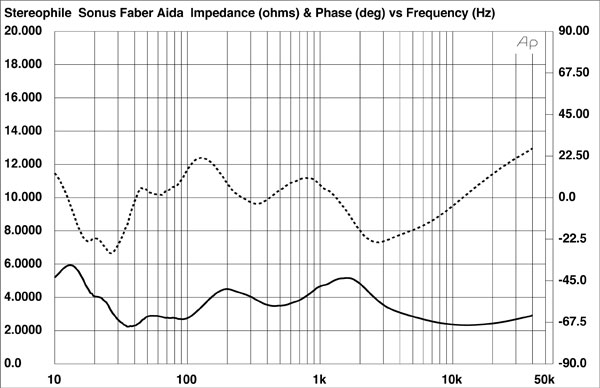
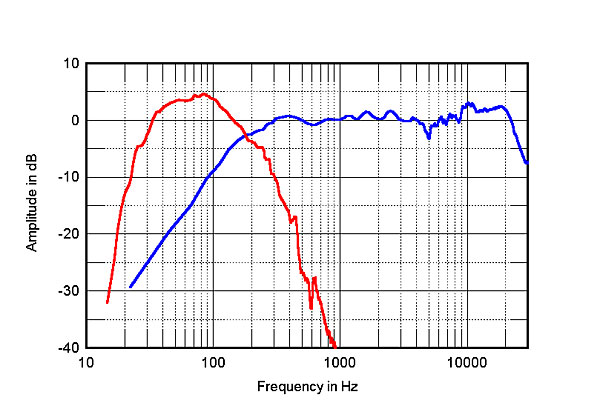


Fig.1 Sonus Faber Aida, electrical impedance (solid) and phase (dashed) (2 ohms/vertical div.).
The impedance traces are difficult to interpret with respect to the tuning of the woofers and subwoofer. In addition, there is always the possibility of crosstalk between the low-frequency radiators when I perform nearfield measurements. Nevertheless, there was a null at 33Hz in the front-facing woofers' nearfield responses, which suggests that this is the tuning frequency of the two vertical slot ports on the enclosure's rear. The woofers themselves have slightly different responses, the lower woofer rolling off a little earlier in the midrange than the upper. The complex sum of the outputs of the two woofers and their ports, measured in the nearfield and taking into account acoustic phase and the different distances from a nominal farfield microphone position, is shown in fig.2 (red trace). It peaks broadly between 30 and 120Hz, and the upper-frequency rolloff is free from any resonant spikes. I haven't shown in this graph the nearfield output of the downward-firing subwoofer—it was undoubtedly affected by crosstalk from the front-firing woofers—but it appears to reinforce the Aida's low-frequency response to a true 20Hz.
Fig.2 Sonus Faber Aida, anechoic response of midrange unit and tweeter averaged across 30° horizontal window centered on tweeter axis at 50" and corrected for microphone response (blue), with nearfield response of midrange unit (blue) and complex sum of nearfield responses of front-firing woofers and their ports (red), respectively plotted below 300Hz and 900Hz.
The blue trace below 300Hz in fig.2 shows the nearfield output of the midrange unit; above that frequency, it shows the farfield response of the midrange unit and tweeter averaged across a 30° horizontal window centered on the listening axis. The Sonus Faber's response is impressively flat, other than a small plateau in energy in the top octave. As shown by the plot of the Aida's lateral dispersion, normalized to the tweeter-axis response (fig.3), this plateau will compensate for the fact that the tweeter starts to become directional above 7kHz, which would otherwise make the speaker sound a bit lacking in top-octave air in large or overdamped rooms. In the vertical plane (fig.4), the Aida maintains its even tweeter-axis response for up to 10° below that axis, which is just as well given that the tweeter is 48" above the ground.
Fig.3 Sonus Faber Aida, lateral response family at 50", normalized to response on tweeter axis, from back to front: differences in response 90–5° off axis, reference response, differences in response 5–90° off axis.
Fig.4 Sonus Faber Aida, vertical response family at 50", normalized to response on tweeter axis, from back to front: differences in response 15–5° above axis, reference response, differences in response 5–10° below axis.
MF's reference is the Wilson Audio Alexx, which he reviewed in May 2017. Fig.5 compares the spatially averaged response in his room of the Sonus Fabers (red trace) and the Wilsons (blue). (The traces were generated by averaging 20 1/6-octave–smoothed spectra, taken for the left and right speakers individually using SMUGSoftware's FuzzMeasure 3.0 program and a 96kHz sample rate, in a vertical rectangular grid 36" wide by 18" high and centered on the positions of MF's ears.) The two speakers appear to have broadly similar responses below 300Hz, where the spatial averaging has not eliminated major room-acoustic issues. Both speakers offer effective output to 20Hz, but the Wilsons have a little more output below 20Hz, if that matters. The Sonus Fabers have a little more midrange energy than the Wilsons and a little less presence-region energy, but of more subjective significance is how smooth and even the Aida's in-room response is throughout the midrange and treble. The output smoothly slopes down by about 5dB from 400Hz to 18kHz, which is almost exactly the in-room behavior you need from a pair of speakers for them to sound flat. Certainly in my own auditioning of the Aidas when I visited Mikey, the sound quality was as superb as this graph implies. Incidentally, the individual measured responses of the left and right speakers at the listening position indicated superb pair matching, the two outputs matching within 0.5dB from 600Hz to 8kHz.
Fig.5 Sonus Faber Aida, spatially averaged, 1/6 -octave response in MF's listening room (red); and of Wilson Audio Alexx (blue).
In the time domain, the Aida's step response on the tweeter axis is shown in fig.6; it reveals that the tweeter and midrange unit are connected in positive acoustic polarity, with the tweeter's output arriving at the microphone before that of the woofer. The woofers are all connected in inverted acoustic polarity, but the beginning of their step is smoothly integrated with the decay of the midrange step, implying optimal crossover implementation. The same is true for the time-domain integration of the tweeter and midrange outputs. The Sonus Faber's cumulative spectral-decay plot is very clean (fig.7).
Fig.6 Sonus Faber Aida, step response on tweeter axis at 50" (5ms time window, 30kHz bandwidth).
Fig.7 Sonus Faber Aida, cumulative spectral-decay plot on tweeter axis at 50" (0.15ms risetime).
The excellent measured performance of Sonus Faber's Aida indicates that some serious engineering talent was involved in its design.—John Atkinson