Sidebar 3: Measurements
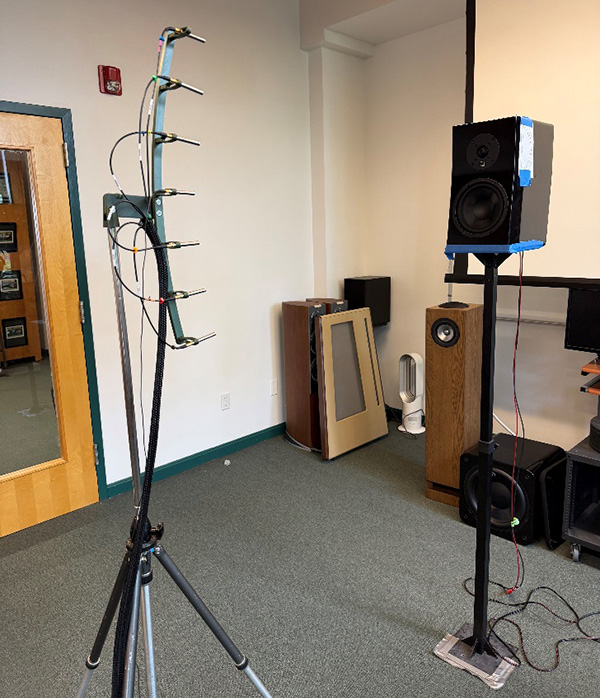
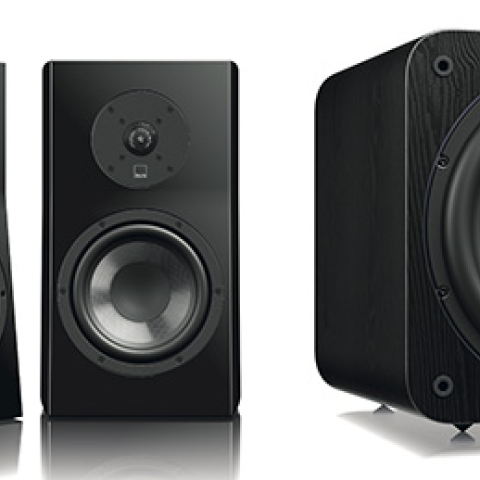
Measurement setup: the SVS Ultra Evolution Bookshelf and the seven-microphone vertical array.
The SVS Ultra Evolution Bookshelf loudspeaker and SB-3000 R|Evolution subwoofer were measured in a large conference room 11'11" H × 25'3" L × 15'8" W. The bookshelf speaker was measured on top of a PT&D MDT turntable, on a loudspeaker stand and with an accelerometer attached; the first reflection was off the floor at about 5ms, which limits the farfield response to 200Hz and above. The subwoofer was measured on the floor, in the nearfield of its woofer. The bookshelf was measured on the tweeter axis at a 1m microphone distance. From the center of the tweeter to the floor was about 68.5".
The equipment used for the measurements was a GRAS 40BD ¼" microphone and a 26CB preamp, with an SCM2 measurement ¼" microphone, a seven-microphone array at 15° vertical increments, and an AmpConnect 621 audio interface and amplifier. The system was calibrated with a B&K 4231 acoustic calibrator at an SPL of 94dB at 1kHz.
The Ultra Evolution Bookshelf is a compact design with a 1" diamond-coated aluminum-dome tweeter and a 6.5" glass-fiber composite midwoofer. The front of the cabinet is sloped to help time-align the tweeter with the woofer below it. The companion SB-3000 R|Evolution subwoofer complements the bookshelf nicely, extending the low-frequency response down an extra octave, to 20Hz. The following measurements were primarily made on the bookshelf loudspeaker.
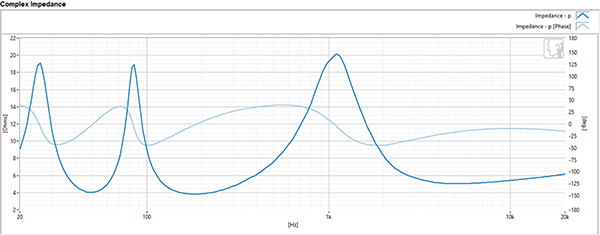
Fig.1 SVS Ultra Evolution Bookshelf, electrical impedance (dark blue trace) and phase (light blue trace) (2 ohms/vertical div.).
SVS specifies the Ultra Evolution Bookshelf's nominal impedance as 6 ohms. The minimum impedance is 3.7 ohms (fig.1, dark blue trace), with a small phase angle (light blue trace); the speaker should be an easy load for an amplifier to drive. SVS specifies the bookshelf's sensitivity as 87dB/2.83V/1m. With the microphone pointing at the tweeter, the average sensitivity from 100Hz–10kHz was 87dB/2.83V/1m, exactly matching the specification.
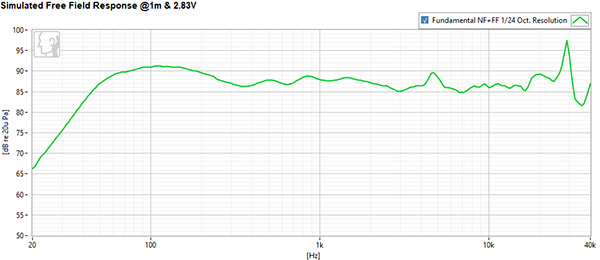
Fig.2 SVS Ultra Evolution Bookshelf, 1/24-octave smoothed quasi-anechoic response on tweeter axis at 1m, 2.83V, with nearfield and farfield responses spliced at 250Hz.
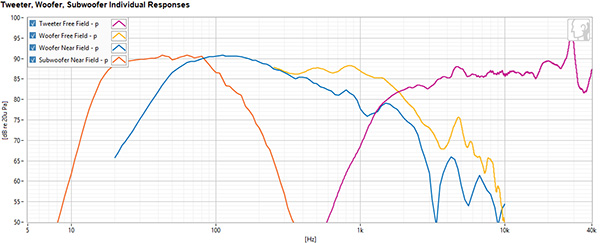
Fig.3 SVS Ultra Evolution Bookshelf & SB-3000 R|Evolution, individual driver responses: tweeter farfield (magenta trace), woofer farfield (yellow trace), woofer nearfield (blue trace), subwoofer nearfield (orange trace).
The frequency response (fig.2) is ±3dB from 40Hz to 26kHz, with a few resonances around 4.6kHz, 20kHz, and 29kHz. The individual driver responses, including the nearfield and farfield measurements (fig.3), imply that the crossover is at 1.8kHz, as specified. Since the subwoofer can be tuned and crossed over across a range of frequencies, it matches well with the bookshelf, extending the low-frequency response down to an impressive 17Hz.
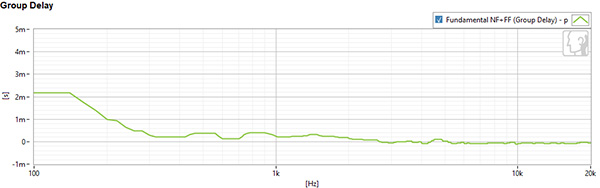
Fig.4 SVS Ultra Evolution Bookshelf, group delay on tweeter axis at 1m.
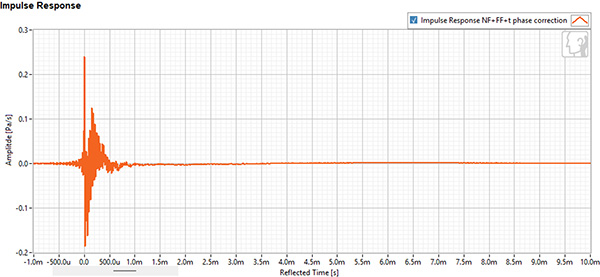
Fig.5 SVS Ultra Evolution Bookshelf, impulse response on tweeter axis at 1m (10ms time window).
The group delay (fig.4) represents the difference in time it takes for sound at all frequencies to travel from the individual drivers and reach the measurement microphone. Ideally it should be zero, but it usually increases at low frequencies, where the speaker driver is physically large and therefore difficult to time-align with the tweeter. SVS has done a good job here: The sloped lower front of the cabinet places the woofer's acoustic center, which sits farther back than the tweeter's dome, in improved alignment, minimizing group delay. The impulse response (fig.5) indicates good transient response, though there is some high-frequency ringing due to the high-Q resonance of the stiff diamond-coated tweeter.
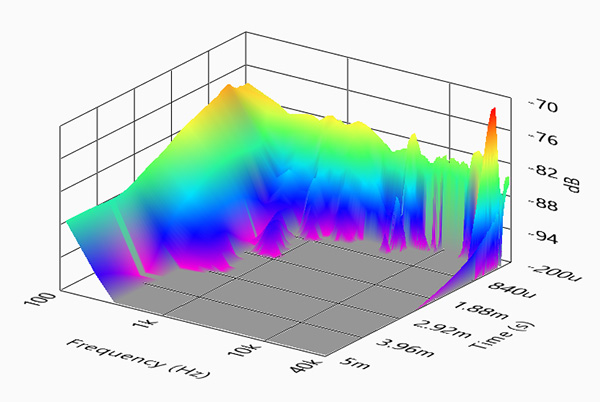
Fig.6 SVS Ultra Evolution Bookshelf, cumulative spectral-decay plot on tweeter axis at 1m.
The waterfall, or cumulative spectral decay, plot (fig.6) reveals high-frequency resonances at 29kHz and 40kHz with some corresponding ringing. Since there is typically no musical content—and no hearing acuity—at frequencies this high, this should not be audible. Otherwise, there is very little ringing in the speaker's transient response.
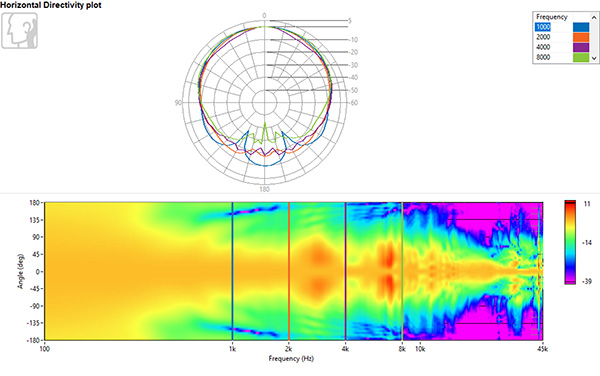
Fig.7 SVS Ultra Evolution Bookshelf, horizontal directivity: polar responses at 1kHz, 2kHz, 4kHz, and 8kHz (top); contour map of response vs horizontal angle, ±180° (bottom).
The horizontal directivity (fig.7) is mostly omnidirectional up to 15kHz, with some off-axis lobing between 3kHz and 7kHz. This is both good and bad, depending on the loudspeaker's placement in the listening room. Since this is a bookshelf loudspeaker, care should be taken not to place it too far back on a ledge or shelf, because early reflections can blur the sound image. Placed on stands away from hard surfaces, the speakers should create a very nice image regardless of listening position.
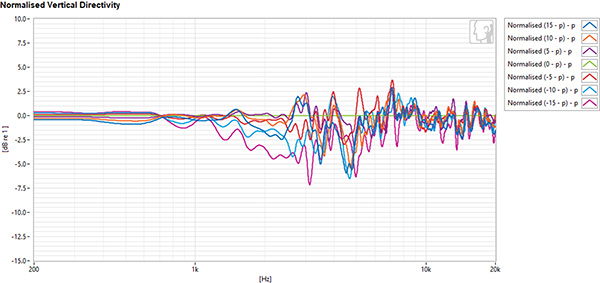
Fig.8 SVS Ultra Evolution Bookshelf, vertical directivity, normalized to tweeter-axis response: responses from 15° above axis to 15° below, in 5° steps.
The vertical directivity (fig.8) also looks mostly omnidirectional, though there are still some rough spots between 3kHz and 7kHz. Since the subwoofer is used only at very low frequencies, where the sound wavelengths are much greater than the size of its cabinet, it will be omnidirectional; there was no need to measure directivity.
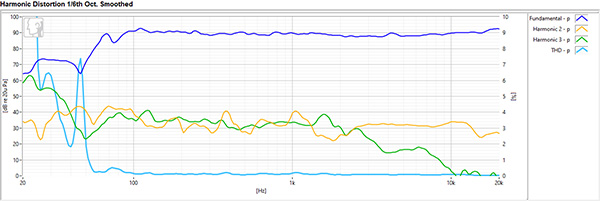
Fig.9 SVS Ultra Evolution Bookshelf, harmonic distortion at 90dB SPL, corrected to 1m (fundamental, dark blue trace; second harmonic, orange trace; third harmonic, green trace; THD, light blue trace; distortion percentage, right-hand scale).
In order to measure harmonic distortion down to low frequencies, the microphone was placed closer to the loudspeaker, at 17", to reduce room reflections; the sound level was then corrected to a distance of 1m for an SPL of 90dB. For most of the frequency range—50Hz and above—the total harmonic distortion (fig.9, light blue trace) is below 1%, and below 0.5% above 100Hz, which is excellent.
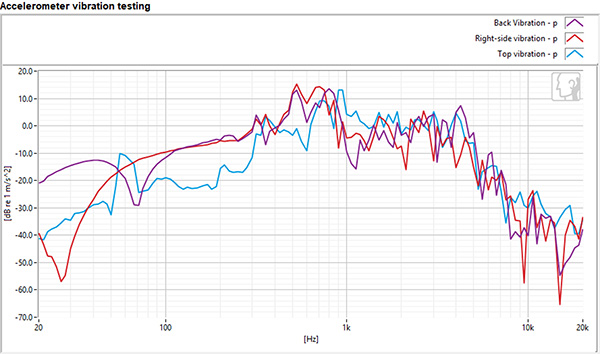
Fig.10 SVS Ultra Evolution Bookshelf, cabinet vibration measured with an accelerometer (driving voltage, 2.83V): back panel (purple trace), right side panel (red trace), top panel (blue trace).
Finally, vibration measurements of the cabinet were made using an accelerometer to check for cabinet resonances that could impact the sound. The cabinet is made from 1"-thick MDF, so it is fairly rigid. The accelerometer was placed at different positions on the panels, and the vibration was measured using the same sinewave sweep at 2.83V. The surface with the highest vibration was the right side panel, between 500Hz and 700Hz (fig.10).—Steve Temme