Sidebar 3: Measurements
I used DRA Labs' MLSSA system, a calibrated DPA 4006 microphone, and an Earthworks microphone preamplifier to measure the Tannoy Stirling Prestige Gold Reference's frequency response in the farfield. I used an Earthworks QTC40 mike for the nearfield responses and Dayton Audio's DATS V2 system to measure the impedance magnitude and electrical phase angle.
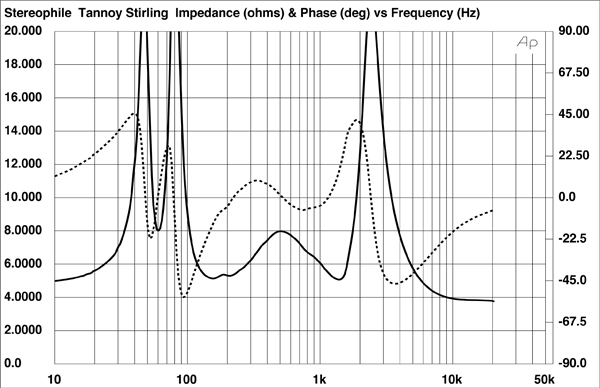
The Stirling's anechoic sensitivity is specified as a high 91dB/2.83V/m. My B-weighted estimate was even higher, at 93.8dB(B)/2.83V/m. Tannoy specifies the Stirling's impedance as 8 ohms, with a minimum magnitude of 5 ohms. My impedance measurement (fig.1, solid trace) varied between 5 ohms and 8 ohms over most of the audioband, with a minimum value of 3.8 ohms in the top audio octave. The peak at 2.4kHz in the magnitude trace is due to the crossover filters. The Stirling would therefore appear to be a relatively easy load for the partnering amplifier. However, the electrical phase angle (dotted trace) is high in a few regions and the effective resistance, or EPDR (footnote 1), lies under 3 ohms below 37Hz, between 96Hz and 156Hz, between 1.4kHz and 1.8kHz, and above 3.5kHz. The minimum effective resistance is 2.4 ohms at 115Hz, 2.3 ohms at 1.58kHz, and 1.825 ohms at 6.5kHz. The Stirling will work best with amplifiers that don't have problems driving low impedances, though the speaker's high sensitivity will reduce its need for current.

 The fact that the port's output peaks a little higher in amplitude than the woofer's suggests that the low-frequency alignment is underdamped. The complex sum of the woofer and port responses is shown as the black trace below 300Hz in fig.4. The usual peak in the midbass region due to the nearfield measurement technique is present, though perhaps exaggerated a little by the apparently underdamped alignment.
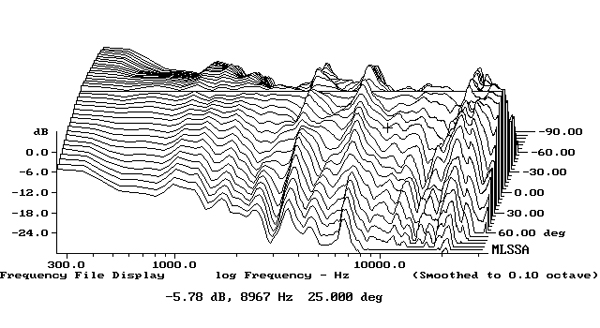
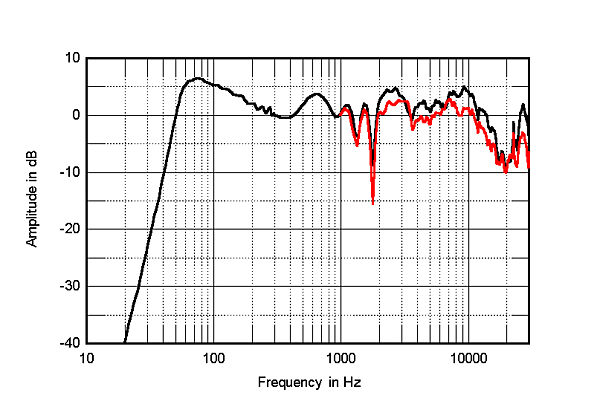 Fig.5 shows the Stirling's horizontal dispersion, normalized to the response on the tweeter axis, which thus appears as a straight line. The coaxial mounting of the tweeter means that the off-axis behavior is complex, though this graph suggests that the on-axis suckouts in the mid-treble tend to fill in to the speaker's sides. The Tannoy's dispersion in the vertical plane is shown in fig.6 and confirms what I described earlier: that the optimal treble response is obtained above the tweeter axis.
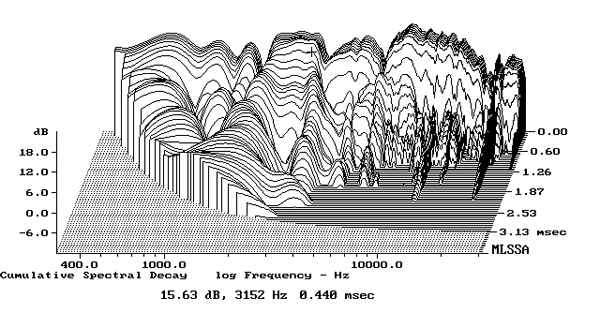
 In the time domain, the Stirling's step response (fig.7) indicates that the woofer is connected in positive acoustic polarity, the tweeter in negative polarity. Because the tweeter diaphragm is mounted at the rear of the woofer's voice-coil, its output arrives at the microphone after that of the woofer, but the positive-going decay of its step coincides with the peak of the woofer's step. The decay of the Stirling's step response is disturbed by some oscillations, which correlates with ridges of delayed resonant energy in the speaker's cumulative spectral-decay plot (fig.8). I could hear this behavior as some low-treble coloration in the sound of the MLSSA noise signal.

Footnote 1: EPDR is the resistive load that gives rise to the same peak dissipation in an amplifier's output devices as the loudspeaker. See "Audio Power Amplifiers for Loudspeaker Loads," JAES, Vol.42 No.9, September 1994, and stereophile.com/reference/707heavy/index.html.
Fig.1 Tannoy Stirling Prestige Gold Reference, electrical impedance (solid) and phase (dashed) (2 ohms/vertical div.).
A slight peak is visible in the magnitude trace in fig.1 just below 200Hz, which implies the presence of some sort of resonance in this region. However, when I investigated the enclosure's vibrational behavior with a plastic-tape accelerometer, the panels seemed well damped. While I did find some resonant modes (fig.2), they were of relatively low amplitude and almost all higher in frequency than 200Hz.
Fig.2 Tannoy Stirling Prestige Gold Reference, cumulative spectral-decay plot calculated from output of accelerometer fastened to center of back panel behind drive-unit (MLS driving voltage to speaker, 7.55V; measurement bandwidth, 2kHz).
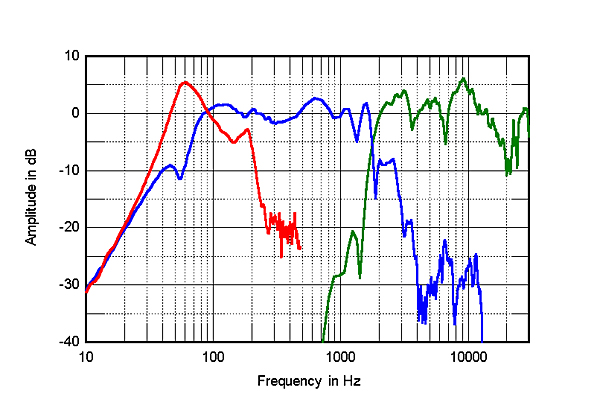
The saddle centered at 55Hz in the impedance magnitude trace indicates that this is the tuning frequency of the slots to the sides of the front baffle, which act as reflex ports. This is higher in frequency than I had anticipated for this relatively large loudspeaker; the woofer alignment seems optimized for sensitivity rather than low-frequency extension. The port's response, measured in the nearfield with the ¼"-diameter tip of the Earthworks microphone inserted into one of the lower slots, is shown as the red trace in fig.3. The output peaks just above the tuning frequency; an otherwise smooth upper-frequency rolloff is disturbed by a peak just below 200Hz. This peak coincides with a small suckout at the same frequency in the woofer's nearfield output (blue trace). The woofer's response has some peaks and dips before it crosses over to that of the tweeter (green trace) at the specified 1.8kHz. As I expect from a coaxially mounted tweeter, its on-axis response is relatively uneven.
Fig.3 Tannoy Stirling Prestige Gold Reference, acoustic crossover on tweeter axis at 50", corrected for microphone response, with the nearfield responses of woofer (blue) and port (red), respectively plotted below 350Hz and 500Hz.
Fig.4 Tannoy Stirling Prestige Gold Reference, anechoic response on tweeter axis (black) and at 10" above tweeter axis (red) at 50", averaged across 30° horizontal window and corrected for microphone response, with the complex sum of the nearfield woofer and port responses plotted below 300Hz.
The black trace in fig.4 above 300Hz shows the Stirling's quasi-anechoic farfield response averaged across a 30° horizontal window centered on the tweeter axis. The peaks centered on 650Hz, 2.5kHz, and 9kHz probably contributed to the higher-than-specified sensitivity estimate. The tweeter axis is just 26" from the floor, so I took a second measurement with the microphone 10" higher, which corresponds to what we have found is the height of the ears of a typical seated listener. The result of this measurement is shown as the red trace in fig.4. It is identical to the tweeter-axis response up to 2kHz, though the narrow suckout at the crossover frequency is deeper. While the response from 2kHz to 11kHz is more even, the output above that region is suppressed. I examined the effect of the front-panel high-frequency controls—these do very little below 5kHz, but the +3 setting raises the level between 8kHz and 16kHz by up to 3dB, which would optimize the top-octave response at the greater listening height. The traces in fig.4 were taken without the grille. The response with the grille (not shown) reduced the level of the peak centered at 2.5kHz by a couple of dB.
Fig.5 Tannoy Stirling GR-OW, lateral response family at 50", normalized to response on tweeter axis, from back to front: differences in response 90–5° off axis, reference response, differences in response 5–90° off axis.
Fig.6 Tannoy Prestige Gold Reference, vertical response family at 50", normalized to response on tweeter axis, from back to front: differences in response 20–5° above axis, reference response, differences in response 5° below axis.
Fig.7 Tannoy Stirling Prestige Gold Reference, step response on tweeter axis at 50" (5ms time window, 30kHz bandwidth).
Fig.8 Tannoy Stirling Prestige Gold Reference, cumulative spectral-decay plot on tweeter axis at 50" (0.15ms risetime).
The Tannoy Stirling Prestige Gold Reference's measured performance is dominated by the effects of the tweeter being coaxially mounted behind the woofer cone. Experimentation with vertical listening axis and/or toe-in, in combination with the high-frequency controls, will be necessary to optimize its in-room tonal balance.—John Atkinson
Footnote 1: EPDR is the resistive load that gives rise to the same peak dissipation in an amplifier's output devices as the loudspeaker. See "Audio Power Amplifiers for Loudspeaker Loads," JAES, Vol.42 No.9, September 1994, and stereophile.com/reference/707heavy/index.html.