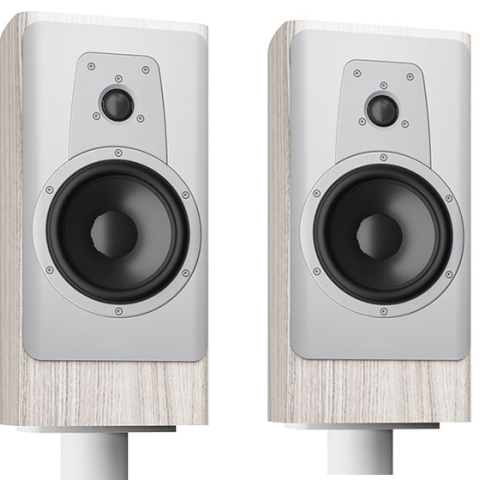
The dual-mono pink noise track on Editor's Choice sounded hollow if I stood up but evenly balanced, uncolored, and smooth when I sat up straight with my ears level with the Minos' tweeters, which are 41" from the floor. The central image of the noise signal was extremely narrow, with no splashing to the sides at some frequencies.
The stereo imaging continued to impress me throughout my auditioning of the Minos. One of my 2020 "Records to Die For" was Stemmeklang's Tomba Sonora (DSD64 file ripped from SACD, 2L 2L-155-SABD). Although this extraordinary recording had been captured in full surround, with height information, the sound was immersive even in two channels when played on the Vimbergs, with no ambiguity in the positions of the singers in the extremely reverberant acoustic. The images were the right size within the soundstage thrown by the Minos, when the recording had been made appropriately. Another of my test tracks for this performance aspect is Eric Whitacre's "When David Heard," from Water Night, performed by the Eric Whitacre Singers conducted by the composer (24/96 ALAC file, Decca 2796323). As the voices successively sing the phrase "my son" in this work, they create a tonal cluster that crescendos to a climax, creating a transcendent dome of sound between and behind the plane of the Vimberg speakers.
If I had to swear to it, however, I'd say the Minos didn't quite equal what I had heard with this recording from the much more expensive Magico M2s. Even so, the improvements in image depth and clarity and the sense of drive introduced by the Chord Hugo M Scaler when it upsampled CD data to 705.6kHz were readily audible with the Vimbergs. The same was true with the differences between the low-frequency character of the Chord DAVE D/A processor and my regular PS Audio DirectStream DAC. The Chord's tighter, deeper bass better matched the Minos' low frequencies when I left their top ports open, whereas the PS Audio's softer-sounding lows worked better with the top port closed.
With both ports open and the DAVE in the system, Jaco Pastorius's opening detuned bass-guitar notes on "Overture/Cotton Avenue" from Joni Mitchell's Don Juan's Reckless Daughter (24/192 needle drop from Reprise K63003) sounded suitably subterranean. But with the late Doug Rauch's double-thumbed bass guitar line on "Look Up (To See What's Coming Down)," from the 2003 remastering of Santana's Caravanserai (16/44.1 ALAC file ripped from CD), I preferred the low-frequency definition with the top port blocked.
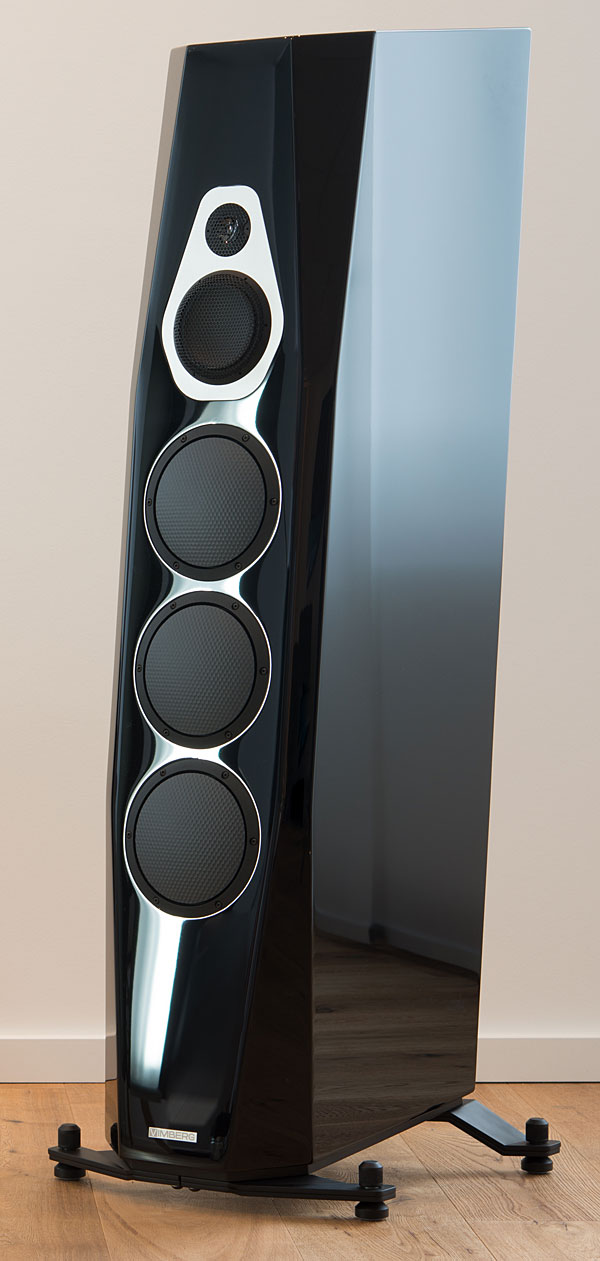 However, the Minos' low-frequency dynamics were a tad better with both ports open, communicating more of the visceral excitement from a great live rock recording: "Moby Dick," John Bonham's drum solo from Led Zeppelin's How the West Was Won (24/48 ALAC file ripped from DVD-A, Atlantic 83587-9) benefited from the extra midbass that I got with the top port unblocked. But when I played the live recording of Free's "Mr. Big," from 20th Century Masters (CD, A&M 490735), which has a less–well-recorded kickdrum, I reached for the port plugs. Throughout my auditioning of the Minos, in my room with my system, the optimal bass setup depended on which recording I was playing. Overall, however, I preferred the balance between low-frequency weight and bass definition with the top port closed.
I have very little to say about the Vimberg's high frequencies. They sounded as silky smooth as my memory of the Tidal Akira's, even though the Tidal speaker used the Accuton diamond-dome tweeter rather than the Mino's ceramic-diaphragm unit. The Mino's top octave also had a little more air than the Magico M2.
In the midrange, the Minos sounded as clean and uncolored as the Dutch & Dutch 8c speakers that I also review in this issue. I found myself playing a lot of solo piano recordings with the Vimbergs. Not only did this loudspeaker love pianos, but its transparency and imaging accuracy clearly revealed the differences between different recordings. I followed Tor Espen Aspaas's performance of the Maestoso from Beethoven's Piano Sonata No.32 in C minor, Op.111 (24/96 FLAC file from Mirror Canon, 2L 2L-49) with my own recording, made in 2000, of Robert Silverman performing the same movement (24/88.2 ALAC file, OrpheumMasters, no longer available). Aspaas's piano sounded powerful and close-up, set within a supportive (Norwegian church) acoustic, while the Vimbergs made it only too clear that Silverman's Bösendorfer piano had been recorded in too small a hall in Santa Monica. (In my defense, I had not been involved in the choice of the hall, and when I set up my microphones, it proved impossible to move the piano.) But this was offset by the Minos' lack of coloration, low-frequency clarity, and impressive dynamics, allowing me to be caught up in Silverman's engaging interpretation.
The Vimberg Mino demonstrated that neutrality in a loudspeaker is not just an absence of shortcomings: It is a positive quality that allows the listener to put aside recorded problems and be carried away by the music.
Conclusion
However, the Minos' low-frequency dynamics were a tad better with both ports open, communicating more of the visceral excitement from a great live rock recording: "Moby Dick," John Bonham's drum solo from Led Zeppelin's How the West Was Won (24/48 ALAC file ripped from DVD-A, Atlantic 83587-9) benefited from the extra midbass that I got with the top port unblocked. But when I played the live recording of Free's "Mr. Big," from 20th Century Masters (CD, A&M 490735), which has a less–well-recorded kickdrum, I reached for the port plugs. Throughout my auditioning of the Minos, in my room with my system, the optimal bass setup depended on which recording I was playing. Overall, however, I preferred the balance between low-frequency weight and bass definition with the top port closed.
I have very little to say about the Vimberg's high frequencies. They sounded as silky smooth as my memory of the Tidal Akira's, even though the Tidal speaker used the Accuton diamond-dome tweeter rather than the Mino's ceramic-diaphragm unit. The Mino's top octave also had a little more air than the Magico M2.
In the midrange, the Minos sounded as clean and uncolored as the Dutch & Dutch 8c speakers that I also review in this issue. I found myself playing a lot of solo piano recordings with the Vimbergs. Not only did this loudspeaker love pianos, but its transparency and imaging accuracy clearly revealed the differences between different recordings. I followed Tor Espen Aspaas's performance of the Maestoso from Beethoven's Piano Sonata No.32 in C minor, Op.111 (24/96 FLAC file from Mirror Canon, 2L 2L-49) with my own recording, made in 2000, of Robert Silverman performing the same movement (24/88.2 ALAC file, OrpheumMasters, no longer available). Aspaas's piano sounded powerful and close-up, set within a supportive (Norwegian church) acoustic, while the Vimbergs made it only too clear that Silverman's Bösendorfer piano had been recorded in too small a hall in Santa Monica. (In my defense, I had not been involved in the choice of the hall, and when I set up my microphones, it proved impossible to move the piano.) But this was offset by the Minos' lack of coloration, low-frequency clarity, and impressive dynamics, allowing me to be caught up in Silverman's engaging interpretation.
The Vimberg Mino demonstrated that neutrality in a loudspeaker is not just an absence of shortcomings: It is a positive quality that allows the listener to put aside recorded problems and be carried away by the music.
Conclusion
I was impressed by the Vimberg Mino. In my room and with my ancillary gear, it produced a full-range, neutrally balanced, transparent sound that rivaled what I remember experiencing with the seven-times-the-price Tidal Akira. Yes, this is still a pricey loudspeaker, but the Mino's sound quality revealed that it had been designed and manufactured without compromise. A true Class A loudspeaker.
However, the Minos' low-frequency dynamics were a tad better with both ports open, communicating more of the visceral excitement from a great live rock recording: "Moby Dick," John Bonham's drum solo from Led Zeppelin's How the West Was Won (24/48 ALAC file ripped from DVD-A, Atlantic 83587-9) benefited from the extra midbass that I got with the top port unblocked. But when I played the live recording of Free's "Mr. Big," from 20th Century Masters (CD, A&M 490735), which has a less–well-recorded kickdrum, I reached for the port plugs. Throughout my auditioning of the Minos, in my room with my system, the optimal bass setup depended on which recording I was playing. Overall, however, I preferred the balance between low-frequency weight and bass definition with the top port closed.
I have very little to say about the Vimberg's high frequencies. They sounded as silky smooth as my memory of the Tidal Akira's, even though the Tidal speaker used the Accuton diamond-dome tweeter rather than the Mino's ceramic-diaphragm unit. The Mino's top octave also had a little more air than the Magico M2.
I was impressed by the Vimberg Mino. In my room and with my ancillary gear, it produced a full-range, neutrally balanced, transparent sound that rivaled what I remember experiencing with the seven-times-the-price Tidal Akira. Yes, this is still a pricey loudspeaker, but the Mino's sound quality revealed that it had been designed and manufactured without compromise. A true Class A loudspeaker.