Art Dudley reviewed the Diamond 225 loudspeaker in October 2017 (Vol.40 No.10):
Just as the arc of the moral universe bends toward justice, the arc of commercial audio seems to bend toward conformity. Nowhere is that more apparent than in the loudspeaker industry, where many once-great manufacturers—great inasmuch as they designed breathtakingly original products, built them to the highest levels of quality, and thus created not only community jobs but also a justification, other than hollow jingoism, for community pride—now exist only as oft-traded names affixed to reflex-loaded loudspeakers that look less and less like the ones that put the brand on the map in the first place, and more and more like the ones made by everydamnbody else. That newer such products tend to be made where the people who own the famous name can get the best deal on labor—and that place is usually China—adds to the appearance of a herd mentality.
That said, some such brands remain vital—including, I think, the British firm Wharfedale, whose Diamond 225 loudspeaker ($449/pair) was reviewed by Herb Reichert in the March 2017 Stereophile, with a follow-up from Ken Micallef in the June 2017 issue. Like Herb, I have a tendency to "romanticize those good old days when little British companies were [cough cough] Little British companies in charming brick factories." Yet whether or not the Wharfedale of today fits my idea of what a British audio manufacturer should be, the fact is: Had something like the Diamond 225 existed in 1974, the 20-year-old Art Dudley would have convulsed with gratitude for being able to buy, at an unambiguously affordable price (footnote 1), a big dose of competence, as opposed to a big dose of uncompromised eccentricity. (Of course, it's also likely I would never have parted with them, and so might never have become an audiophile in the accepted sense. I'm not sure what to make of that.)
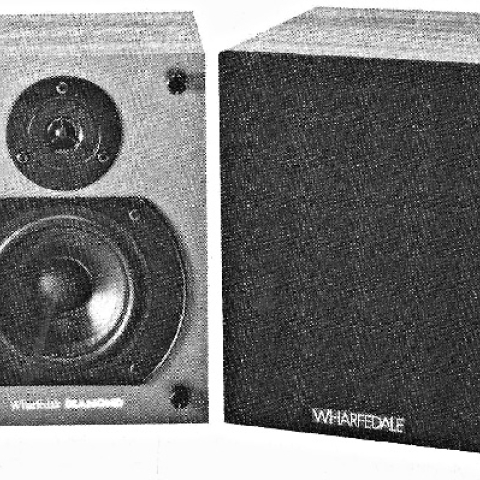
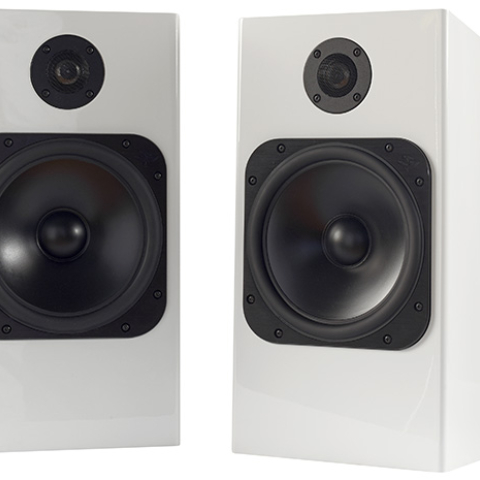
The Diamond 225 is a two-way speaker with a 1" fabric-dome tweeter and a 6.5" woven-Kevlar cone. The dome is built into a rigid molding that, from a distance, suggests a considerably larger tweeter with a half-roll surround; the Kevlar cone is reflex-loaded by a slot in the bottom of an MDF cabinet 14" high by 7.7" wide by 10.3" deep. Four rubber feet raise the cabinet just high enough that the slot isn't blocked by the surface supporting the speaker.
Speaking of supports, once Herb's review pair had found their way to my listening room, I used the Wharfedales on 21"-tall stands of forgotten provenance, supplemented with additional top and bottom plates of stacked plywood (the former 3" thick, the latter 1.5" thick) that I'd made for some other project, also forgotten. I tried a variety of speaker positions, and even had good luck toeing-in the Wharfedales so drastically that their axes crossed a foot or so in front of the central listening area, but mostly kept them 32–39" from their sidewalls and 57" from the front wall, toed-in gently enough that I could still see a bit of each cabinet's inner sidewall. I drove the Diamond 225s with my Shindo Laboratory Haut-Brion amplifier, itself driven by Shindo Masseto and Monbrison preamplifiers, fed by my Garrard 301 turntable with EMT 997 tonearm, Hommage T2 and EMIA Phono transformers, various cartridges, and interconnects and speaker cables from Audio Note, Auditorium 23, Luna, and Shindo. I did most of my listening with the Wharfedales' grilles removed.
The first selection I played through the Wharfedales was the Grumiaux Trio's recording of Haydn's String Trio 1 in G (LP, Philips 802 905 LY). I was surprised by how similar the Diamond 225s' tonal balance was to that of my Altec Flamencos: Once I'd turned up the volume control on my preamp and the dual-mono level controls on my stereo amp—the Altecs are, of course, considerably more sensitive and efficient—I heard the same meaty, substantial trebles and believably, naturally warm mids I'm used to around here. Bass tones were in sufficient proportion to the rest of the range—admittedly, not a high bar to clear with a record such as this—but didn't have the tightness or timbral detail I get from my reference speakers. Note attacks in the cello line were a little sluggish, and there was less sharpness of tone than I like: playing a sustained G2 (98Hz) in the first movement, the cello had a slight hooty/resonant quality, as of someone blowing air across the mouth of an empty bottle. But that was minor and easily overlooked: I grooved on the abundant texture throughout most of the audioband, and the music itself was reliably compelling.
If the good tone I heard from the Haydn was surprising, I was shocked by what I heard from the famous recording—famous among audiophiles, but in this case rightly so—of Rachmaninoff's Symphonic Dances by Donald Johanos and the Dallas Symphony Orchestra (LP, Turnabout TV 34145S): The Wharfedales reproduced the sounds of timpani, piano, and even bass drum with far greater bass weight and depth than their smallness had led me to expect. Even the contrabassoon's low D-flat (34.65Hz) was present and accounted for, at least partly: I was probably hearing as much second harmonic as fundamental, but the results were nonetheless convincing (footnote 2). Granted, there wasn't as much force behind that note as I hear from my Altecs and their tightly suspended 15" woofers, but . . . well, it was there, and it was musically significant. The music's momentum and overall timing weren't as tight as I'd like, and the tambourine usually heard at the rear of the stage was missing in action—shortcomings that all seemed to stem from the Wharfedales' tendency to put everything at a slight remove. Timbral colors were as they should be—not pastel—but other aspects of the music seemed slightly dulled.
And yet: When I reread that last paragraph, I'm struck by how wrong it seems in a general sense. Yes, elements of musical timing, not to mention sonic space, were rendered slightly indistinct by the Wharfedales; and no, these speakers were hardly the last word in snap and sparkle. But the Diamond 225s delivered the groceries: They satisfied. They played that great-sounding Rachmaninoff record with more sonic truth and musical involvement than I'd expected, and I never once found myself squirming on the settee, one brain on the music and the other devoted to the chore of wondering when I could reinstall my Altecs. When the Wharfedales were playing, I loved most of what I heard.
So it continued, day after day. When I borrowed Sasha Matson's copy of the Beatles' Sgt. Pepper's Lonely Hearts Club Band: 50th Anniversary Edition (2 LPs, EMI PCS 7027), and listened to the outtakes "Good Morning Good Morning (Take 8)" and "With a Little Help from my Friends (Take 2)," I was thoroughly charmed by the Wharfedales' ability to put across the essence of the music. Sure, Paul's nimble and seemingly endlessly creative electric-bass lines had more sonic snap and musical flow through my Altecs, and George's maracas weren't as clearly audible through the Wharfedales as I would have hoped, but the little Diamonds had lots of drive, and the lead vocals were clear and present and altogether believable. Perhaps best of all, in what was possibly the key to their success, the Wharfedales were coherent: everything sounded as if cut from the same sonic cloth.
Hoping to finish up with some good piano music, I played my mono copy of the Samson Francois recording of Chopin's 24 Preludes (LP, UK Columbia 33CX 1877). During a recent visit to Stereophile's New York office, John Atkinson and I had a conversation, illustrated with recordings he's made of pink-noise playback from various speakers, about the usefulness of piano music in revealing frequency-response aberrations of audible consequence. Even through JA's desktop computer and desktop speakers, the unpleasant artifacts produced by two speakers in particular, one very recent, were easy to hear. Yet while listening to the densely scored Preludes 14 in e-flat and 24 in d, I heard no such obvious misbehavior from the Wharfedales. More important, the very small Diamonds communicated the nuances, subtle and not-so-subtle, of Francois's artistry, including the way he rushes into certain phrases in the famous Prelude 15 in D-flat, yet still turns in a performance of greater-than-average gravitas. That said, I noticed that, spatially, some low-frequency notes sounded rather distant. What's up with that?
Indeed, the Samson Francois LP was so thoroughly enjoyable through the Wharfedales that I moved directly to another recent favorite, the Electric Recording Company's reissue of a program of Chopin Nocturnes recorded in 1956 by the Swiss pianist Yura Guller (10" LP, Ducretet/ERC 255 C 040). This record is my ideal: the sort of moody, idiosyncratic, slightly weird late-night listening fodder that seems solely the province of monophonic piano recordings by obscure, eccentric European artists, most of them women. This recording is not blessed with an abundance of treble, yet that didn't deter the already soft-sounding Wharfedales from declaring every nuance of Madame Guller's (1895–1980) artistry with no less musical clarity than do my Altecs.
Incidentally, though I'd rather not mention the early Bowers & Wilkins 801 by name, I confess that previous experience listening to certain loudspeakers with Kevlar woofers or mid/woofers has led me to associate with them an artifact I think of as the Kevlar Crunch—a bit of excessive texture, bordering on hardness, that I find fatiguing. I heard no such thing from the Wharfedales except on one not-terribly-well-taped live piano recording: a 1953 recital from New York's Frick Collection included in the boxed set William Kapell Edition (9 CDs, RCA Red Seal 68442-2). The most forcefully struck chords in Kapell's performance of Copland's Piano Sonata, off-putting through even my Altecs, were more so here.
The best thing about the Wharfedale Diamond 225 loudspeaker? It's easy—easy to afford, easy to install, easy to drive, and, with its apparently low distortion and a frequency range absurdly wide for its size (the manufacturer's specs are 45Hz–20kHz, ±3dB), easy to enjoy. More money and far more effort—in journeying and experimenting and learning—may, if you're as lucky as I've been, get you something nearer to transcendence. The Wharfedale isn't transcendent; it's just darn good, and an exceptional value. As Herb-O said: highly recommended.—Art Dudley
Footnote 1: Adjusted for inflation, of course. The $100 I spent in 1974 on a pair of EPI 100s—a speaker that was fine for its time but was comparatively bassless, inefficient, and mildly distorted—would be $522.58 today. Footnote 2: I later checked the Wharfedales' bass extension using Stereophile's first Test CD (Stereophile STPH002-2), and was astounded by the amount of useful response at 31.5Hz—though I heard nothing a third of an octave lower (25Hz).
Footnote 1: Adjusted for inflation, of course. The $100 I spent in 1974 on a pair of EPI 100s—a speaker that was fine for its time but was comparatively bassless, inefficient, and mildly distorted—would be $522.58 today. Footnote 2: I later checked the Wharfedales' bass extension using Stereophile's first Test CD (Stereophile STPH002-2), and was astounded by the amount of useful response at 31.5Hz—though I heard nothing a third of an octave lower (25Hz).