The Wilson Audio Specialties Alexx V ($135,000–$151,000/pair) is the biggest, heaviest, most expensive loudspeaker I've had in my listening room. It replaces the original Alexx in Wilson's lineup; Michael Fremer reviewed the earlier Alexx, bought it, and owned it until replacing it recently with the Wilson Chronosonic XVX.
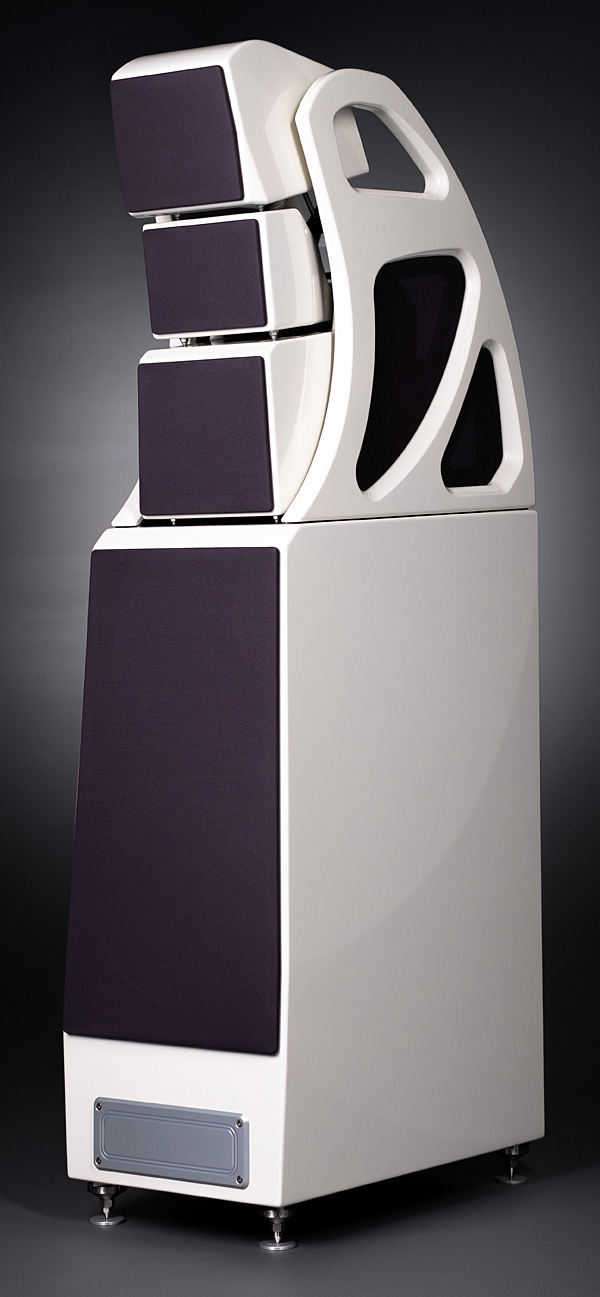
The V in the name—Alexx V—isn't the Roman number five; rather, it's a reference to Wilson's most recent proprietary composite material, "V." But more is new here than a new material. Wilson has recast its second-largest regular-production speaker along the lines of its largest, the Chronosonic XVX (footnote 1). The similarity is most obvious in the open-gantry design that the new Alexx inherited from the XVX. Wilson claims—and I believe—that this improves the sound because pressure waves were trapped by the semi-enclosed areas enfolded by the original Alexx's solid-sided gantry. The new design also allows for somewhat finer adjustment of the higher-frequency drivers: The tweeter can now be adjusted to within 1/16", which corresponds to less than 5µs of travel time for sound—surely below the ear's time-resolution.
Wilson has long put much stock in the composite materials they make their cabinets from. X-Material, the primary material used in Wilson cabinets, is "extremely monotonic and damped in its response," according to Wilson marketing materials. I'm not sure what "monotonic" means in this context—perhaps that the energy it absorbs is broadband, so it doesn't impose specific colorations on the sound. (Stereophile's measurements over the years have found Wilson's X-Material cabinets to be admirably free from resonant energy.) The S-Material, which is used for the company's front baffles, "provides a neutral and natural surface from which music can launch," according to Wilson literature. Why does a front baffle need to have different properties than the rest of the speaker cabinet? I'm not sure; it could be as simple as being easier to machine, or engineered to hold screws better for easier, more permanent driver-mounting (footnote 2).
The new V-Material, which is used where two parts of the cabinet come together, "behaves like a vibration absorber," according to Wilson. It is used in the top panel of the woofer cabinet, where the objective, clearly, is to keep vibrations from the woofer cabinet from reaching the gantry and the lowest gantry-mounted driver. Wilson also uses the V-Material in its new, vibration-absorbing footers, which are installed on these Alexx V's and available for other Wilson models.
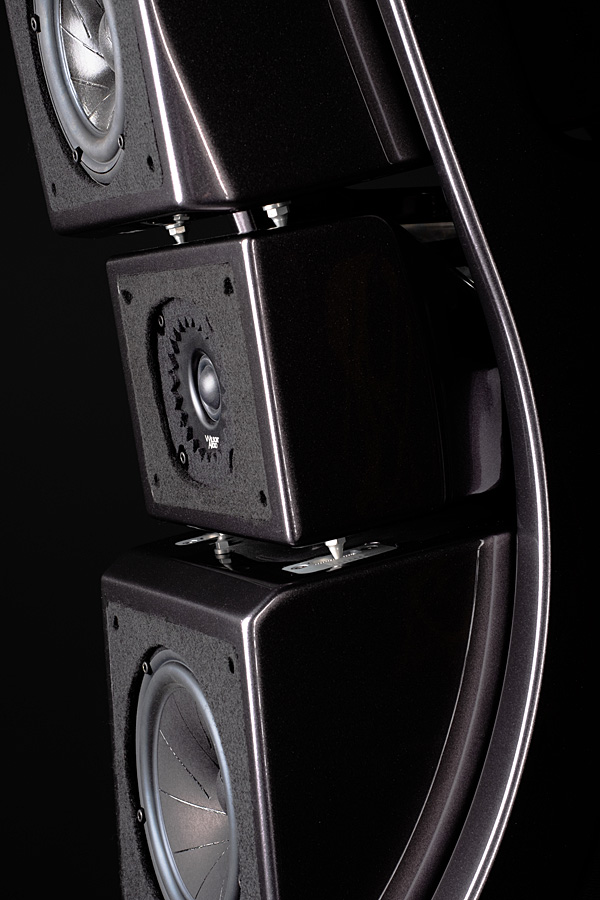 Wilson invents whole new composites to endow its cabinets with the desired properties, but when it comes to driver materials—the cones and domes at least—Wilson is old-school (footnote 3). The Alexx V's tweeter dome is doped silk. The midrange drivers are described as "doped paper pulp." Woofers are "hard paper pulp." I asked Daryl Wilson to explain. "Hard paper pulp," he told me, "indicates a compression process that hardens the materials used. Doped paper pulp indicates a sealant used on the cone that is an additional step in the build process. The different drivers we use in different applications have unique mixtures of organic material, and those unique materials used are based on the suitability for the bandpass of the driver's application." No diamond, beryllium, or carbon fiber in sight—at least not in the finished product.
"Visitors to Wilson Audio have been astounded by the range of driver technologies that they see, which we have sourced from all over the world for evaluation. These include beryllium, aluminum, diamond, ceramic, carbon fiber, etc. After all the technical experimentations and an exhaustive measurement protocol has been conducted on all the drivers we have assessed, we get into the most critical evaluation parameter: Does it sound real?
"Some have stated that the materials we use in our selected drivers are somehow inferior because they don't carry the buzz of the latest materials fad or exotic properties, which, in theory, should be better. For more than four decades, we have been collecting, testing, and evaluating drivers of all kinds of materials and construction. As we've listened to what's available in the market and compared them to our own drivers, we are very pleased with how well our choices meet our specifications and how close to the music our deeply refined drivers bring the listener.
"At the heart of every final sonic decision we make in research and development, we ask ourselves, 'Is this truly believable?' and 'Is this serving the music faithfully?'"
Perhaps the key phrase in what Daryl Wilson wrote is "which, in theory, should be better." There are important reasons for preferring high-tech cone and dome materials. Cones should be stiff and light, and some newer materials achieve a higher ratio of stiffness to weight than old-school materials do. The tradeoff—so goes the conventional wisdom—is that cone breakup, when it comes, is violent. The question every loudspeaker designer must ask is: Which drivers behave best and sound best in the context of a particular design?
Wilson continues to use paper and silk. It also continues to research and upgrade its drivers. In the Alexx V, only one driver—the smaller midwoofer—is retained from the original Alexx. The 7" midwoofer was developed for the XVX; it utilizes Wilson's "QuadraMag" configuration, "which combines [four] Alnico magnets in an entirely re-imagined 'quadrature' geometry." Both of the Alexx's woofers—the 10½" and the 12½"—were developed, Wilson says, for (or in conjunction with) the WAMM Master Chronosonic.
Wilson invents whole new composites to endow its cabinets with the desired properties, but when it comes to driver materials—the cones and domes at least—Wilson is old-school (footnote 3). The Alexx V's tweeter dome is doped silk. The midrange drivers are described as "doped paper pulp." Woofers are "hard paper pulp." I asked Daryl Wilson to explain. "Hard paper pulp," he told me, "indicates a compression process that hardens the materials used. Doped paper pulp indicates a sealant used on the cone that is an additional step in the build process. The different drivers we use in different applications have unique mixtures of organic material, and those unique materials used are based on the suitability for the bandpass of the driver's application." No diamond, beryllium, or carbon fiber in sight—at least not in the finished product.
"Visitors to Wilson Audio have been astounded by the range of driver technologies that they see, which we have sourced from all over the world for evaluation. These include beryllium, aluminum, diamond, ceramic, carbon fiber, etc. After all the technical experimentations and an exhaustive measurement protocol has been conducted on all the drivers we have assessed, we get into the most critical evaluation parameter: Does it sound real?
"Some have stated that the materials we use in our selected drivers are somehow inferior because they don't carry the buzz of the latest materials fad or exotic properties, which, in theory, should be better. For more than four decades, we have been collecting, testing, and evaluating drivers of all kinds of materials and construction. As we've listened to what's available in the market and compared them to our own drivers, we are very pleased with how well our choices meet our specifications and how close to the music our deeply refined drivers bring the listener.
"At the heart of every final sonic decision we make in research and development, we ask ourselves, 'Is this truly believable?' and 'Is this serving the music faithfully?'"
Perhaps the key phrase in what Daryl Wilson wrote is "which, in theory, should be better." There are important reasons for preferring high-tech cone and dome materials. Cones should be stiff and light, and some newer materials achieve a higher ratio of stiffness to weight than old-school materials do. The tradeoff—so goes the conventional wisdom—is that cone breakup, when it comes, is violent. The question every loudspeaker designer must ask is: Which drivers behave best and sound best in the context of a particular design?
Wilson continues to use paper and silk. It also continues to research and upgrade its drivers. In the Alexx V, only one driver—the smaller midwoofer—is retained from the original Alexx. The 7" midwoofer was developed for the XVX; it utilizes Wilson's "QuadraMag" configuration, "which combines [four] Alnico magnets in an entirely re-imagined 'quadrature' geometry." Both of the Alexx's woofers—the 10½" and the 12½"—were developed, Wilson says, for (or in conjunction with) the WAMM Master Chronosonic.
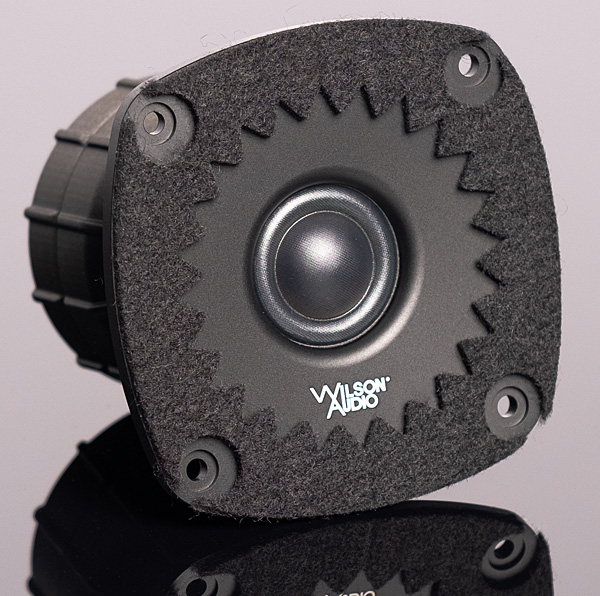 The tweeter is new. It "builds upon a modified version of the previous Convergent Synergy motor while embracing a re-imagined, intricate, and innovative rear-wave chamber," which is 3D-printed in-house from (if I'm reading the literature correctly) carbon fiber.
What other things are new? The Alexx V adds a woofer port that can be situated on the front or rear panels, which is also in the XVX (and, if memory serves, the Alexandria XLF).
The V is the first Alexx to use Wilson's own in-house capacitors. The midrange-driver housings now incorporate internal diffusers, built into the back of the cabinet; Wilson says this reduces the settling time, which makes sense. The crossover has been tweaked to make the V a little more amplifier friendly than its predecessor: Compared to the original Alexx, the Alexx V has gained 1dB in sensitivity, and its minimum impedance has increased by half an ohm.
A short interlude about time
The tweeter is new. It "builds upon a modified version of the previous Convergent Synergy motor while embracing a re-imagined, intricate, and innovative rear-wave chamber," which is 3D-printed in-house from (if I'm reading the literature correctly) carbon fiber.
What other things are new? The Alexx V adds a woofer port that can be situated on the front or rear panels, which is also in the XVX (and, if memory serves, the Alexandria XLF).
The V is the first Alexx to use Wilson's own in-house capacitors. The midrange-driver housings now incorporate internal diffusers, built into the back of the cabinet; Wilson says this reduces the settling time, which makes sense. The crossover has been tweaked to make the V a little more amplifier friendly than its predecessor: Compared to the original Alexx, the Alexx V has gained 1dB in sensitivity, and its minimum impedance has increased by half an ohm.
A short interlude about time
Daryl Wilson told me that, long ago, his father set up some drivers in such a way that he could sit in his listening chair and adjust their relative positions by pulling a string. The elder Wilson adjusted and listened, adjusted and listened again—"and he knew it made a difference," Daryl told me. "He didn't understand why. Just the observation of that difference caused this whole chain of events of exploration and R&D." David Wilson's observations led to the development of the complex mechanism of supports and adjustments that today, in the company's larger speakers, allow precise adjustment of the positions of the midrange drivers and tweeter relative to each other and relative to the woofer cabinet below. Front-to-back position can be adjusted to within fractions of an inch, rake angle within a few degrees, for each of the upper-frequency drivers.
 A major current of thought in the history of loudspeaker design, especially over the last two or three decades, involves the question, how much does time-alignment matter? And: Is it worth the tradeoffs? These are questions that can only be answered empirically, and the majority of speaker designers apparently have concluded that the answer to at least one of those two questions is "no." I have long found arguments in favor of time-alignment compelling.
Designers of high-end electronic components go to great lengths to eliminate distortion, which is to say, to ensure the integrity of the musical waveform. But when that waveform reaches the loudspeaker, all hell breaks loose. Because of the crossover (and how the drivers are connected electrically), the physical layout of the drivers, and differences in how quickly the various drivers launch sound toward the listener, different frequencies arrive at the listener's ears at different times.
A handful of speaker designers have made a serious attempt at time-aligning their speakers' output so that the wavefronts from the various drivers arrive at the ear at the same time; classic examples are Dunlavy, Spica, Thiel, and Vandersteen (footnote 4). Typically, this is achieved by using low-slope crossovers (first-order is optimal) and offsetting the drivers so that the tweeter launches its sound farther back than the midrange driver, and so on.
Such designs present major challenges. Low-slope crossovers mean drivers need to have a wide bandwidth, lest they be required to operate outside their optimal frequency range. A first-order crossover reduces output by just 6dB between, for example, 2kHz and 4kHz, so there's substantial overlap between midrange drivers and tweeters, which aggravates interference over a wide region of overlap. What's more, the midrange driver, which is now positioned a few inches in front of the tweeter, partially reflects the tweeter's output.
At best, perfect alignment of wavefronts from different drivers can only happen at one point in space (unless there's just one driver, or unless the drivers are coaxial). If you want the full, perfect effect, you need to position the speakers and your head exactly correctly, and you mustn't move.
A major current of thought in the history of loudspeaker design, especially over the last two or three decades, involves the question, how much does time-alignment matter? And: Is it worth the tradeoffs? These are questions that can only be answered empirically, and the majority of speaker designers apparently have concluded that the answer to at least one of those two questions is "no." I have long found arguments in favor of time-alignment compelling.
Designers of high-end electronic components go to great lengths to eliminate distortion, which is to say, to ensure the integrity of the musical waveform. But when that waveform reaches the loudspeaker, all hell breaks loose. Because of the crossover (and how the drivers are connected electrically), the physical layout of the drivers, and differences in how quickly the various drivers launch sound toward the listener, different frequencies arrive at the listener's ears at different times.
A handful of speaker designers have made a serious attempt at time-aligning their speakers' output so that the wavefronts from the various drivers arrive at the ear at the same time; classic examples are Dunlavy, Spica, Thiel, and Vandersteen (footnote 4). Typically, this is achieved by using low-slope crossovers (first-order is optimal) and offsetting the drivers so that the tweeter launches its sound farther back than the midrange driver, and so on.
Such designs present major challenges. Low-slope crossovers mean drivers need to have a wide bandwidth, lest they be required to operate outside their optimal frequency range. A first-order crossover reduces output by just 6dB between, for example, 2kHz and 4kHz, so there's substantial overlap between midrange drivers and tweeters, which aggravates interference over a wide region of overlap. What's more, the midrange driver, which is now positioned a few inches in front of the tweeter, partially reflects the tweeter's output.
At best, perfect alignment of wavefronts from different drivers can only happen at one point in space (unless there's just one driver, or unless the drivers are coaxial). If you want the full, perfect effect, you need to position the speakers and your head exactly correctly, and you mustn't move.
Footnote 1: The even bigger, twice-as-expensive WAMM Master Chronosonic is not a regular-production speaker. Footnote 2: I asked Daryl Wilson if he would provide more specific information about the properties of Wilson Audio's proprietary materials. He kept his answer general. "The various composite enclosure materials we use have been thoughtfully and methodically fine-tuned in density and construction to manage vibration in the strategic way we have outlined (vibration isolation vs transmission)."
Footnote 3: Which of course doesn't mean that they don't experiment with driver materials—read on.
Footnote 4: See, for example, the step response for the Thiel CS2.4 in fig.6 here. For an example of the tradeoffs of time-coincident design, see figs.4 and 5.
Wilson invents whole new composites to endow its cabinets with the desired properties, but when it comes to driver materials—the cones and domes at least—Wilson is old-school (footnote 3). The Alexx V's tweeter dome is doped silk. The midrange drivers are described as "doped paper pulp." Woofers are "hard paper pulp." I asked Daryl Wilson to explain. "Hard paper pulp," he told me, "indicates a compression process that hardens the materials used. Doped paper pulp indicates a sealant used on the cone that is an additional step in the build process. The different drivers we use in different applications have unique mixtures of organic material, and those unique materials used are based on the suitability for the bandpass of the driver's application." No diamond, beryllium, or carbon fiber in sight—at least not in the finished product.
"Visitors to Wilson Audio have been astounded by the range of driver technologies that they see, which we have sourced from all over the world for evaluation. These include beryllium, aluminum, diamond, ceramic, carbon fiber, etc. After all the technical experimentations and an exhaustive measurement protocol has been conducted on all the drivers we have assessed, we get into the most critical evaluation parameter: Does it sound real?
The tweeter is new. It "builds upon a modified version of the previous Convergent Synergy motor while embracing a re-imagined, intricate, and innovative rear-wave chamber," which is 3D-printed in-house from (if I'm reading the literature correctly) carbon fiber.
What other things are new? The Alexx V adds a woofer port that can be situated on the front or rear panels, which is also in the XVX (and, if memory serves, the Alexandria XLF).
Daryl Wilson told me that, long ago, his father set up some drivers in such a way that he could sit in his listening chair and adjust their relative positions by pulling a string. The elder Wilson adjusted and listened, adjusted and listened again—"and he knew it made a difference," Daryl told me. "He didn't understand why. Just the observation of that difference caused this whole chain of events of exploration and R&D." David Wilson's observations led to the development of the complex mechanism of supports and adjustments that today, in the company's larger speakers, allow precise adjustment of the positions of the midrange drivers and tweeter relative to each other and relative to the woofer cabinet below. Front-to-back position can be adjusted to within fractions of an inch, rake angle within a few degrees, for each of the upper-frequency drivers.
A major current of thought in the history of loudspeaker design, especially over the last two or three decades, involves the question, how much does time-alignment matter? And: Is it worth the tradeoffs? These are questions that can only be answered empirically, and the majority of speaker designers apparently have concluded that the answer to at least one of those two questions is "no." I have long found arguments in favor of time-alignment compelling.
Designers of high-end electronic components go to great lengths to eliminate distortion, which is to say, to ensure the integrity of the musical waveform. But when that waveform reaches the loudspeaker, all hell breaks loose. Because of the crossover (and how the drivers are connected electrically), the physical layout of the drivers, and differences in how quickly the various drivers launch sound toward the listener, different frequencies arrive at the listener's ears at different times.
A handful of speaker designers have made a serious attempt at time-aligning their speakers' output so that the wavefronts from the various drivers arrive at the ear at the same time; classic examples are Dunlavy, Spica, Thiel, and Vandersteen (footnote 4). Typically, this is achieved by using low-slope crossovers (first-order is optimal) and offsetting the drivers so that the tweeter launches its sound farther back than the midrange driver, and so on.
Footnote 1: The even bigger, twice-as-expensive WAMM Master Chronosonic is not a regular-production speaker. Footnote 2: I asked Daryl Wilson if he would provide more specific information about the properties of Wilson Audio's proprietary materials. He kept his answer general. "The various composite enclosure materials we use have been thoughtfully and methodically fine-tuned in density and construction to manage vibration in the strategic way we have outlined (vibration isolation vs transmission)."