

The Book of David (Gilmour)
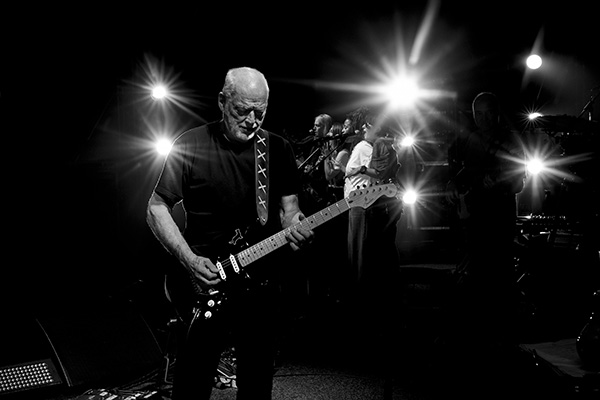
"Thank you very much indeed." That's David Gilmour offering his recurrent humble rejoinder to the fever-pitched audience response throughout the 2.5-hour performance that makes up the bulk of his latest solo release, Live at the Circus Maximus (Sony Music).
The Fifth Element #1
From the days of Les Paul's chum Mary Ford, through Amanda McBroom and Jennifer Warnes, right up to Patricia Barber, audiophiles have been fascinated, and sometimes obsessed, with female vocals. I nominate to membership in that select sorority another Patricia, in this case O'Callaghan, whose third CD has just been released worldwide by her new label, Teldec.
The Gospel According to Mark Levinson
 Nothing at 41 E. 62nd Street in Manhattan offers any clue as to what sort of business that takes place inside. The waiting room feels vaguely monastic: straw mats on the floor, a row of shoes near the door. Like a day spa offering acupuncture and shiatsu. There's no corporate name, no logo, no mission statement.
A clock running six and a half hours late hangs above a receptionist's unoccupied desk. An enormous white dog is asleep under framed pictures of old blues artists: Son Thomas, Etta Baker, Pernell King, Cora Fluker, Big Joe Williams.
Nothing at 41 E. 62nd Street in Manhattan offers any clue as to what sort of business that takes place inside. The waiting room feels vaguely monastic: straw mats on the floor, a row of shoes near the door. Like a day spa offering acupuncture and shiatsu. There's no corporate name, no logo, no mission statement.
A clock running six and a half hours late hangs above a receptionist's unoccupied desk. An enormous white dog is asleep under framed pictures of old blues artists: Son Thomas, Etta Baker, Pernell King, Cora Fluker, Big Joe Williams.
The Grimm Truth: Eelco Grimm of Grimm Audio

Most audio engineers split hairs. Eelco Grimm splits microseconds. His expertise in high-precision audio laid the groundwork for Grimm Audio, the Dutch venture he cofounded in 2004 with fellow electrical engineer Guido Tent. The company's master clocks and DACs, developed for both the pro audio and home hi-fi markets, combat tiny timing errors and jitter that can blight digital audio.
The Music Goes Round & Round
"Turntable Wars" was the phrase used by Anthony H. Cordesman to head his review of the Oracle, SOTA, and VPI turntables in Vol.9 No.4. To judge from the reaction of the manufacturers at CES to this innocent phraseology, you would have thought that Stereophile had been warmongering, rather than publishing what were actually pretty positive opinions of the products concerned. So enraged was Jacques Riendeau of Oracle, and concerned that the record be put straight, that he insisted on a "right to reply" to AHC's review; as it happened, Ivor Tiefenbrun and Charlie Brennan of Linn (right in photograph, footnote 1), and SOTA's Rodney Herman (center in photo, footnote 2), also wanted to contribute to the debate, so a small crowd of illuminati gathered in Room 417 of the Americana Congress to commit opinions to tape. I held the microphone and clicked the shutter; Larry Archibald (left in photo) was there to lend the proceedings a businesslike air.
The Search for Roy DuNann
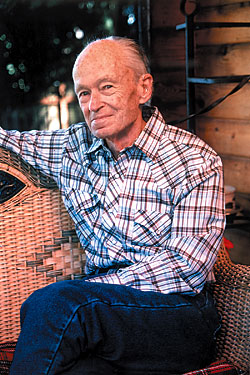
I don't remember the year, but I remember the moment when I first became intensely curious about Roy DuNann. It must have been about 1975, right after I moved to Seattle. I bought a Sonny Rollins LP called Way Out West, took it home, cued it up on my Thorens turntable, dropped the tonearm, and suddenly I was in a room with Rollins and Shelly Manne and Ray Brown. It was a shipping room with records stacked on shelves all around the musicians, but I wouldn't know that until many years later.
The Single-Ended Amplifier: Cary's Dennis Had
Cary Audio Design founder Dennis Had is largely responsible for popularizing single-ended amplifiers in America. Since appearing on the scene in 1989, Cary Audio Design has forged its own niche in the high-end audio industry. I spoke with Dennis Had about how he got started building amplifiers, and why he's so committed to single-ended triode designs.
The Wind Cries Marty (Krystall)

Marty Krystall is a musician's musician, highly regarded and known to his peers in the LA music world as a triple-threat wind player equally adept at jazz, classical, and in the studio. He is also an audiophile, a recording engineer, and a record company owner, having created the K2B2 label with bassist and colleague Buell Neidlinger in 1979.
Tim de Paravicini

Stereophile: You are president of Esoteric Audio Research, a British manufacturer of tube amplifiers, and a world-renowned designer of tube equipment and output transformers. I thought we'd begin with a little background. Where were you born? What kind of education did you get to prepare you for a career in audio?
Tim de Paravicini: Dialing-in the Original Experience
Meeting Englishman Tim de Paravicini for the first time, you start to wonder if your mind has slipped a gear, whether premature brain fade has cut in. The conversation seems not only to be racing by unexpectedly quickly, but also subjects you hadn't even realized were subjects are being examined in knowledgeable depth. It was at the end of the 1970s that I bumped into Tim at a trade show in the UK; having wanted to ask his opinion of tube-amp design, knowing that the gangling, wispy-bearded, Nigeria-born, one-time resident of South Africa and Japan, ex-Lux engineer (footnote 1) had cast a magic wand over the Michaelson & Austin product line, I found myself instead being treated to an exposition of color phosphor problems in TV monitors. For Tim is a true polymath, his mind seemingly capable of running at high speed along several sets of tracks simultaneously.