

Tim de Paravicini: King of Tubes
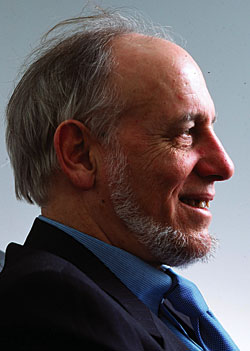
How many hi-fi professionals can say that they've designed at least one of every part of a complete recording system, from microphones to tape recorders to vinyl-disc-cutting electronics? Probably only Tim de Paravicini (footnote 1). Best known to audiophiles for his extraordinarily durable EAR valve amplifiers, Tim is also an electronics guru to the professional recording world. His global reputation today is based on more than four decades of making things better, building equipment that stands the test of time.
Todd Garfinkle of M•A Recordings—A World Citizen
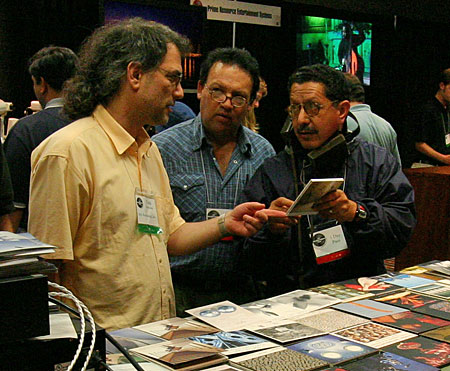
Todd Garfinkle, guiding light of M•A">http://www.marecordings.com">M•A Recordings, travels the globe recording provocative music in unbelievably wonderful acoustic settings. Todd travels to exotic climes such as Macedonia and Southern Siberia to capture unique and beautiful traditional ethnic music and song. He records with only two omnidirectional microphones, the signals of which are fed into handmade recording equipment designed especially for his work. Kathleen and I caught up with him at St. Peter's on 20th Street, a popular recording venue in the West Village. After wrapping a session, Todd stopped by our loft, where we rolled some tape of our own...
Tom Jung of DMP: Making Musical Sense

Tom Jung's career has been dotted with numbers. In 1969, he and a partner founded Sound 80, a Minneapolis recording studio named by an advertising wizard who had previously conjured up the appellation Cure 81 for a Hormel ham, supposedly while sipping Vat 69 scotch. Some years later, engineers from another Midwestern company with a numeral in its name, 3M, stopped by with an experimental tape recorder that also employed digits. Those zeros and ones proved critical to the recordings Jung went on to engineer and produce at his next company, Digital Music Products, better known as DMP.
Tom Jung: I Want More!

Tom Jung of DMP (Digital Music Products) is known as one of digital's early adopters. He's also an outspoken proponent of Sony's Super Audio CD over DVD-Audio. As I was intending to review Sony's first SACD player, the SCD-1, I invited Tom to Kathleen's and my Manhattan loft to investigate further. Tom and son Paul, who's responsible for DMP's sales and marketing, arrived with a passel of big drives, a DSD computer controller, and electronics designed by Ed Meitner.
Tony Federici: Accurate in the USA
I first met Tony Federici at a 1986 high-end show in Lucerne, Switzerland. He was at that time distributing Perreaux amplifiers in the US; the dem room Perreaux shared with KEF and McIntosh overlooked Lake Lucerne and Wagner's villa at Tribschen, perhaps the most idyllic setting for Show sound I have ever experienced. Tony was educated as a philosopher: In the 10 years I've known him, I have never known him at a loss for an opinion. It's all the more strange, therefore, that Stereophile has never asked him to submit to the ordeal of a formal interview.
Tube Porn: Leeds Radio
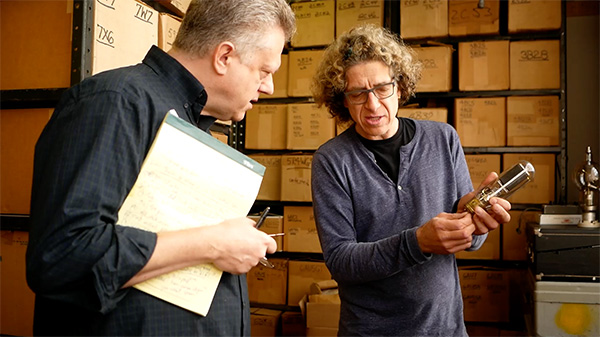
Richard Matthews has sold upwards of 30,000 tubes in the last ten years and he still has 100,000 tubes to go! Working out of his Leeds Radio warehouse in the Bronx, Matthews has every tube imaginable in stock, as well as a vast variety of tube testers, classic radios, capacitors, beautiful vintage tube boxes and many, many collector's pieces.
Ulrik Poulsen and his Amazing Alpha-Core Cables
 Jonathan Scull: How long have you been making cables, Ulrik?
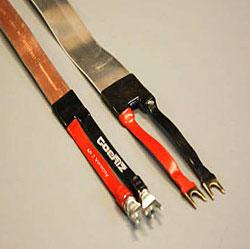
Ulrik Poulsen: It's actually close to three years now...It's a spinoff from other products we make. Actually, Alpha-Core manufactures magnetic cores and various materials and components for transformers...And we have a daughter company called Tortran that manufactures toroidal transformers. Anyway, five years ago we introduced a new product called Laminax. It's a combination of copper and aluminum with various kinds of dielectrics. This is laminated together continuously in various fashions to produce a material that's used as shielding for EMI and RFI in the electronics industry.
Jonathan Scull: How long have you been making cables, Ulrik?
Ulrik Poulsen: It's actually close to three years now...It's a spinoff from other products we make. Actually, Alpha-Core manufactures magnetic cores and various materials and components for transformers...And we have a daughter company called Tortran that manufactures toroidal transformers. Anyway, five years ago we introduced a new product called Laminax. It's a combination of copper and aluminum with various kinds of dielectrics. This is laminated together continuously in various fashions to produce a material that's used as shielding for EMI and RFI in the electronics industry.
VTL's Luke Manley
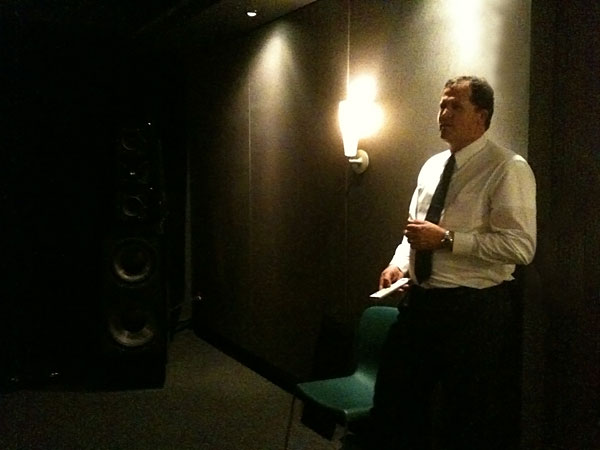
Luke Manley at Manhattan's Innovative Audio (Photo: John Atkinson)
Jonathan Scull: How long has VTL been in business, Luke? Luke Manley: My dad, David Manley, and I co-founded VTL in June of 1986. We started small on the East Coast, and soon after we moved to California. Scull: Is it because you're really a West Coast kind of guy? Manley: [laughs] You bet! There's a lot of supporting industries out there; a big base of electronics manufacturers, for example. Scull: What, in the San Francisco area?
Walter Sear's Analog Rules
The first thing you notice about Walter Sear's legendary">http://www.searsound.com">legendary Manhattan studio is that it feels so darn comfortable. Sear Sound doesn't have a wall of gold records, gleaming million-dollar consoles, or the latest high-resolution digital workstations, but a quick stroll around the three studios reveals a treasure trove of tube and analog professional gear: a pair of Sgt. Pepper–era Studer recorders plucked from EMI's Abbey Road studios; an early Modular Moog synthesizer Sear built with Bob Moog; and a collection of 250 new and classic microphones.
What's His Naim? Julian Vereker
 Editor's Introduction: One of the big industry stories of 1985 was the split, both personal and commercial, between the British Linn and Naim companies. Led by Ivor Tiefenbrun and Julian Vereker (footnote 1) respectively, both companies had started up in the early 1970s. Both men held similar views, both about the fat-cat complacency of British designers (which had led to a grievous sound-quality slump in the mid '70s), and about the system rethinking necessary for what some writers, unaware of the rigors of thought required by followers of that spiritual descendant of Fowler, William Safire, would term a "quantum leap" forward in sound reproduction.