

Changes of Everything
As of February, 1982, the ownership of this publication passed to other hands. In total despair about its precarious finances, JGH accepted with alacrity an offer by Larry Archibald (an occasional contributor in recent years) to purchase the magazine. This has now come to pass, and it is because of the resulting infusion of money that you are holding this issue in your hot little hands now instead of three months from now (and that is probably being a little optimistic about the way things were).
Chasing Rainbows
There was a time, very recently in terms of human history, when high fidelity promised to free the music lover from the constraints of the concert hall and the local repertoire, allowing him to choose at his whim any orchestra in the world playing any work he desired under the baton of any conductor he preferred. "All the pleasure of concert-hall listening, in the comfort of your home," was the way one display advertisement painted this musical utopia which, only 20 years ago, seemed right around the corner.
Chesky's 24/96 DVDs & HI-FI '98
"What the heck is that icon trying to tell me?" I had switched on Denon's new DVD-3000 player—a cute "Welcome to DVD World" message scrolled across its display—and put a disc in its drawer. The icon, which looked at best like a Japanese character and at worst like a child's drawing of a house (complete with windows), was lit up in light blue on the display. But the game was given away by the magic words "96kHz 24 bit" illuminated in red below the mysterious icon. For this was no DVD movie, but a test pressing of Chesky's">http://www.chesky.com">Chesky's new Super Audio Disc, The Super Audio Collection & Professional Test Disc, which makes use of the DVD-Video specification's provision for including a two-channel, linear-PCM signal encoded with a 96kHz sampling rate and a word depth of up to 24 bits. (Contrary to what you may have read in the popular press, using DVD-Video to carry high-definition sound quality does not introduce a new and incompatible standard.)
Chips Are Still For Chumps
One Saturday not long before press time for this issue, I received an email from Technical Editor (and former Editor) John Atkinson with the subject line, "20 Years Ago."
"Just read your May 2005 As We See It for the first time in many years," John wrote. "Great stuff!"
Could 20 years really have passed since I wrote that piece? Back then, I was in a different career, indulging my hi-fi passion by contributing to Stereophile on the side; now I'm in my seventh year as Stereophile editor. Then I was still a youngish dude; now I am an oldish dude. "Time flies" just doesn't capture it.
Some readers will surely remember that long-ago editorial. It was about a product dubbed the Intelligent Chip, a small piece ofwell, somethingencased in plastic. I wrote, "This small, plastic-encased device is claimed to permanently improve the sound of CDs. Just place the chip atop your CD player, insert a CD, and press Play. 'The sound of the upgraded disc more closely resembles the sound of the original master recording.'"
Chips for Chumps
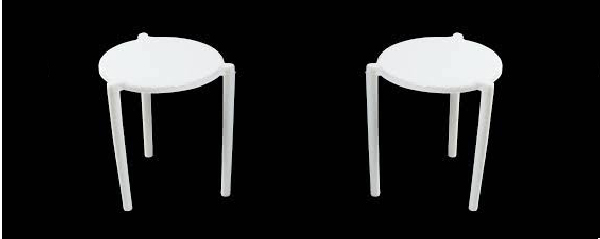
In his "From the Editor's Desk" in the March issue of Stereophile's e-newsletter, John Atkinson recounts how, years ago, "erstwhile audio scribe Enid Lumley" demonstrated her pizza-box-tripod tweak at a hi-fi show. Lumley, JA writes, "placed the tripod atop a CD player and convinced her audience—including me—that the sound was better."
Cholera in the time of love
I was recently reunited with an old friend from high school. My best friend from high school, in fact. Our families got together, everyone got along, and as the dust of conversation settled toward the rug of companionable silence, talk turned to work. And when the inevitable happened, and my old friend and his wifeclassical-music lovers bothasked how much a person had to spend these days in order to get a good music system, I answered their question with a questiona question that, crazily enough, just popped into my head...
Classical Music as an Act of Rebellion
There's a widespread myth that writers who get published are more talented than writers who don't get published, and that musicians who make records are more talented than musicians who don't make records. But anyone with any talent who has ever tried to earn a living as a writer, a musician, or any other kind of artist understands that the correlation between merit and success is, at best, loose. Some successful artists are talented, and some talented artists are successful. But for every talented artist who manages to make a living there are a dozen more, equally deserving, who have no choice but to keep their day jobs.
Closer Together Covers?
The audiophile in the plaid shirt and gray Dockers had his hand up. Moderator Jonathan Scull handed him the roving microphone, and the Stereophile writers on the podium at HI-FI '99's Sunday afternoon "Ask the Editors" session shifted in their chairs. "This one's for John Atkinson," came the windup. The other writers relaxed; I started to sweat. Then the pitch: "How come Stereophile issues are so small these days?"
Clowns to the left of me, jokers to the right . . .
The dichotomy between what is measured and what is heard has resurfaced in recent months. Jon Iverson discussed it in his "As We See It" in our December 2018 issue, and I followed up on the subject in my January 2019 "As We See It." These further thoughts were triggered by an e-mail exchange I had last December with Stereophile's longtime copyeditor, Richard Lehnert.
Cocktail Parties, Wedding Parties, Recording Sessions
It's called the "Cocktail Party Effect." You may be immersed in the middle of a crowd of audiophiles all talking at once, but when someone says something that catches your attention, such as your name, you can focus on the sound of that person's voice and exclude the babble. The noise suppression can be 9–15dB; ie, the sound being concentrated on seems to be three to four times louder than the ambient noise, according to Wikipediahttp://en.wikipedia.org/wiki/Cocktail_party_effect">Wikipedia;. The exact mechanism of the Cocktail Party Effect is not known, but it is conjectured that it has something to do with the binaural nature of human hearing: the fact that we have two ears allows us to apply spatial discrimination to what would otherwise be a jumble of sound.