

Live as Canned, Reproduced as True
A funny thing happened at the symphony the other night. A concert by the great Berlin Philharmonic sounded like lousy hi-fi.
Living Sound Meets Living Art
I've always considered the high end to be industrial art. People who favor a certain brand are saying, in a way, "I like that designer's interpretation. I like his or her art."David Wilson
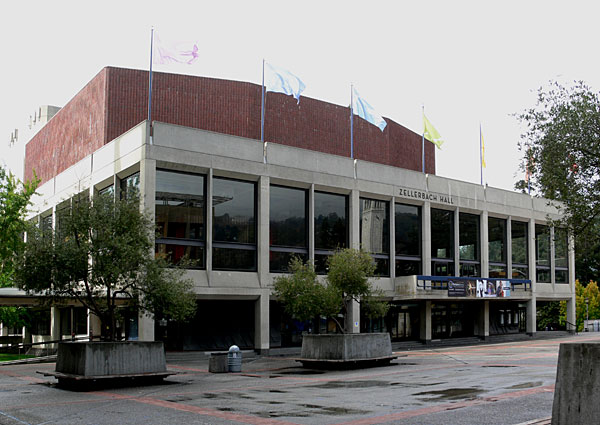
Last March, I had a rare experience akin to hearing the same recording through two different systems. I heard Andris Nelsons conduct the Vienna Philharmonic Orchestra in the same programHaydn's Symphony 90, and Brahms's Variations on a Theme by Haydn, followed by his Symphony 3in two very different venues: UC Berkeley's Zellerbach Hall and, 50 miles north, Sonoma State University's Weill Hall.
Mark Fisher
Some time ago I wrote about the need for high-end audio companies to constantly reinvent themselves: You may be receiving accolades for your latest and greatest product, but you'd also better be well along the path to developing its replacement. High-end audio is a field of constant change; no product remains supreme for long.
Marking Their Territory?
It's easy for us audiophiles to feel neglected. Consider that this year witnesses the debuts of not one, but two new audio formats that should answer the prayers of just about every frustrated audiophile out there: SACD and DVD-Audio. Both approaches represent the state of the art of recording and reproducing music, and finally fulfill for serious listeners the promise that CD teased us with more than 15 years ago.
Matters of Opinion
Now that audio technology seems to be on the verge of being able to do anything asked of it, it seems only fitting to wonder about what we should be asking it to do. We probably all agree that high fidelity should yield a felicitous reproduction of music, but felicitous to what? Should a system give an accurate replica of what is on the disc, or of the original musical sounds?
Measurements & Sound Quality
"One of the worst-kept secrets in audio engineering is that what we hear does not always correlate with what we measure." So wrote the late Richard Heyser 30 years ago, as quoted in Time">http://www.stereophile.com/historical/572">Time Delay Spectrometry, a 1987 anthology of his writings (footnote 1). What do we hear? Music heard live consists of a sound pressure that changes according to the logical demands of two things that have no physical reality: the way in which music is structured in time and pitch, and how that structure is ordered by the composer/musician. Heyser, one of the most perceptive audio engineers I've had the privilege to meet, repeatedly emphasized in his essays and papers that the reproduction of music is a multidimensional event.
Measurements, Maps & Precision
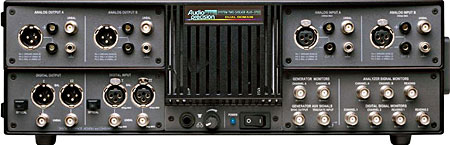
As I wrote in this space last month, test-equipment manufacturer Audio Precision has loaned Stereophile a sample of their top-of-the-line SYS2722 system, which has both significantly greater resolution and greater bandwidth than the Audio Precision System One Dual Domain we have been using since 1989. The reviews you can read in this issue include the first measurements I have performed with this impressive piece of gear, though there are still a number of graphs I produced using our System One. In fact, with the equipment I tested using the SYS2722, I performed duplicate sets of measurements using both the System One and the Miller Audio Research QC Suite in order to get a handle on how close the three systems agreed. (They did on the tests where the SYS2722's improved resolution was not a factor.)
Memories: Best of, Vol.1
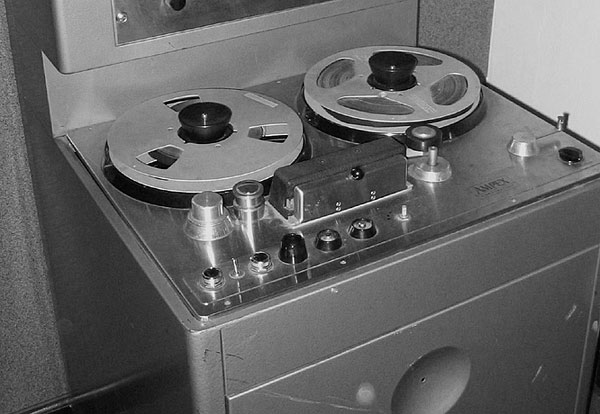
It happened 30 years ago, but I remember it as if it were yesterday: My best friend's brother's friend showed me his record playeran AR turntable equipped with an SME 3009 Mk.III tonearm and a Shure V15 Type V-MR cartridgeand offered to sell it to me at a price that, until that moment, I would never have considered spending for a complete system. "It's audiophile gear," he said with a knowing smile.
Audiophile? The word sounded exoticand grown-up.
Mentors & Audio Shows
Where do audiophiles come from?
Merry Christmas Indeed
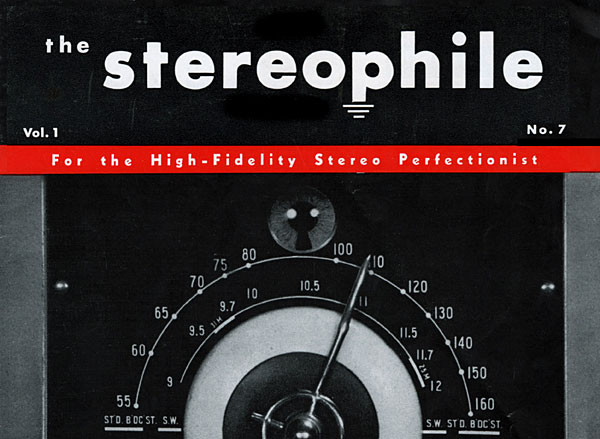
Editor's Note: The editorial leader for the seventh issue of what was then called The Stereophile, cover-dated April 1964, was the first to introduce a recurring theme to the magazine's first 20 years of publication: an apology to subscribers for being late.John Atkinson
Those of you who have a mind for dates may have noticed that this issue of The Stereophile is very, very late. This, the seventh issue, was supposed to have been a Merry Christmas NovemberDecember issue, but as things worked out, it doesn't even deserve the title of JanuaryFebruary issue. So, we think a few words of explanation are in order.