

Academic?
Our Delta L-1011 emerged from the cloud split-seconds before its wheels touched the waterlogged ground. "How much lower does the cloud cover have to be before they divert us to another city?" I asked Tom Norton. "About an inch," came the phlegmatic reply. (Ex-F4 pilot TJN categorizes any landing you can walk away from as "good.") But at least we had reached Atlanta, after a saga of air-traffic control problems, weather delays, and missed connections. (Does anyone remember taking a flight that wasn't full, wasn't late, and wasn't sweaty and stressful? Wasn't deregulation supposed to improve service by increasing the choices available to travelers?)
Academy? What Academy?!
It was the subhead that caught my eye: "Today's super-rich just don't seem interested in $300,000 stereos." Clunky writing, sure. But at least it gave some idea of what the next 2000 words were about, and spared the pain of having to read further.
Accentuate the Positive?
"You'll wonder where the yellow went, when you brush your teeth with Pepsodent."
Access Journalism vs Accountability Journalism
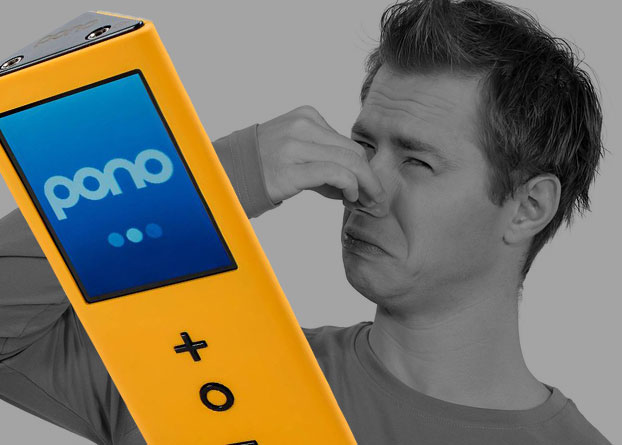
I write this in a Seattle coffee barmy flight home to New York has been canceled due to a snowstorm. As I try to put down these thoughts, I'm listening to the high-resolution masters of the April issue's "Recording of the Month," Sasha Matson's jazz opera Cooperstown, on my Pono player using Ultimate Ears UE18 in-ear monitors. I was in Seattle for Music Matters 10, held by retailer Definitive Audio, and this was my first road trip with the Pono since I reviewed it for the April issue. (Bruce Botnick and Charles Hansen comment on that review elsewhere in this issue.)
Accuracy Is Not the Answer

Before 1982, when the Compact Disc arrived, I didn't love LPs. Analog was already very old tech, and while every trick in the book had been applied to turntables and LPs, they still wowed & fluttered at 33 1/3 revolutions per minute. Vinyl's deficiencies were legion: warped LPs were more common than truly flat ones; surface noise, clicks, and pops sang along with the tune; LPs rarely had perfectly centered spindle holes; inner-groove distortions popped up at inopportune moments; and each time an LP is played, its sound quality degrades, if only ever so slightly. The LP format? Imperfect sound forever.
Across the Great Divide
The audio community's "Great Debate" has reached an amazing level of absurdity. On one side are the Objectivists, whose rationalist argument insists that all human auditory experience is the result of electro-physical phenomena which can be measured and mapped using established scientific methods. On the other side are the Subjectivists, romantics who believe in the synergistic interplay of music, room, equipment, and listener, and whose attempts to describe their experiences tend toward the florid and metaphorical.
An Amusement Park for the Mind
"An amusement park for the mind." That was how, some years ago, one engineer described the Audio Engineering Society's biannual conventions, which alternate between European and American venues. The 111th convention, subtitled "Advancing the Art of Sound," was held at the cavernous Jacob Javits Center on Manhattan's west side in early December. (It had originally been scheduled to take place last September, but was postponed for the obvious reason.)
An argument for measurements
In my early years of writing about audio (footnote 1), I was knownto the extent that I was known at allas something of an objectivist. I was, after all, working as an editor at a leading science journal at the time, just a few years out from a brief career as an actual scientist, still in recovery from the physics PhD I'd earned a decade or so before.
An Ending That's Also a Beginning
One of my biggest surprises since I became the editor of Stereophileand so started focusing more on all things audiophileis how often I find myself thinking about the ethics of this hobby. This is unusual for me: I dislike moralism and prefer aesthetics to ethics.
An Ounce of Gold for a Fine Suit of Clothes...
One day in the early 1960s, Arnold Gingrich, Esquire magazine's founder and editor-in-chief, phoned his stockbroker with an unusual request: Gingrich needed a cashier's check for $12,000 right away. Would the broker please sell some of Gingrich's stocks?