

Where We Are and How We Got Here
As another Consumer Electronics Show rolls around, we are seeing some interesting and not-entirely encouraging things taking place in the audio field. The people for whom high fidelity was originally intended—so-called serious music listeners —have abandoned audio almost completely, leaving the pursuit of perfect music reproduction to a group of hobbyists who have more interest in hardware than in music. This, plus the recession, has almost killed middle-fi, which is now flailing out in all directions looking for a new market. Here's how it all came to pass:
Who Are You?
In the four years since our last readership survey, Stereophile's circulation has grown by one third, from 45,000 to over 60,000 (footnote 1). We thought it time, therefore, to commission new numbers, from specialists Mediamark Research Inc. (footnote 2). Table 1 shows the demographic breakdown of the magazine's readers. While the launch of CD did bring more women into the audiophile fold almost 10 years ago, the proportion of Stereophile's female readers has not changed since 1988, at just over 1% (footnote 3). At one of the panel sessions at the 1992 High End Hi-Fi Show in Los Angeles, a man in the audience asked why high-end audio was so testosterone-bound when women were just as interested in music as men? The answers given by some of the many women at the show ranged from the fact that women only earn 47 cents on the dollar compared with men to conjecture that women are turned off by the hobby's tweak aspect. Certainly dealer Andrew Singer felt last October (footnote 4) that the high-end industry is hobbling itself by ignoring half the US's population.
Who Watches the Watchers?

When we launched Stereophile's website at the end of 1997, we decided that we would not reprint the magazine's most popular features, including the biannual "Recommended Components" listings and Michael Fremer's monthly "Analog Corner" column. We were concerned that doing so would cannibalize magazine sales. As it turned out, we were wrongand so the latest "Recommended Components" is available on our free-access website day-and-date with the publication of the April and October issues in which it appears. And starting with Mikey's very first "Analog Corner," from July 1995, I have been posting his column on our AnalogPlanet.com website.
Who's Right? Accuracy or Musicality
 Many years ago, the now-defunct Life magazine ran a feature article about science and its sacred cows, in which a cartoon showed a huge inverted pyramid-shaped structure of great complexity, tapering downward to a single support at its base: a toothpick. The toothpick was labeled "basic premise," the inverted pyramid was the entire body of scientific knowledge.
Everything we do or think or know is based upon assumptions, some of which are rather more justified than others. When we set the alarm clock, we assume there will be a tomorrow. When we reach for the car's brake pedal without glancing at it, we assume it will be where it was yesterday, and that it will stop the car. When we scorn a phono cartridge because it is too bright, we assume the brightness is in the cartridge, not in the rest of our system. We have to trust our toothpicks or live in a world totally devoid of securitya world where 2+2 can equal anything from 3 to 11, all the laws change unannounced every few days, and Greenwich Mean Time is determined by a roulette wheel.
Many years ago, the now-defunct Life magazine ran a feature article about science and its sacred cows, in which a cartoon showed a huge inverted pyramid-shaped structure of great complexity, tapering downward to a single support at its base: a toothpick. The toothpick was labeled "basic premise," the inverted pyramid was the entire body of scientific knowledge.
Everything we do or think or know is based upon assumptions, some of which are rather more justified than others. When we set the alarm clock, we assume there will be a tomorrow. When we reach for the car's brake pedal without glancing at it, we assume it will be where it was yesterday, and that it will stop the car. When we scorn a phono cartridge because it is too bright, we assume the brightness is in the cartridge, not in the rest of our system. We have to trust our toothpicks or live in a world totally devoid of securitya world where 2+2 can equal anything from 3 to 11, all the laws change unannounced every few days, and Greenwich Mean Time is determined by a roulette wheel.Why Argue?
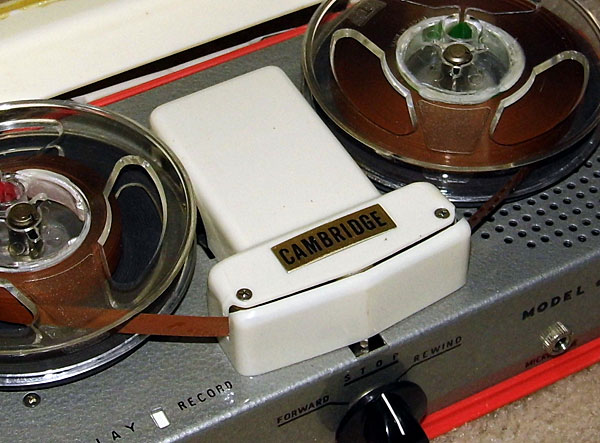
While we were preparing our list of specifications for our perfectionist's tape recorder discussed elsewhere in this issue, we suddenly came to a screeching halt at the spec which started "Scrape flutter less than . . ."
What, we wondered, was the scrape flutter percentage in a recorder in which scrape flutter is audible? Would it be 0.5%? Or 1%? Or even 5%? We perused the readily available literature, and were informed that "scrape flutter is caused by the tape's tendency to move past the heads in a series of tiny jerks in stead of in a smooth gliding motion." We were also told that scrape flutter is due to friction between the tape and the head surfaces, plus the slight elasticity of the tape that allows it to stretch slightly before being dragged along by another silly millimeter, and that it sounds like a rough edge riding on all signal frequencies between about 3kHz and 8kHz.
Why Stereophile Makes Recordings
This morning, John Atkinson passed along to me an e-mail he received from one of our most attentive correspondents—a reviewer, in fact, for an erstwhile competitor. We know that this particular writer ranks among our closest readers because an issue seldom comes out but that he writes an analysis of it, including, and down to, what he considers our excessive political correctness in choice of pronouns.
Why Hi-Fi Experts Disagree
Dateline: late August 1989. The scene: my palatial office in the Stereophile Tower. Present were the magazine's official technowizard Robert Harley, Circulation Kahuna Michael Harvey, and myself. The subject under discussion was the program for the Stereophile Test CD, launched in this issue, and Bob had been dazzling Michael and myself with a description of the sophisticated signal-processing power offered by the Digidesign Sound Tools music editing system with which he had outfitted his Macintosh IIX computer. (He had to fit it with a 600-megabyte hard-disk drive!) "It'll even do edits as crossfades as well as butt joins," enthused Bob. "Let me tell you about the crossfade I once did when editing a drum solo for a CD master that lasted ten seconds..."
Why Hi-Fi Prices Have Risen

I wrote much of this column, including the title, in early April before the Trump administration announced "reciprocal" tariffs on imported goods. A random example: Switzerland, home of CH Precision, darTZeel, Goldmund, Orpheus Lab, Piega, Stenheim, Thorens, and Wattson, among other hi-fi companies, where the tariff is 31%. Before this issue closed, the Trump administration announced a 90-day reprieve for everyone but China, then exempted computers and smartphones (and a few other categories) from the China tariffs. Importers and foreign manufacturers I talked to at AXPONA in April were happy for the reprieve but remained on edge. Uncertainty reigned.
Why I Can't Stop Being an Audiophile

"Why can't you stop being an audiophile?"
The question took me off-guard. It didn't come from one of the usual suspectsa hostile anti-audiophile, or a non-audiophile who simply can't fathom why we should care so much about something as nonessential as sound reproductionbut from Louis, a sharp dressed, goateed, middle-aged man who was known, among his audio repair shop's clientele, for not only his virtuosity as a classical solo violinist, but his expertisesome would say his preternatural abilityin setting up turntables to sound their very best.
Why Music Matters Most
"Stanley, see this? This is this. This ain't something else. This is this."—Michael, inThe Deer Hunter