

Manley Laboratories Stingray integrated amplifier

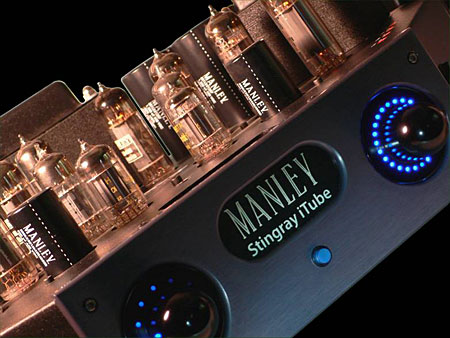
There's an aesthetic dimension to the Manley Laboratories Stingray that transcends high-end audio and borders on modern sculpture—not unlike the E.A.R. V20, which I auditioned in the October issue. Still, the Stingray is by no means an exercise in gimmickry. Form has clearly followed function at every step in the design process, the ultimate goal of which was to fashion a vacuum-tube integrated amplifier with real-world power that defined the outer limits of high-end performance in a functional, affordable, bare-bones package...with a touch of style.
Manley Labs Stingray iTube integrated amplifier
Years ago, when I taught high school choirs, I had many types of kids in my ensembles. Though none exclusively fit the overly stereotypical lineup of kids on Fox TV's Glee, I always managed to have a nice assortment of jocks, preps, goths, motorheads, geeks, wastoids, and dweebs. One of the things that always fascinated me was how the big, tough jocks would turn out to be the most sensitive, emotional singers. It was always a touching moment when an otherwise stoic football star or wrestler would get all misty while singing the final song of the year-end concert. It showed me that the toughest exteriors often hide the creamiest creampuffs.
Marantz Model 30 integrated amplifier
DeKalb, Illinois, 1971: When I was in college, my anthropology professor would invite me and a few of his other favored students to his house for fondue parties. We sat on shag carpet around a glass-topped coffee table, drank wine, and dipped vegetables in molten cheese. The stated purpose of this rite was to discuss Margaret Mead or Franz Boas, but that was obviously a ruse. The gathering was really about excessive pot smoking accompanied by coughing fits and the telling of ridiculous stories, all while playing LPs on his top-of-the-line Dual turntable/record-changer.
Marantz Model 40n integrated amplifier
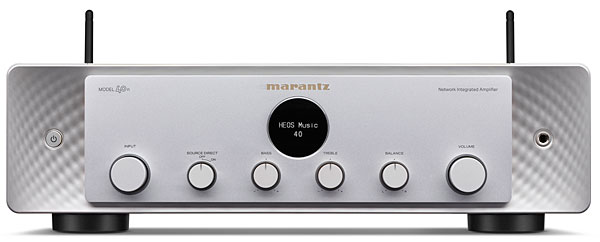
On a cold, clear February morning, I attended my first in-person press event since the beginning of the pandemic. Marantz had invited me to a small group session in a suite at the Equinox Hotel at Hudson Yards but gave no indication of what was in store. After two years without live press events or audio shows, I was not going to spurn the offer no matter what would be presented: I was hungry for hi-fi. Upon arrival, I learned that Marantz would be featuring just one new product, a streaming integrated amplifier, the Marantz Model 40n ($2499). Sure, I'm in.
Marantz PM-KI-Pearl integrated amplifier

To celebrate his 30 years with the company, Marantz threw designer Ken Ishiwata a birthday party in the form of an assignment: Design a new, limited-edition integrated amplifier and SACD/CD player bearing his initials. (Only 500 of each will be made worldwide.)
Marantz PM5003 integrated amplifier

We crotchety middle-aged (and older) audiophiles frequently sit around and whine about the apparently rising median age of enthusiasts of two-channel audio. "We need to do something to attract the youts to our cause!" one of us will say. (Youts? See Joe Pesci in My Cousin Vinny.)
Mark Levinson No.383 integrated amplifier
When I learned that Madrigal Audio Labs was marketing their first integrated amplifier, the Mark Levinson No.383, I felt this was a big change for the Connecticut company. Mark Levinson literally started the high-end marketing revolution back in the early 1970s by manufacturing cost-no-object separate amplifiers and preamplifiers. The purist designs had one overriding rule: employ the simplest circuit path possible. Each amplifier or preamplifier used only individual circuit-board components (no integrated circuits) and had a minimal number of controls, eschewing elaborate switches and tone controls. Mark Levinson Audio Systems and its successor, Madrigal Audio Laboratories, has continued this philosophy of separate components for the past 25 years.
Mark Levinson No.5805 integrated amplifier
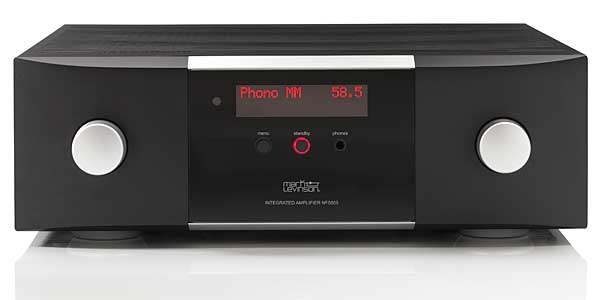
Mark Levinson isn't known as a budget brand, and most people would not consider $8500 a budget price for anything short of a new car. One could argue, though, that Levinson's new No.5805 integrated amplifier ($8500 with DAC and phono stage) is a budget componentcombining high performance and build quality with a price tag that's moderate by hi-fi standards. Plus, there's a lot of functionality in one box.
Mark Levinson No.585 integrated amplifier
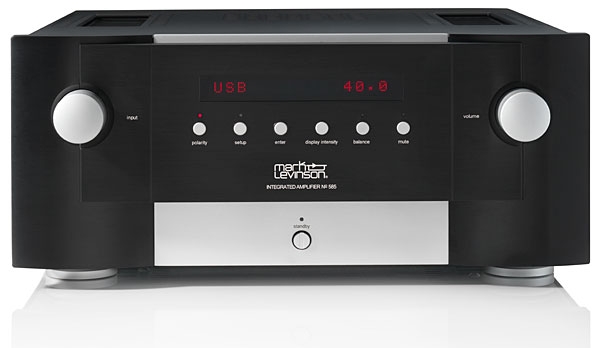
In July 2000, I reviewed the Mark Levinson company's first integrated amplifier, the No.383, and found that its sound had "clarity, transparency, liquid mids and highs, with dynamic contrasts." Also evident were the No.383's power-output limitations, the result of building large power supplies and heatsinks into a single case that had to fulfill multiple functions. Still, the No.383's price of $5900 was much less than the total cost of the equivalent in Mark Levinson separates. Later, in April 2007, I reviewed a similarly powered integrated amplifier, Bryston's B100-DA ($3195), which included a built-in DAC.
Mastersound 300 B S.E. integrated amplifier

Although she'll deny it, my wife thinks ill of me because I've failed to buy her a new Mini Cooper. I can point to a number of things in my defense—especially the Mini's lack of all-wheel drive, which we need for climbing our quarter-mile driveway in bad weather, and its insufficient cargo and passenger space—all of which would constrain a Dudley-owned Mini Cooper to recreational use only. And a new round of car payments would be difficult to justify for those reasons: not because I'm cheap, and not because I'm too old to appreciate a car that's fun to drive.