

Mastersound 845 Compact integrated amplifier
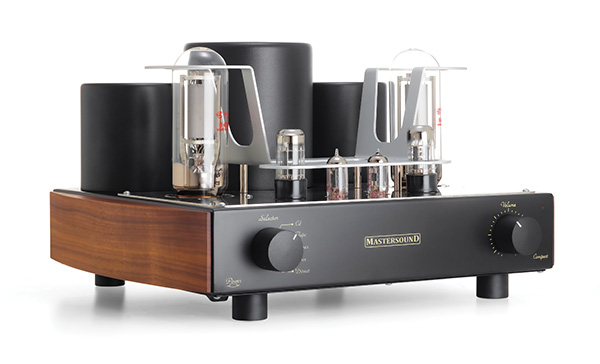
Back in the 1950s, Cesare Sanavio, then a new electronics graduate with a specialty in output transformers for tube amplifiers, began his career in radio and television, traveling to various locations outside his native Italy to apply his expertise. Eventually he settled in Paraguay and started designing tubed sound systems for public installations, teaching his son Luciano the art. A few years later, Sanavio and his family returned to Italy. There, he worked as a consultant to several hi-fi companies. Finally, in 1994, drawing on decades of accumulated knowledge of tube-amplifier design and manufacturing, and a particular focus on output transformers of the highest quality, Cesare Sanavio and his two sons, Luciano and Lorenzo, formed Mastersound.
When Cesare Sanavio died, Lorenzo and Luciano continued operations. In 2015, the company re-formed, with some new international business connections and a new CEO, Antonio Ferro.
McIntosh MAC7200 stereo receiver

Recently, I received an email from Editor Jim Austin. "Larry, do you still use your Day Sequerra FM Reference tuner1 to listen to FM radio?" he asked.
"Jim, yes, I still listen to FM classical music in the Bay area. Why?"
Mesa Tigris integrated amplifier
Obviously, no one wants to listen to exaggerated bass, italicized highs, or colored mids. But if you (as I have in the past few months) plug in several high-quality integrated amplifiers, each designed to a different price point, into the same basic signal chain, you'll experience a wide disparity of sound signatures.
Micromega AS-400 D/A integrated amplifier
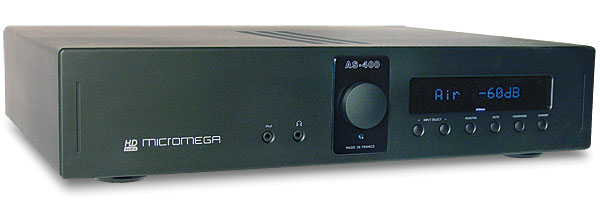
Blind though I am to the allure of blind testing, I can appreciate some degree of review-sample anonymity: Distinctive products elicit distinctive responses, but a plain black box encourages us to leave our prejudices at the door. It asks of us a certain . . . objectivity.
So it was with the Micromega AS-400 digital source/integrated amplifier ($4495), the anonymity of which was compounded, in my case, by a generous helping of forgetfulness: I suppose I was told, ahead of time, that this was a class-D amplifier, but at some point in time before my first at-home audition I apparently killed the brain cells responsible for remembering that fact. So I was innocent of conscious prejudice when I listened to this elegant cipher of a box and wrote, in my notes: "Dynamic, dramatic, and almost relentlessly exciting with some recordings. Imbued pianos with almost too much dynamism for the roomtoo much being very good!but lacked some 'purr' in the die-away. Basically fine and fun. Wish it had a little more color and spatial depth."
MOON by Simaudio 371 streaming integrated amplifier
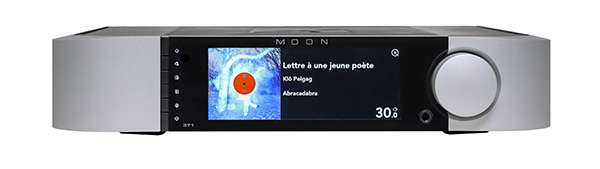
The origins of Canadian audio manufacturer MOON, from the company called Simaudio, stretch back to 1980, when audio engineer Victor Sima created his first designs. Sima's company became Simaudio Ltd. in 1990. Simaudio launched the MOON brand in 1997.
Moon by Simaudio Neo 340i integrated amplifier
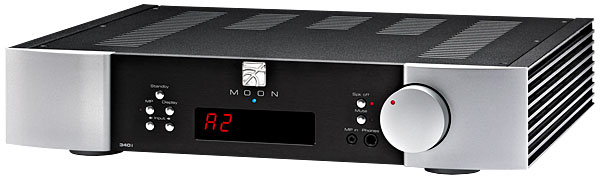
August 26, 1944: The liberation of Paris. Imagine ranks of tattered Canadian soldiers marching past the Moulin Rouge à Paris. The voice of Édith Piaf singing "Ou sont-ils, mes petits copains?" (Where are my boyfriends?). Maurice Chevalier crooning "Ça sent si bon la France" (It smells so good in France). A Canadian army tank with the words Kaput and Finito painted in white above the word Montréal, motoring past the Eiffel Tower. Remember the fresh, celebratory taste of fine Champagne.
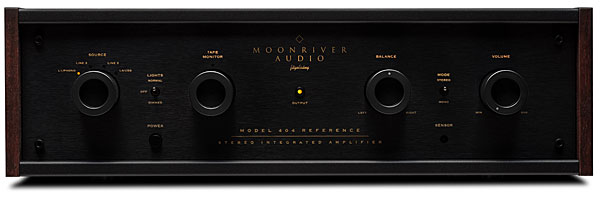
Moonriver 404 Reference integrated amplifier
Joy. It's all about the joy.
Joy manifests during those moments when the critical mind suspends, the lens clears, and only union between you and your experience exists. When joy arises, time stands still, all sense of separation vanishes, and only wonder remains.
Many of us live for those moments. Moments of understanding that transcend verbiage and mental chatter and affirm what is real and eternal about the human condition.
Musical Fidelity A1 integrated amplifier
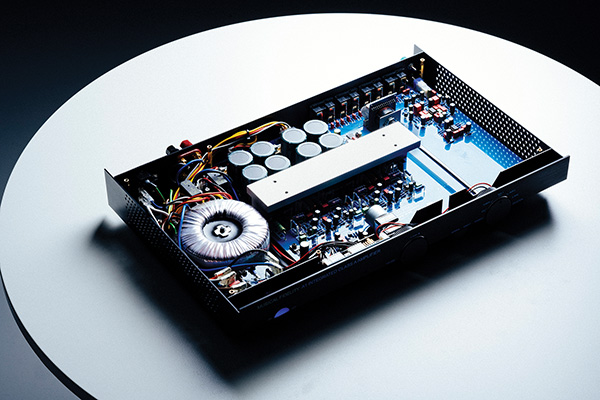
In 1989, I bought my second pair of Rogers LS3/5a's from a guy on Staten Island who had them hooked up to a Musical Fidelity A1 integrated amplifier. After playing the speakers for me, he began removing his zip-cord speaker cables and paused to show me how, at the amplifier end, his red-plastic Pomona Electronics banana plugs had partially melted from the A1's heat. We both laughed.
After it first appeared in 1985, the A1 quickly became famous for its hot top plate. The top plate got as hot as it did because it was used as a heatsink for the output transistors, which were biased highly into class-A. The A1's hot top made tabloid headlines, but for me it was its bold, sinewy, un-transistory sound and timeless, sharply drawn styling that distinguished it from cooler running Brit-fi competitors such as Audiolab's 8000A, Creek's 4040, A&R Cambridge's A60, and NAD's 3020.
Now it's back, priced at $1779, looking and feeling cooler than before.
Musical Fidelity A3.2 integrated amplifier

It was 20 years ago today that Sgt. Michaelson taught the band to play. I was living in London when Antony Michaelson launched Musical Fidelity in an attempt to make a major statement in the area of affordable, high-quality, high-value electronics. Other Brits at the time were doing the same—companies such as Creek, A&R Cambridge (now Arcam), and DNM began to compete for the destitute audiophile's dollar.
Musical Fidelity M3 Nu-Vista integrated amplifier

The old advertising jingle "Who put eight great tomatoes in that itty-bitty can?" bubbled through my head as Musical Fidelity's Antony Michaelson proudly unboxed the new $4500 M3 Nu-Vista integrated amplifier. How did they cram it all in there?