

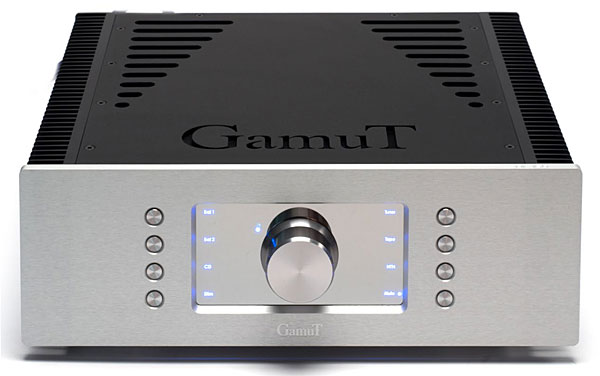
GamuT Di150 LE integrated amplifier
As Stereophile's true cub reportersorry, Herb Reichert, you're senior staff!I work in the domestic fields of the high-end audio landscape. Meanwhile, my fellow Stereophile correspondents trot the globe, attending international audio shows, experiencing all the sweet spots offered by such far-flung locales as Munich, Montreal, and Northamptonshire, UK. Am I complaining? Not! But when an audio show of merit invades New York City, still the capital of the civilized world, you can believe I'm there on opening day, pen and pad in hand. The first rooms on my must-visit list usually include Audio Note UK, DeVore Fidelity, MBLand, when the gear is warm and the good vibes flowing, as they usually are, Wes Bender Studio NYC.
Grandinote Shinai integrated amplifier

I was doing my press beat for Stereophile in the hallway of Montreal's 2019 Audiofest when I glimpsed something that stopped me in my tracks. It was a marketing slogan, across the room on importer/exhibitor Goerner Audio's floorstanding banner: "Tubes or semiconductors? Magneto-solid technology amplifies emotions."
Gryphon Audio Designs Diablo 333 integrated amplifier
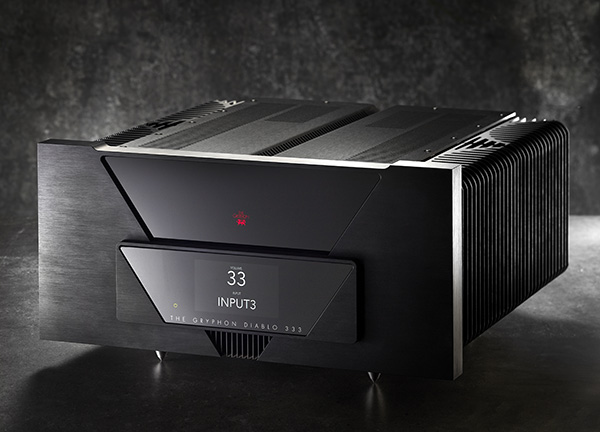
What's in a name? Denmark-based Gryphon Audio Designs laid down a marker when company founder Flemming Rasmussen chose that name in 1985. Browsing through the current Stereophile Recommended Components list, I only found one other manufacturer that utilizes an animal moniker. The imagery summoned by the use of the mythical treasure-guarding Gryphon seems appropriate; a hybrid creature combining features of the eagle and the lion, creatures of strength and speedthis choice underlines some of the aesthetics and performance Gryphon Audio has become known for. The handsome hardcover user's manual for the Diablo 333 simply states in gold "The Gryphon," along with a side-on profile of that winged lion-tailed creature, as a logo.
The Gryphon Diablo 333, a solid state, stereo integrated amplifier ($24,900 without optional DAC and phono stage modules), replaces the Gryphon Diablo 300, which was in production since 2016.
Harman Kardon HK 990 integrated amplifier

The very first amplifier I bought was a Harman Kardon PC-200, aka The Prelude. It was a 10Wpc integrated, but I chose it over the competition for some of the same reasons that the HK 990 has appealed to me. Almost all amps back in the1960s had a plain cake-pan chassis with tubes, capacitors, and transformers studding the top. Integrated amps had the standard four knobs on the front for input selection, volume, bass, and treble. The HK PC-200 had an enclosed black chassis cage that formed a graceful cowl over the brushed-copper front panel and the six matte-black knobs: for Input selection (with three phono turnover settings), Volume, Bass, Treble, Loudness contour, and Treble rolloff. In addition, it had a Rumble Filter switch. The PC-200 was not only more beautiful than the rest of the push-pull competition powered by EL84 tubes, it also had more useful features. (Take that, you fans of the Grommes Little Jewel!). Over the decades, H/K products have always been stylish and innovative, but in today's fractured marketing world, most such creative energies are applied to audio/video receivers and lifestyle products.
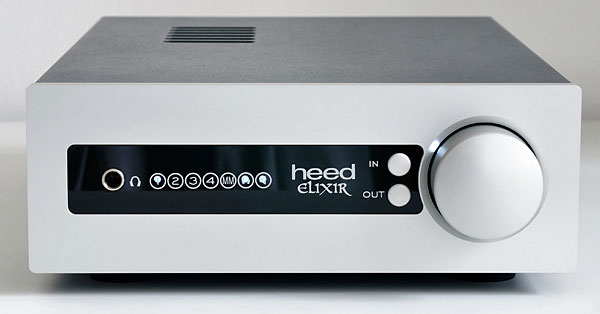
Heed Audio Elixir integrated amplifier
I recently watched Terra, an exceptional film by French directors Yann Arthus-Bertrand and Michael Pitiot. It's not a nature documentary per se, rather a history of life on Earth from lichens to lions, amoebas to humans. Terra boasts stunning cinematography of the natural world, revealing a beauty that nearly softens the film's cautionary message.
"How have our relations with other living beings changed so much?" asks Arthus-Bertrand on his website. "What do we still see, or notice, of the living world around us? . . . We no longer see the wild, we dream of it. It's an age-old fascination, visible in the paintings of the Chauvet Cave. But this dream is today disappearing, vanishing in factory smoke and industrial smog. . . .
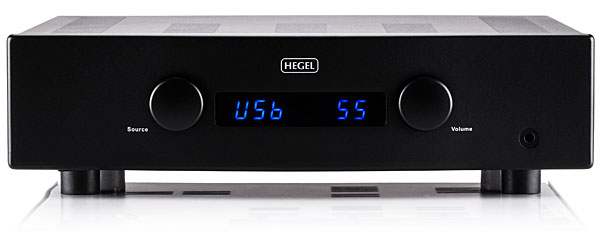
Hegel H400 streaming integrated amplifier
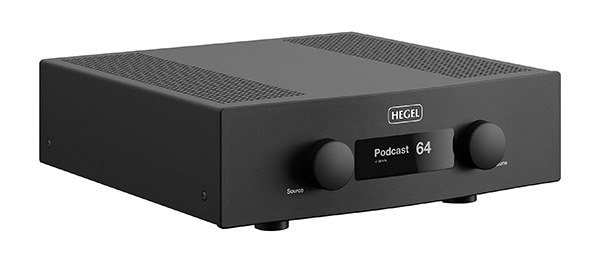
The Internet of Things has arrived at the stereo rack. Many hi-fi systems are now connected to the wider world, controlled by phones and tablets. Complex front panels with many switches and buttons have practically vanished; those still around are retro pieces or style statements. Little front-panel touchscreens with complex menu trees have been rendered vestigial or at least redundant. Designers of receivers, integrated amplifiers, and DACs must now at least consider incorporating a streaming module and a device-control app. In certain component categories and certain price brackets, a built-in app-controlled streamer is now a key part of the value proposition, much as a tuner was back in the days of terrestrial radio.
The Hegel H400 combines the functions of an integrated amplifier, DAC, and streamer.
Hegel Music Systems H160 integrated amplifier
For decades, I read all the British and American audio magazines, and I pretty much believed everything written thereinwith one exception. The equipment reviews published in Stereo Review had an off-puttingly disingenuous quality. I learned a lot from the magazine's reviews of recordings and loudspeakers, but every time senior editor Julian Hirsch wrote that any amp with sufficiently high power, low measured distortion, and high damping factor would sound the same as any other with similar qualifications, I felt estranged from my favorite hobby. Stereo Review's arrogance came off as duplicitous and self-serving. The magazine seemed committed to stamping out all forms of individualized audio connoisseurship.
HiFi Rose RA180 integrated amplifier

Sometimes it's good to step outside your comfort zone. In fact, I relish new and novel experiences. It's a major reason I enjoy attending hi-fi shows and events: for the chance to see and hear new thingsnew hi-fi equipment, especially equipment that's groundbreaking or unusual.
HiFi Rose RA280 integrated amplifier
It's been said before, but the essential truth remains as shiny as a new 2A3 tube: A well-made, good-sounding integrated amplifier is a sonic marvel, a triumph of audio engineering.
HiFi Rose RS520 streaming integrated amplifier

My first car was a decrepit, mustard-yellow Peugeot 304 with a navy hood. The blue hue wasn't a fashion statement; after an accident, the previous owner had gone to a salvage yard where only a blue replacement could be procured. When he grew sick of the carbecause it made him look "like a frickin' ad for Ikea"I paid him 600 Dutch guilders for the old heap, the equivalent of about $300 US. . .
Years later, when I got into hi-fi, I thought of that car and subsequent ones. What stood out to me most about high-end audio was: separates.