

"If it sounds good..."
"...and measures bad, then you're measuring the wrong thing!" If one motto could sum up this magazine's philosophy, this would be it. Too many times we have discovered components that sounded musically fabulous while offering measured performance that was, at best, merely competent. Yet recently, I'm starting to lose confidence in that old saw.
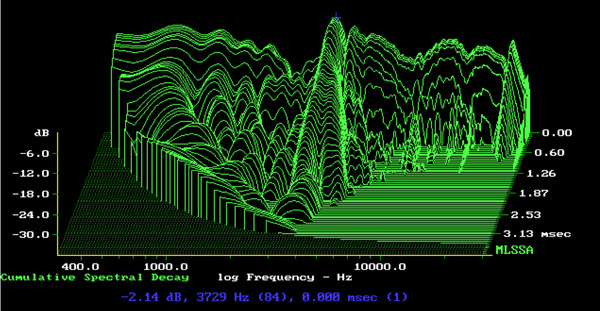
On a number of occasions, I or another of Stereophile's reviewing team has heard a product sounding flawed in ways later revealed by measurements. A closed story, you might thinkbut consider the NEAR-50M loudspeaker reviewed by Dick Olsher in this issue. Despite hearing many good things in the speaker's sound, Dick was bothered by a tonal-balance problem in the low treble. He was also disturbed by a lack of integration between the tweeter and midrange unit. When I measured the '50M, my response graphs (footnote 1) pretty much explained why Dick heard what he heard. Nevertheless, other reviews of this loudspeaker have been ecstatic in their praise, one even stating that it was "one of the most transparent and balanced dynamic loudspeakers available at any price" (my italics).
"Observe the Candle..."
"Observe the candle!"
"Recommended Components"—the St. Hubbins' Syndrome!
Suppose you've put aside some cash for a new preamp. You survey the field and zero in on the Musical Ecstasy 1000 and the Sonic Nirvana Special. Both got good reviews in all the magazines, they look great, and each will set you back about the same number of mortgage payments. So you visit your dealer and camp out for a weekend or two. You listen, you think, you walk around the store, you listen some more, you recalculate your tax return. You listen some more. Finally, you have a winner. "I want that one," you tell your dealer; "the Sonic Nirvana."
"Vat do you zink of all my toops?"
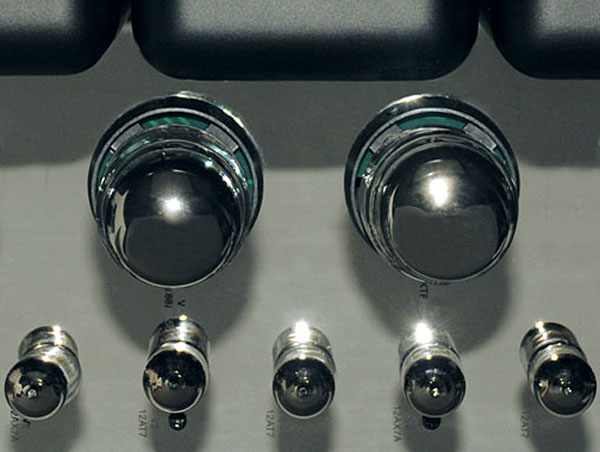
Pollock, Rothko, Amperex, and Sylvania? Last spring I went to a contemporary art show out on Chicago's Navy Pier. I wanted to get away from things with wires and knobs—you know, rub elbows with Chicago's better-dressed, sip some wine, maybe practice talking about artistic creations that I usually don't understand ("It's so brutally honest...yet, somehow, still deceptive"). But there's no rest for the weary, confused audiophile. Along with artists, paintings, and sculptures from all over the world, thousands of vacuum tubes had descended on the Pier.
A High-Resolution Audio Primer
January's Industry Update included a report on a scientific article presented at last year's AES meeting, in which the authors used test tones and a modest audio system (albeit in an anechoic chamber) to prove that listeners can discriminate between high-rez and CD-rez audio. This is important because scientific evidence of an audible difference between high-rez and CD-rez music is considered weak by some, even as anecdotal evidence grows stronger by the day.
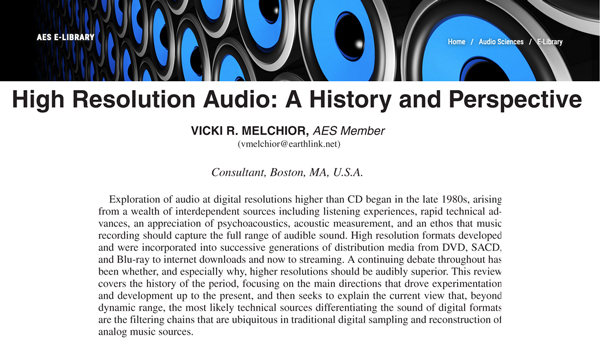
As I pondered this, I recalled a recent paper I'd seen in the Journal of the Audio Engineering Society but hadn't yet read. "High Resolution Audio: A History and Perspective," which the AES has made available free online, does precisely what the title says: reviews the history of digital audio beyond CD-rez and frames the issue of high-rez audio's audible superiority on the basis of the available evidence.
A New and Awful Silence
The electric clocks in my house keep better time than the ones I wind, yet I scarcely look at them. It is the ticking, I think, that comforts me. I like to lean my ear against these various pendulums and, back and forth, gently rock my life away.
A Tale of Two Speakers

A comment by "cgh" in an online reprint of a Stereophile review caught my attention: "The [1990s] were probably the last real decade that we could reasonably bend the truth. Everything since is verifiable electronically."
Everything?
Accuracy & Resolution: the Jagger Effect
Back in 1968, nothing sounded better to me than "Penny Lane"—one of my all-time favorite songs—blasting out over my Dad's home-built Eico gear (when no one else was around, of course). For some reason, the various sounds packed into that song grabbed my attention as much as that old integrated amp whose steel case got as hot as the tubes inside—ouch! When the Beatles broke up, I played Magical Mystery Tour over and over for days before I felt I'd paid them sufficient homage. Like everyone else, I heard a lot of the Beatles through the '70s and '80s. (And now, of course, it may as well be the '60s again: if you can stomach another "Magic Carpet Ride" every hour (or so it seems), just tune in your local "classic rock" station and you'll hear lots of "Penny Lane," too.)
Amplifier Power: How Much is Enough?
Considering the amount of careful research, cautious theorizing and wild speculation that have been lavished on the amplifier power question, we should expect to be considerably closer to the answer in 1962 than we were five years ago. This does not seem to be the case.
Are Audiophiles Music-Lovers?
"Like many audiophiles I have often sped home from a concert to fire up the audio system, and then, to the sore vexation of my wife and guests, spent the rest of the evening plunged in the morbid contemplation of what, exactly, was missing."