

Allaerts MC2 Finish Gold phono cartridge
These are great times for analog, and I'm happy to have played a small part in the revival, but recently the demand for some products has outstripped supply; getting review samples has been next to impossible. I've requested an Audio Research PH7 phono preamplifier for literally years now, but ARC can't build them fast enough, so they don't need a review. The more they sell, the greater the buzz, and the greater the buzz, the more e-mails I get from readers asking for a review. It's not nice to not be needed.
Analog Corner #236: Clearaudio Maestro V2 phono cartridge

Clearaudio began making moving-coil cartridges in the 1970s, and only later got into the moving-magnet business. Moving-magnet cartridge designers must now be mindful that most of today's tonearms are of medium to high mass and that therefore, to be compatible, their MMs must be of low to medium compliance and of higher mass than those of the 1960s and '70s.
Audio Dynamics ADC-1 phono cartridge
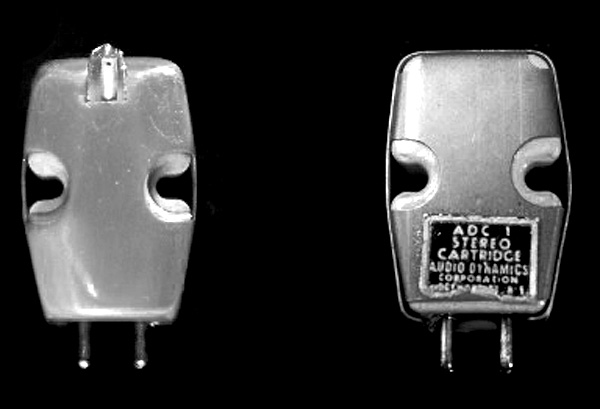
We tested two samples of the ADC-1 phono cartridge, both of which were taken from a dealer's stock. One was a demonstrator that had been in use for some months. The other was brand new, right off the shelf. Both were tested in an Empire 98 tonearm and in a Gray 108-C tonearm with its damping lightly adjusted, but results with both cartridges were for all intents and purposes identical in both arms.
Audio-Technica AT-ML 150/OCC phono cartridge
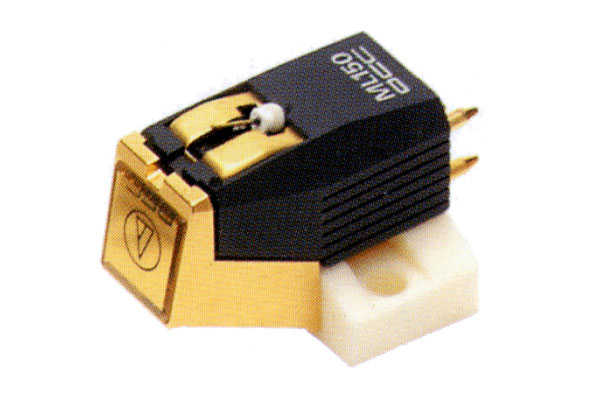
How can two meticulously built, high-technology, high-performance, premium-quality moving-magnet cartridges that measure so well (according to their manufacturer-supplied specs) sound so different?
Audio-Technica AT-OC9 phono cartridge
 While the AT-OC9 bears the Audio-Technica logo, you won't find a sample of this moving-coil cartridge at your friendly Audio-Technica dealership. The US distributor of Audio-Technica products has apparently decided that their market does not include high-end cartridges. A quick perusal of the latest Audio directory issue (October 1988) lists the most expensive AT cartridge at $295, with no moving-coils in sight. When I first heard of the AT-OC9, the only reasonably accessible source, short of Japan, was Audio-Technica in the UK. A quick phone call and follow-up letter resulted in a review sample. Since that time, Music Hall in the US importers of the Epos loudspeakers, among other items) has begun importing the AT-OC9 (along with the less-expensive AT-F5). Mail-order company Lyle Cartridges also stock it, I believe.
AudioQuest 7000 Fe5 MC phono cartridge
You know what's the first thing they teach you in dental school? Don't ever say "Oops!" Even if you stick one of those hooked teeth scrapers through the patient's cheek, you don't say "Oops!" "Don't move!"? Yes. "Oops!"? No. That's the big day-one lesson—and given the cost of medical malpractice insurance today, a damn good one.
Benz-Micro MC-20E II & MC Silver phono cartridges

No matter how much I upgrade my digital rig, my trusty $1195 Well-Tempered Record Player blows it away without half trying. . . That's why I corralled a bunch of promising midpriced cartridges and spent a couple of months settin' 'em up, breakin' 'em in, and listenin' to 'em on my favorite records.
Benz-Micro MC20E2-L MC phono cartridge

The ceiling remains, but the floor has changed: Benz-Micro continues to offer a selection of rather expensive phono cartridges, including their well-established LP Ebony ($4700) and Ruby 3 ($3000) models. But in recent years, my attention has been drawn by the succession of budget Benzes: first, the Gliders ($795), then the ACEs ($550), and now the MC20E2-L ($199).
Brinkmann EMT Titanium phono cartridge

There are a thousand different ways to make a loudspeaker. A hundred to make an amplifier. And at least a million to make a piece of wire. But here's the deal with a moving-coil phono cartridge: stylus, cantilever, rubber grommet, tensioning wire, coils, magnet, output pins, and maybe a body. Done.
Brinkmann Pi phono cartridge
 The Brinkmann Pi cartridge's Benz-Micro heritage was obvious from the get-go. The motor is built to Brinkmann's specifications by Benz-Micro and includes a Micro-Ridge stylus. The cantilever material is not specified. The Pi's output is approximately 0.25mV, and its compliance is moderate at 15µm/mN. Recommended are a tracking force of 1.82gm, a VTA of 23°, and a resistive load of 600 ohms.
Helmut Brinkmann says he tweaked the Pi's design for a year and a half before he achieved the results he desired, including making the tiny set screws out of various materials. The Pi, with a body of machined aluminum designed to control the dissipation of resonant energy, weighs a hefty 14gm. Brinkmann supplies aluminum screws and titanium washers, which, he claims, in combination with special damping between the cartridge body and headshell, have been "sonically tuned to create a unique musical instrument."
The Brinkmann Pi cartridge's Benz-Micro heritage was obvious from the get-go. The motor is built to Brinkmann's specifications by Benz-Micro and includes a Micro-Ridge stylus. The cantilever material is not specified. The Pi's output is approximately 0.25mV, and its compliance is moderate at 15µm/mN. Recommended are a tracking force of 1.82gm, a VTA of 23°, and a resistive load of 600 ohms.
Helmut Brinkmann says he tweaked the Pi's design for a year and a half before he achieved the results he desired, including making the tiny set screws out of various materials. The Pi, with a body of machined aluminum designed to control the dissipation of resonant energy, weighs a hefty 14gm. Brinkmann supplies aluminum screws and titanium washers, which, he claims, in combination with special damping between the cartridge body and headshell, have been "sonically tuned to create a unique musical instrument."