

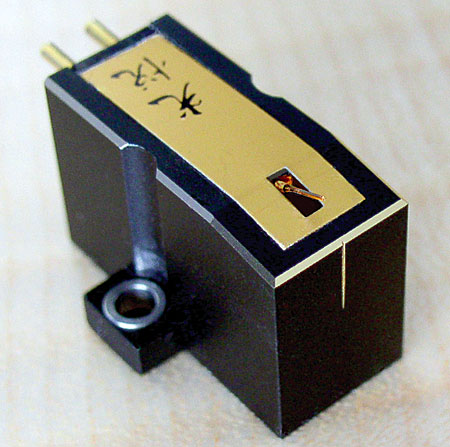
Koetsu Black MC phono cartridge
Every two or three years my family and I travel to Disney World in Orlando, Florida—one of those places I used to think I'd hate, but which I always enjoy in spite of myself. No such trip would be complete without visiting the Mitsukoshi department store at Epcot Center, which represents the pinnacle of Japanese consumer culture. At the Epcot Mitsukoshi store—the 430-year-old company's only US location—one can buy the finest of everything, including the rarest and most expensive writing papers and inks, the most exquisitely crafted pottery, and the loveliest freshwater pearls on Earth. Young shoppers are accommodated with the latest toys, trends, and technology—but there's nothing frantic or cheap about the manner in which they're offered. The watchword at Mitsukoshi is quality, and the presentation borders on being artistic.
Koetsu Rosewood Signature Platinum moving-coil cartridge
Among the more intriguing audio-related announcements this year was that Koetsu phono cartridges were once again available in the States. In fact, they're being handmade in limited quantities by the sons of founder Yoshiaki Sugano.
Koetsu Urushi MC phono cartridge

What makes a phono cartridge worth $3500 or $4000? Pride of ownership? Snob appeal? Sound? Tracking ability? Exotic materials? Styling? Labor cost for skilled artisans? Special ether? Cool wooden box? All of the above?
Linn Akiva MC phono cartridge
The observation has been made, often and well, that audio writers are out of touch when it comes to judging value for money. For one thing, we get to live with exotic gear for months at a time, without spending a penny. For another, when we do decide on a more permanent upgrade, we usually get the opportunity to buy at wholesale—at a so-called "industry accommodation price," extended to us because, after all, we are a part of the industry.
Linn Arkiv B phono cartridge

Ten years ago, I'd probably have got pretty good odds from industry insiders on a bet that Stereophile would still be reviewing phono cartridges into the new millennium. Linn's Arkiv B may not be a brand-new design—I heard my first sample in mid-1997—but phono-cartridge technology is about as stable as anything in hi-fi today. This Stereophile review is long overdue.
Linn Troika MC phono cartridge
Some six or so years ago, the Linn Asak cartridge set new standards for imaging and soundstage reproduction. I can remember the first time I heard an Asak in a system using Quad">http://www.stereophile.com/floorloudspeakers/416">Quad ESL-63s—I had never experienced such depth of soundstage and solidity of imaging from any system, and that with Quad amplification! The Asak was relatively quickly overshadowed in this area, however, and in any case, soundstaging precision by itself didn't seem to be a high priority for the Linn design team, who were apparently more concerned with dynamics and a musical integration of the sound across the frequency range.
London (Decca) Jubilee/Reference phono cartridge
 London phono cartridges still carry the famous Decca name (even if only in parentheses), but they are now produced by John Wright, a precision engineer and ex-Decca employee. Wright (not to be confused with his IMF and more recent TDL loudspeaker-designer namesake) was assigned the rights in 1989 by Decca's Special Products division (footnote 1), when the company's new owner, Racal, decided that they didn't want to be involved in the manufacture of audio equipment. Wright worked for 20 years in Decca's phono-cartridge division, where he gained a wealth of experience. As well as manufacturing the current range of London cartridges, he is also responsible for servicing and overhauling older Decca models.
Luxman LMC-5 moving coil phono cartridge
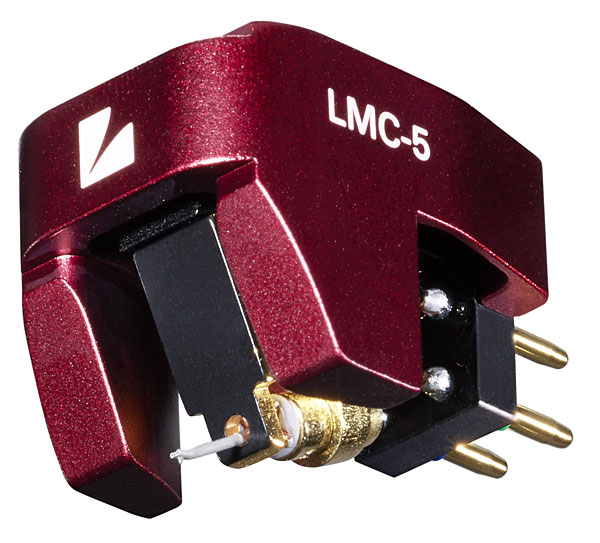
Since 1925, Japan-based Luxman Corporation has manufactured high-quality integrated amplifiers, preamplifiers, power amplifiers, phono stages, turntables, and, more recently, DACs and CD players. But it has been 40 years since Luxman introduced a new phono cartridge; the last one was the LMC-2 in 1982, released just after 1981's LMC-1. That dry period ended with the introduction of the Luxman LMC-5 ($2695).
Lyra Atlas MC phono cartridge
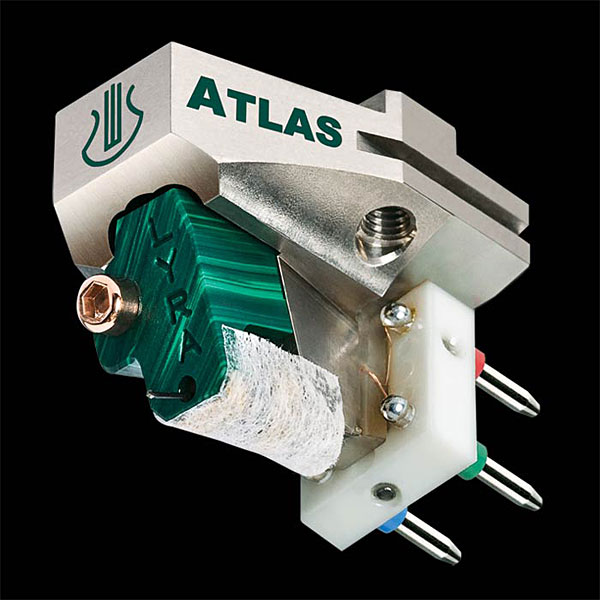
At the 2012 Consumer Electronics Show, I spoke with Lyra's Jonathan Carr about the Atlas. He told me that, rather than having started as a blank sheet of paper, the Atlas is an outgrowth of the Kleos ($2995), which I reviewed in January 2011, when I thought it Carr's best balanced design yet, even if it didn't have quite the resolution of the Titan i. Like the lower-priced Delos ($1650, reviewed in August 2010), the Kleos included Carr's New Angle technology, which mechanically aligns the coils to be perfectly positioned relative to the front and rear magnets when the stylus is in the groove.
Lyra Atlas SL and Etna SL phono cartridges

My 0.56mV-output Lyra Atlas moving-coil cartridge ($11,995) has put in four years of heavy-duty use. But not long ago I began to hear some problems with sibilants from records that previously hadn't given me trouble in that department. Lyra's Jonathan Carr and Stig Bjorge suggested I bring my Atlas to the 2016 Consumer Electronics Show, held last January in Las Vegas, where they would exchange it for a new one.