

Lyra Clavis Da Capo moving-coil phono cartridge
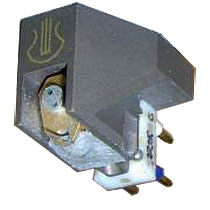
Scan-Tech builds low-output moving-coil cartridges for a number of companies, including AudioQuest, Linn, and Spectral (footnote 1). It also markets its own line, under the Lyra brand name (Lydian, Clavis, Parnassus), which is imported and distributed by Immedia out of Berkeley, CA.
Lyra Parnassus D.C.t phono cartridge

What makes a phono cartridge worth $3500 or $4000? Pride of ownership? Snob appeal? Sound? Tracking ability? Exotic materials? Styling? Labor cost for skilled artisans? Special ether? Cool wooden box? All of the above?
Lyra Skala moving-coil phono cartridge

Back in 2000, when Lyra introduced the Helikon moving-coil cartridge, which replaced the then six-year-old Clavis D.C., the company inexplicably retained the Clavis D.C.'s retail price of $2000. This was inexplicable because the Helikon's revolutionary design was new from the ground up, and because audiophiles—like most, if not all, consumers—perceive price to be a reflection of quality and performance.
Miyajima Shilabe phono cartridge
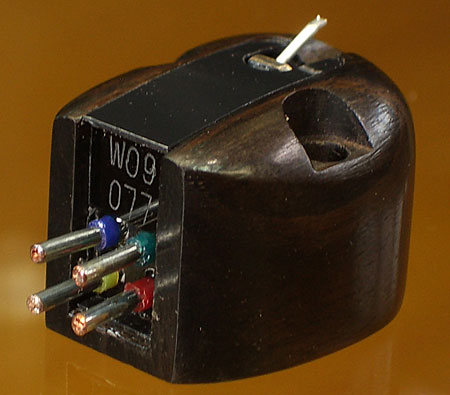
The unusual Miyajima Shilabe moving-coil cartridge ($2800) came to my attention through a friend, and I obtained one from the importer, Robin Wyatt of Robyatt Audio, a music lover and dedicated audiophile who imports gear as a sideline, and who lives nearby in New Jersey.
Monster Cable Alpha Genesis 500 phono cartridge
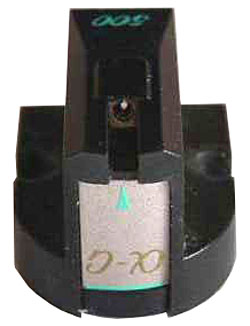 The Genesis 500 ($650) is the baby brother of Monster Cable's top-of-the-line Genesis 1000 cartridge. It is almost identical in physical appearance, differing only in its use of green body trim (the 1000 sports red pinstripes). All of the functional differences appear to be in the stylus and cantilever. The cantilever of the 500 is a hollow sapphire rod tightly attached to an inner aluminum tube (the 1000 has a diamond-coated boron tube cantilever). Its stylus is a 6µm x 35µm line-contact (3µm x 60µm for the 1000). Monster claims a stylus life in excess of 600 hours for the Genesis 500, more than 1000 hours for its higher-priced sibling.
 Ortofon M15 Super phono cartridge
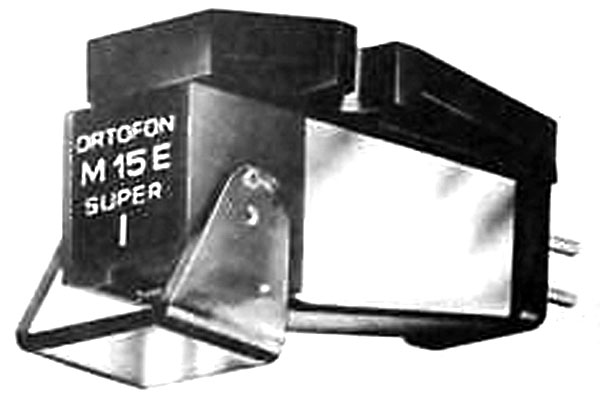
The M15 Super is the first high-output pickup to come from Ortofon. Previous ones required either step-up transformers or a booster preamp, and it is only fairly recently that either kind of step-up device was available with high-enough quality to avoid a noticeable degradation of the sound. Early step-up transformers muddied the bass, and previously-available booster preamps added noise or hardness or both to the sound. Now that there are excellent transformers available from Ortofon and other sources, and at least one extraordinarily good booster preamp (the Mark Levinson, at an extraordinarily high price$170), Ortofon's latest and best pickup doesn't require the use of either.
Ortofon MC Century phono cartridge
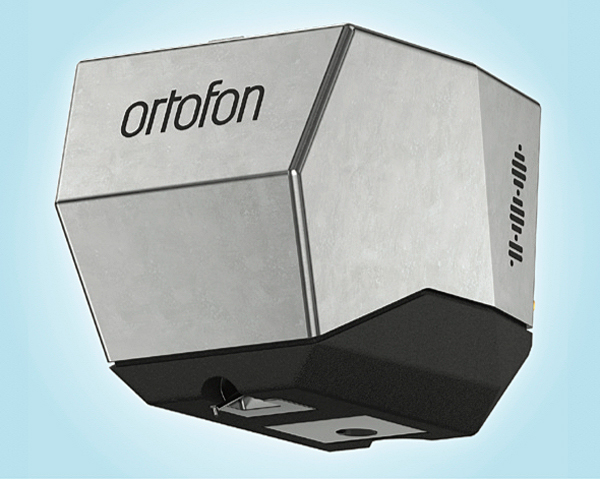
A few years ago, Leif Johannsen, Ortofon's chief officer of acoustics and technology, was tasked with designing new products to commemorate the company's 100th anniversary, in 2018 (footnote 1). Ten years ago, to celebrate Ortofon's 90th, he came up with the radical A90 moving-coil cartridge, which used Selective Laser Melt (SLM) technology to laser-weld together microparticles of stainless steel, layer by layer, to produce a 3D-printed metal body whose shape would have been impossible to machine.
Ortofon MC-2000 MC phono cartridge
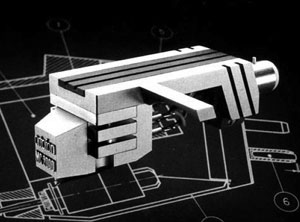
Although the idea of a $1000 moving-coil cartridge no longer shocks audiophiles, it is still not exactly what I'd call "Mainstream Hi-Fi." Audio magazine's 1984 Equipment Directory—the most complete such compendium published in the US—lists only 10 models in this price range, not counting the Kiseki Lapis Lazuli at a whopping three-and-a-half grand! I have not tested most of these, nor have I tried any of the current models from the Japanese Koetsu firm, which was first with the gall to put a $1000 price tag on a cartridge. But I have tested a couple of one-granders during the past few years, and was sufficiently unimpressed to be hesitant about testing any more samples of what were beginning to look like nothing more than monumental ripoffs. So when Ortofon sent us the MC-2000, I was naturally less than enthusiastic about trying it.
Ortofon MC-3000 MC phono cartridge
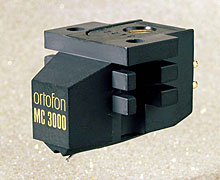
The Ortofon">http://www.stereophile.com/phonocartridges/ortofon_mc-2000_mc_phono_car… MC-2000 may just have been the most impractical cartridge to be unleashed upon the audio community for some years. With a high compliance (20cu) that made it ill-suited for most tonearms, it also had a preposterously low signal output of 50 microvolts, which gave new meaning to the terms hum and noise. Few MC preamps had enough gain to deliver adequate driving voltage to a system, and none of those that did had low enough noise to be usable with the 2000. If the problem wasn't hum, it was hiss; if hiss was acceptably low, there would be too much hum. At least Ortofon had the sense to be aware of the problem and to do something about it, in the form of their T-2000 step-up transformer, which is the only device I ever found that would allow the cartridge to be operated without a constant background of hum or hiss. Despite all this, I have used the MC-2000 as my reference cartridge for the last two years. Why? Because of all the cartridges I've tried, it is by far the most accurate.
Ortofon Rondo Bronze MC phono cartridge

An enduringly healthy phono-cartridge industry? After a quarter of a century of rushing right out to buy the latest digital music appliances? You bet.