

Stereophile: A Personal Odyssey

John Atkinson (left) and Richard Lehnert (right) in RL's house in May 2011, the day before RL moved from Santa Fe, New Mexico, to Ashland, Oregon. (Photo: Susannah Tyrrell)
I first became aware of the existence of Stereophile sometime in spring 1985, while working as a typesetter in Santa Fe, New Mexico. (Remember typesetting?) From far down the hall behind me I heard a big, high-pitched laugh. I turned to see my present boss guiding toward my dark typesetting cell my future boss: a very tall, balding, round-faced man with a huge grin who shambled along in loose chinos and a Hawaiian shirt in full sail.
2020 Jitter Measurements

Even as digital/analog processors were becoming a hot product category in the early 1990s, audiophiles were also learning that timing uncertainties in the AES/EBU and S/PDIF serial datastreamsjitterwould compromise any improvement in sound quality offered by these DACs. Some companies therefore introduced products to reduce or eliminate jitterin the November 1994 issue of Stereophile, Robert Harley reviewed three such products: the Audio Alchemy DTI Pro, the Digital Domain VSP, and the Sonic Frontiers UltrajitterBug. I still have Stereophile's review samples of the UltraJitterBug and VSP, along with two contemporary DACs: a PS Audio UltraLink and a Parts Connection Assemblage DAC-1.
As our reviews of these products were published before Paul Miller's and the late Julian Dunn's development of the "J-Test" diagnostic signal, I performed J-Test jitter measurements to bring that 1994 review into the 21st Century. You can see what I found here.
A New Size For Stereophile
By now you've no doubt realized that Stereophile has changed its size—from 5½" by 8 7/16" to 7½" by 10¼". (All right—maybe you didn't know the exact dimensions of the change, but that's what they are.) We have Edward Chen, Publisher of Stereophile's Chinese edition, to thank for our new size. It is the same size as the Chinese Stereophile and a common size in the Far East. We've been admiring it in Chinese for the last two-and-a-half years, and we thought it would make sense in English as well.
Audio: The View From Outside
I have a confession to make: I play contrabassoon . . . for a living. Now to many this may not seem like such a sin, but within the musical community my instrument is viewed with about as much regard as the common garden slug. This perception is not completely unjustified; often being relegated to roles depicting monsters and evil, along with the occasional digestive grunt, helps perpetuate the general disdain for the contra. However, playing the lowest (non-keyboard) instrument in the symphony orchestra gives me a somewhat different perspective on things, not unlike that of a dwarf in a crowded elevator: a view from the bottom up. It's amazing just how much pitch and harmonic coloration there is down in the subbasement. And shoring up the foundation of the wind section, as well as being the true bottom of the orchestral sonority, can be very satisfying. Although playing an instrument with a limited repertoire can sometimes be disconcerting, it also has its advantages. During rehearsals, if I'm not required for a certain work, I can go out into the house for my own private concert, or stay put in the orchestra and get a sonic thrill that makes the IRS and WAMM systems sound like tin cans.
Book Review: Quad: The Closest Approach
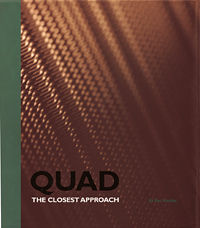
Quad: The Closest Approach
by Ken Kessler. Cambridge, England, UK: International Audio Group Ltd., 2003. Hardcover, 12" square, 215 pp. ISBN 0 954 57420 6.
Available from: Quad dealers or IAG America, 15 Walpole Park South, Walpole, MA 02801. Tel: (508) 850-3950.
by Ken Kessler. Cambridge, England, UK: International Audio Group Ltd., 2003. Hardcover, 12" square, 215 pp. ISBN 0 954 57420 6.
Available from: Quad dealers or IAG America, 15 Walpole Park South, Walpole, MA 02801. Tel: (508) 850-3950.
Bozak Concert Grand B-410 loudspeaker
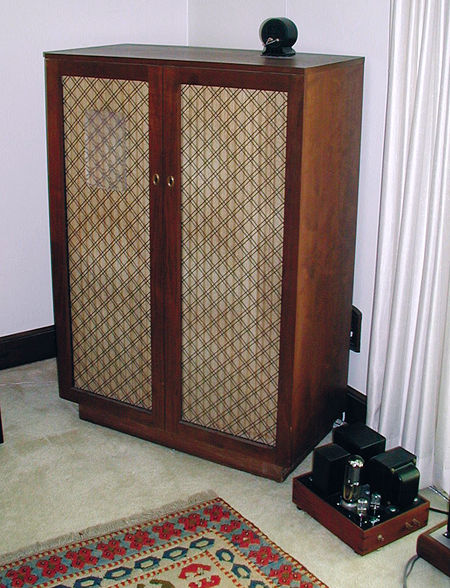
The Bozak Concert Grand is a loudspeaker dreams are made of. I was just a boy, but I remember to this day the impressive pictures of them in Audio magazine. I thought they must be the best loudspeakers ever made because they were so big—they would let more of the music come out. I suspect the Bozaks beckoned to me in some primal way, just as those giant construction trucks do—the ones that have tires bigger than a man.
Farewell to the Paper Cone

Ever since the first electrical loudspeakera glorified headphone with a horn on itwas outmoded by the balanced-armature cone speaker, paper has been the standard diaphragm material for speakers reproducing low frequencies. The Rice-Kellogg moving-coil transducer replaced the balanced-armature driving system in 1925, but the paper cone remained. And although many improvements have since been made, were no more major changes in loudspeaker design for over 30 years!
Fisher 500-C vintage stereo receiver

Back in 1964, Avery Fisher, founder and president of the Fisher Radio Corporation, wrote a short note for the 500-C Stereophonic FM Multiplex Receiver owner's manual. In that note he said, "a door has opened for you, and your family, on virtually unlimited years of musical enjoyment."
How Hi-Fi are Stereo Discs?
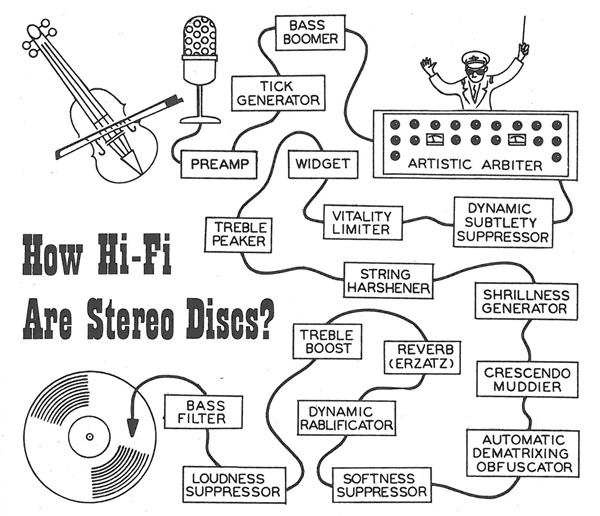
Editor's Note from 1992: This seminal J. Gordon Holt essay on how the art of recording natural sound became compromised in favor of unmusical artificiality for good commercial reasons was originally published in August 1964, in Vol.1 No.8. Though most people these days listen to classical music from CDs, not LPs, in the intervening decades, recording technology has not changed for the better as much as one might have hoped. Nevertheless, the days of wretched multimiking excess described by Gordon are past, and it's rare to find the music treated with the lack of respect typical of a mid-'60s Columbia session. Although some of the smaller companiesReference Recordings, Delos, Chesky, Mapleshade, Dorian, and Sheffield Lab in the US; Meridian, Nimbus, and Hyperion in the UKconsistently use honest, minimal miking, it is not unknown for the majors in the '90s to do likewise. And the use of time delay for spot microphones, pioneered by Denon in the mid-'80s, means that instruments that might tend to become obscured at orchestral climaxes can now be brought up in level without unnaturally time-smearing the sound. I still find it sad, however, that it is rare to hear the sheer dynamic range of a live ensemble successfully captured on a commercial recording.John Atkinson
How to Write an Ad
Everyone knows that advertising people make more money than ordinary people, but many assume that the high pay is because ad writing is so difficult. This is not true. Low-income people can write advertisements, too, so just in case somebody should accost you on the street and ask you to write an advertisement, here is how you may go about it.