

Krell Power: A Visit to the Laboratory of Doctor Morbius

The only one who knows this ounce of words is just a token
Is he who has a tongue to tell, but must remain unspoken.Moondog, 1968 The Lockheed 1011 sits dormant on the ground at Chicago's O'Hare airport. "We have a little light bulb problem here" drawls the pilot in the approved Right Stuff manner. "We don't know if it's the bulb or what, we'll let you know."
Is he who has a tongue to tell, but must remain unspoken.Moondog, 1968 The Lockheed 1011 sits dormant on the ground at Chicago's O'Hare airport. "We have a little light bulb problem here" drawls the pilot in the approved Right Stuff manner. "We don't know if it's the bulb or what, we'll let you know."
No-Holts-Barred: 25 Years of Stereophile
Editor's Introduction: 1987 sees Stereophile celebrating its 25th anniversary of continuous—if occasionally sporadic—publication. For an ostensibly "underground" publication to have survived so long is a tribute to the skills and enthusiasm of the magazine's founder and Editor, J">http://www.stereophile.com//interviews/66/">J. Gordon Holt. I thought it fitting, therefore, to ask a contemporary of Gordon's, Ed Dell (footnote 1), himself a respected publisher and editor, to pen an appreciation of the man who defined the world of subjective reviewing.—John Atkinson
Ralph—The Real Dog
Ralph died last week (September 11, 1991), his great and faithful heart stopped in the aftermath of an affliction not too uncommon for older, larger dogs—a gastric torsion. He was approximately 12 years old.
Readers Review Stereophile's Poem LP
In the Fall of 1989, Stereophile magazine released its first recording, of Gary Woodward and Brooks Smith playing flute sonatas by Prokofiev and Reinecke, and a work by American composer Griffes that gave the LP its title: Poem (footnote 1). The full">http://www.stereophile.com//interviews/527/">full story was published in the September 1989 issue (p.66). We wanted to offer our readers an LP of acoustic music made with the minimum of electronics and processing—the sounds of the instruments would be as true to reality as possible. The images of the instruments were also captured with a purist microphone technique so that, with even a halfway decent system, a true soundstage would be created between and behind the loudspeakers when the recording was played back.
Surround Sound: High Tech Meets the Beast Within Us

It's a tense moment during a suspense thriller. A cannibalistic serial killer has escaped from a maximum-security detention unit and eluded capture for long enough to work up a healthy appetite. Two small children are playing hide-and-seek in an overgrown lot behind their home.
The 1965 New York Audio Show
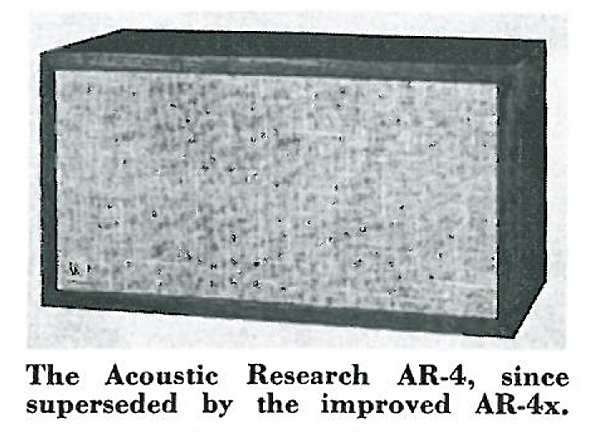
Note: As our coverage of the 2016 New York Audio Show has just been posted, I thought it would be interesting to post our report from the 1965 show, in particular to see which brands are still around 50 years later.John Atkinson
The 1965 New York hi-fi show was, to these observers, most notable for the marked increase in the number of exhibits which featured goodie, classicalmusic for demonstration purposes. In the past, only about a half dozen of the exhibitors played any thing of musical worth, the rest of them evidently figuring they could make more noise with wild brass-and-percussion "demo" records.
The Big Announcement
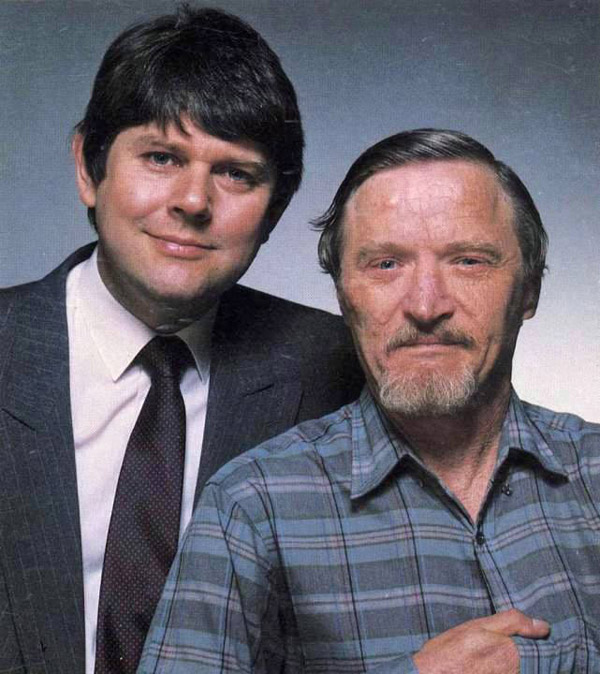
The rumors have been flying, and his arrival is imminent—a couple weeks after you read this—so it's time our readers know: John Atkinson, for the last four years Editor of Britain's prestigious Hi-Fi News & Record Review (left), is joining the staff of Stereophile as Managing Editor and International Editor.
The Horse's Mouth (Stereo Review's 1983 cable tests)
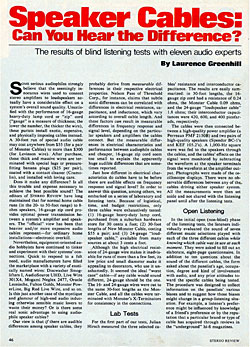
It's not often that you get a chance to have extensive discussions with the horse's mouth, but we recently had that opportunity. Since July of this year there has been extensive discussion in the audio community, particularly the high-end segment, of Larry Greenhill's article">http://bruce.coppola.name/audio/Greenhill.pdf">article on speaker cable listening tests in the August, 1983 issue of Stereo Review (footnote 1). From recent talks with author Greenhill we've learned that the most interesting story was not in Stereo Review; instead it can be found in the varying reactions from different quarters, and what they say about the high-end industry in general.
The Musician in the Middle
Ask most professional symphony musicians for their views concerning recording sessions, and you might be greeted with seemingly nonchalant and cavalier responses. You will probably be told that although recording can be quite lucrative, it is almost always an exercise in futility. If you press further, and inquire as to why these "artists" display such negative attitudes, they would treat you to both a lecture concerning the shortcomings and gross musical distortions usually involved in the recording process, and to a tirade on the incompetence and arrogance of many recording engineers and producers. And once you have opened this can of worms, you will undoubtedly be told about the frustrations of having to deal with inaccurate and distorted representations of their art at the hands of the musically inept.
The Nonstick Embrace Of Home Theater

Editor's Note: 24 years ago, in January 1995, we published the first issue of Stereophile Guide to Home Theater, a sister publication intended to appeal to the the growing number of home-theater enthusiasts. Stereophile's founder, the late J. Gordon Holt, had gotten early into the idea of accompanying movies with high-quality sound, and when I first visited his New Mexico home in January 1986, his system included an Advent NTSC-format video projector.