

Revinylization #19: More Cowbell (Blood, Sweat & Tears)
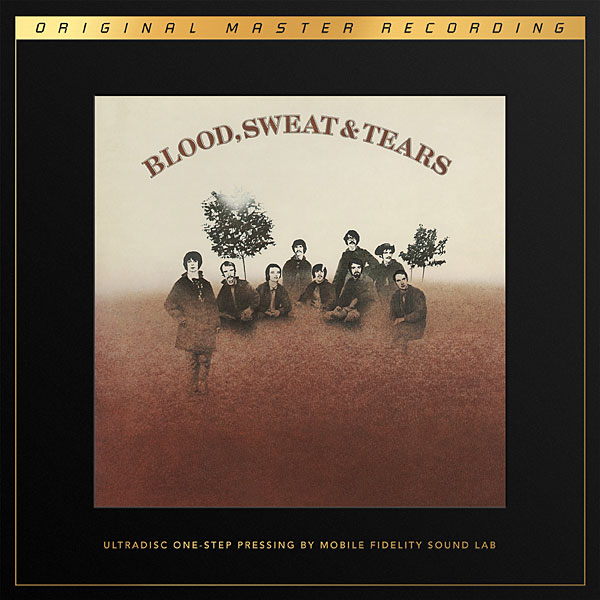
Blood, Sweat & Tears began as Al Kooper's dream of a rock band with horns. By the time he realized the concepton the band's 1968 debut, Child Is Father to the Manit had become much more: an engaging hybrid of New York soul, Greenwich Village folk, and innovative jazz arrangements. With producer John Simon at the helm, Child was a virtual definition of the possibilities inherent in the heady musical experimentation of the late 1960s. Kooper's writing and arranging for that record (including the monumental "I'll Love You More Than You'll Ever Know," later a hit for Donny Hathaway) is one of the high points of his storied career.
Revinylization #2: Frog Pad Records, Electric Recording Company, Blue Note Tone Poet

Next to Christmas carols, Sousa marches, and the collected works of Bobby "Boris" Pickett, there's no more seasonal music than bluegrass, which comes to life at the 30 or so major outdoor festivals and scores of smaller events that take place every summer throughout the US. As I write this, on the day after Thanksgiving, 2019's bluegrass season is only a memory, and the 2020 season is more than a half a year away.
Revinylization #20: Kind of Great: Kind of Blue

Does the world need another audiophile reissue of Kind of Blue? This was the obvious question to ask upon news that Chad Kassem's Analogue Productions was joining the party. The album's arrival in the mail (yes, of course, I bought one) signaled that something special might be happening: the classy hard-box slip case with the wooden dowel spine, the Stoughton tip-on gatefold jacket graced with well-reproduced session photos, a handsome booklet, and, finally, the LP: a 200gm UHQR pressing on off-white Clarity vinyl.
Revinylization #21: Charles Mingus at Carnegie Hall
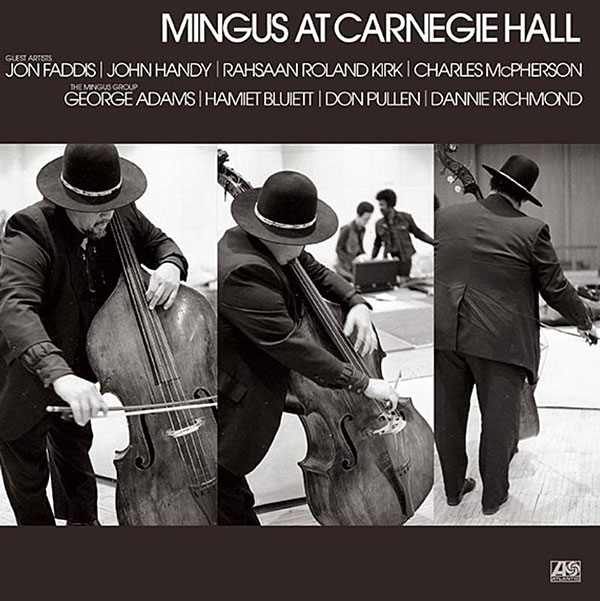
Mingus at Carnegie Hall documents one of the most extraordinary live jazz concerts. Atlantic Records released a one-disc LP of the same title in 1975,a few months after the heady event, but it included only the second half of the showlate-career Charles Mingus's young quintet jamming for 45 minutes with three older guest stars on Ellington standards "C Jam Blues" and "Perdido" (the latter written by Juan Tizol).
Revinylization #22: George Harrison's All Things Must Pass
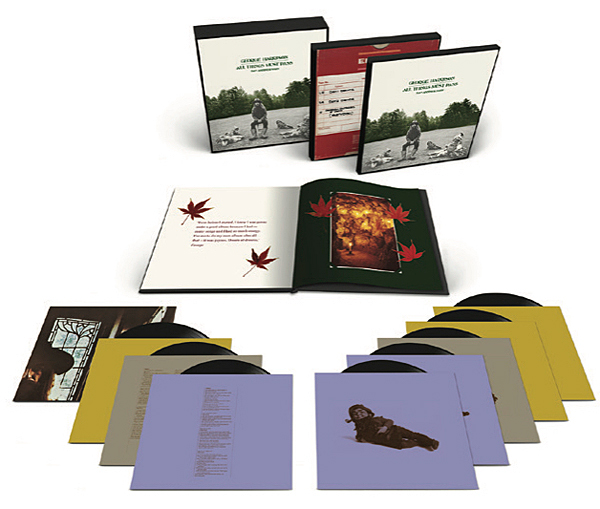
Capitol/UMe 3565238 (5 CD, 1 Blu-ray). 2021. George Harrison, Phil Spector, Harrison, David Zonshine, prods.; Ken Scott, Philip McDonald, Paul Hicks, engs.
Performance *****
Sonics ***** Six weeks after the world's biggest pop group broke up, the "Quiet Beatle" began work on a monumental three-LP album that stands tall a half-century later. George Harrison's first solo album (his third if you count a movie soundtrack and an experimental-music record) is a masterpiece, a musical minestrone of influences and timestamps. For the artist, it was a sprawling release of creative energy too often pent up in the context of the Beatles.
Performance *****
Sonics ***** Six weeks after the world's biggest pop group broke up, the "Quiet Beatle" began work on a monumental three-LP album that stands tall a half-century later. George Harrison's first solo album (his third if you count a movie soundtrack and an experimental-music record) is a masterpiece, a musical minestrone of influences and timestamps. For the artist, it was a sprawling release of creative energy too often pent up in the context of the Beatles.
Revinylization #23: Grant Green, Kenny Burrell, Oliver Nelson
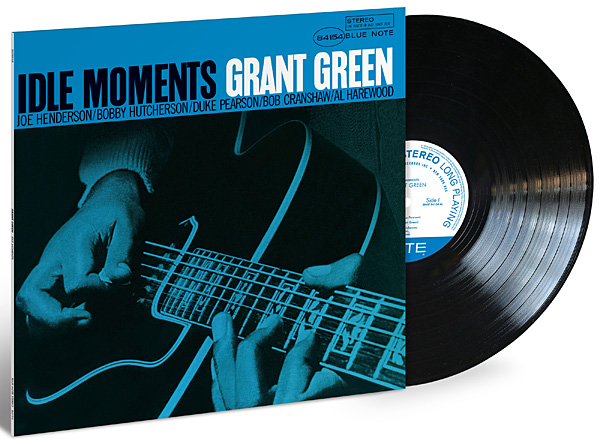
Two new reissues in Blue Note's Classic Vinyl seriesGrant Green's Idle Moments and Kenny Burrell's Midnight Bluecapture peaks of jazz guitar's possibilities at a juncture when modernism was primed for a shift to something else. Both albums were recorded in 1963; both sport "the Blue Note sound," which engineer Rudy Van Gelder had refined to its high point. But the two albums lay out very different musical paths.
Revinylization #24: Blue Note Classic Vinyl: Herbie Hancock's Maiden Voyage & Eric Dolphy's Out to Lunch!
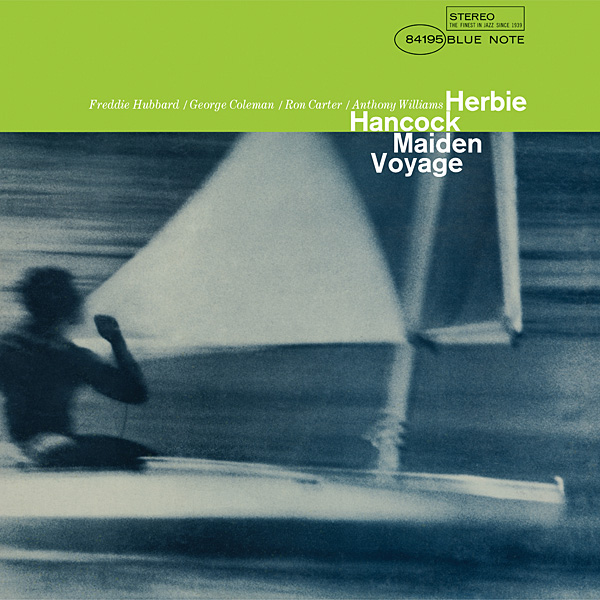
In the mid-'60s, modern jazz pivoted. Charlie Parker, the previous era's key revolutionary, had been dead for a decade. "Hard bop," the soul-and-back-beat variant of Parker's bebop, was running out of steam. The Beatles were rocking the world, and jazz would never recover as a branch of "popular music." In response or indifference to these tough transitions, jazz musicians set sail on several experimental paths. In those first few years, the most adventurous voyages were mapped and carved out at Blue Note Records.
Revinylization #25: The Rolling Stones' Tattoo You—What's the Point?

Tattoo You is near and dear to me. It came out in August 1981, just before I entered 10th grade, the age when a person's rock'n'roll aesthetic begins to take shape. This album was formative.
I knew about the Rolling Stones mainly through the Hot Rocks compilation, from listening on radio to hits from Some Girls (which came out when I was too young and sheltered in leafy suburbia to understand the urban grit and decadence described in its lyrics), and from Emotional Rescue, which I owned, and which I thought (and still think) lacks interesting music in the grooves to match the cool cover. I figured the Stones might already be too old to rock.
Revinylization #26: Two Charles Mingus LPs
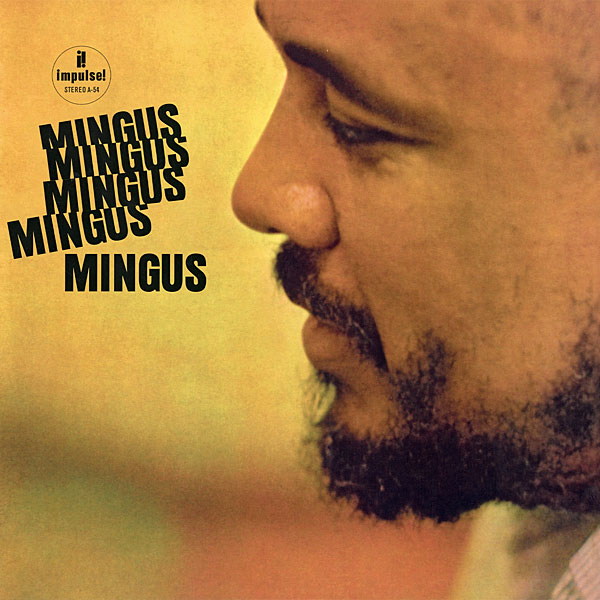
In the annals of jazz, Charles Mingusbassist, pianist, composer, bandleader, unique, headstrong, and deeply influential in every categoryoccupies the transit point between Duke Ellington and the post-'60s avant-garde, a station he carved out deliberately.
Revinylization #27: Round Trip: Ornette Coleman's Blue Note sides on Tone Poet
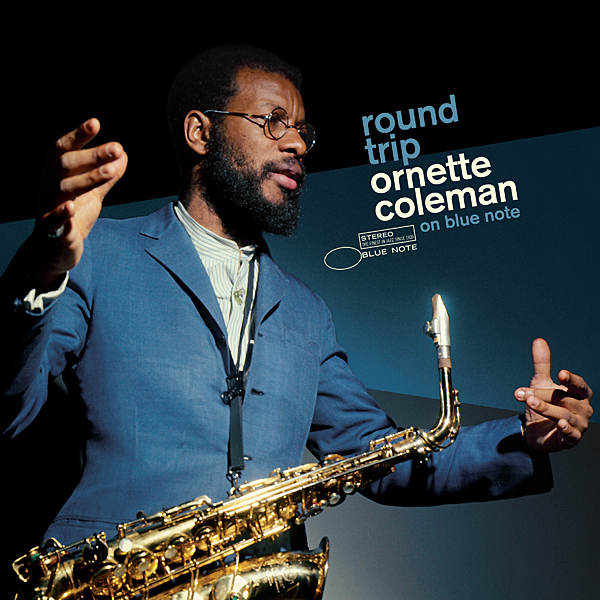
Round Trip: Ornette Coleman on Blue Note is the first boxed set on the label's Tone Poet imprint, and it's a bold move. Audiophiles are not known to be keen on avant-garde music, but Don Was, Blue Note's president, and Joe Harley, the Tone Poet producer, are huge Ornette fans. They've lately been reissuing some other adventurous titles from the catalogso good on them! Fellow fans should dive into this one, and the hesitant should give it a try, with some caveats.