Stand Loudspeaker Reviews

Sort By: Post DateTitle Publish Date

GoldenEar Technology Aon 2 loudspeaker

I was introduced to audiophilia by my friend Gary Gustavsen. Although I'd known Gary since I was 13, I didn't discover his passion for music until that day in high school physics lab when I blurted out an obscure line from the Doors' "The Soft Parade," and Gary bounced back immediately with the next line. It turns out I shared my friend's passions for the Doors and Frank Zappa, but not for Mahler. Before long, Gary was dragging me to every audio store in our area to listen to potential speakers for his first high-end audio system. At the beginning of each trip he'd say, "Right now I'm partial to the Rectilinear 3s." Although I heard him say that many times, I never actually got to hear a pair of Rectilinear 3s.

Audience ClairAudient The One loudspeaker

As the years pass and I turn into a crotchety old man, I'm reminded of those old TV ads for the Honda Accord: "Simplify." Even though I now have more things going on than at any other point in my life, I try to eliminate complications everywhere I can. I now can't believe that, for over 15 years, I used the Infinity RS-1B as my reference loudspeaker. Sure, I loved it—the RS-1B was the first speaker I'd owned that produced a wide, deep soundstage, the full dynamic range of an orchestra, and bass extension down to 25Hz. But it was ridiculously complex: a five-way design with three different driver types and a servomechanism for the woofers. It also required biamplification—I got the best sound with a combination of high-powered tube amp and high-current, solid-state amp.

Opera Callas loudspeaker

Colleen Cardas strongly urged me to try the Callas loudspeaker from Opera Loudspeakers (whose products she also distributes in the US), which she claimed was an ideal match for the Unison S6 amplifier I reviewed last August. In my experience, the stand-mounted Callas ($5000/pair) is unique among loudspeakers in being the logical contrapositive (inverted and flipped, so to speak) of the usual D'Appolito driver array of midrange-tweeter-midrange (MTM).

Pioneer SP-BS22-LR loudspeaker

I often receive letters from Stereophile readers. I've even gotten a few letters from female readers, one an attractive young lover of tube gear who sent me a picture of herself and [sigh] her boyfriend. But most are from people who are either thanking me for a specific review that resulted in a purchase and a satisfied buyer, or are suggesting products they'd like me to review. I frequently take the advice of writers of this second category; in fact, two of the inexpensive speakers I'll review in the next year were recommended by readers.

Spendor S3/5R2 loudspeaker

The Spendor S3/5R2 loudspeaker reminds me of Art Dudley. My friendship with Art began more than 25 years ago, long before either of us joined Stereophile. Frequently, we would sit down to discuss music, guitars, and audiophiles. Art didn't have much patience for a certain category of audiophile who would evaluate an audio component based on how many points on their sonic checklists they could tick off. Image specificity? Check. Soundstage depth? Check. Lower-bass extension? Check.

Canalis Anima loudspeaker

The Anima is a two-way loudspeaker from Canalis Audio, a new enterprise of longtime importer Immedia, of Berkeley, California. Canalis is thereby related to Spiral Groove, and Canalis speakers bear the Spiral Groove logo on their terminal plates. Spiral Groove, founded in 2005, makes turntables; their SG2 ($15,000) was favorably reviewed by Brian Damkroger in the June 2010 issue. Canalis makes at present four models of loudspeakers, all designed in collaboration with noted engineer Joachim Gerhard, formerly of Germany's Audio Physic. All Spiral Groove and Canalis products are made in the US.

Spendor Classic SP100R2 loudspeaker

In late 1996, as Listener magazine entered its third year of existence, the Spendor SP100 became my reference loudspeaker, and would remain so for a considerable time. My decision to try the SP100 was influenced by John Atkinson's review of its antecedent, the nearly identical Spendor S100, in the December 1991 issue of Stereophile. But my purchase decision came down to two things: The SP100 did virtually everything one could ask a modern loudspeaker to do, requiring in the process far less amplifier power than usual. Just as important at the time, it sold for only $3300/pair—which explains how I could afford them on the spotty salary of a teacher turned fledgling publisher.

Dayton Audio B652 loudspeaker

I was ready to have some fun with Dayton Audio's B652 loudspeakers—the ones with the outrageously high price of $39.80/pair.


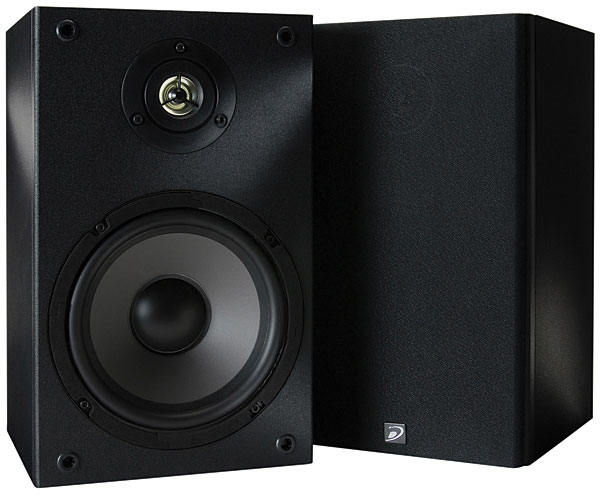
Available from Parts Express (catalog #300-652), the Dayton B652 is a simple two-way, sealed-cabinet design with a 6.5" polypropylene mid/woofer and a ferrofluid-cooled, 5/8" polycarbonate tweeter. The cabinet is clad in black vinyl and has a removable grille of black cloth. The B652s sounded pretty much the same regardless of whether the grilles were in place, but I preferred their looks with the grilles off, so that's how I listened. Better looks often equal better sound—at least in my home.

Aperion Verus Grand Bookshelf loudspeaker

I received a call from Aperion Audio, who wanted to know if was interested in reviewing their Verus Grand Bookshelf loudspeaker ($598/pair). I've had good experiences with speakers from this Oregon-based, Internet-only company. I reviewed their Intimus 6T (January 2009) and Intimus 533-T (April 2007), and felt both provided overall good sound and great value for the money. I was also impressed with the speakers' quality of construction and physical appearance. But those models were floorstanders—what excites me more is finding new bookshelf speakers at low prices. I was anxious to hear the Verus Grand.
Advertisement
Advertisement
Advertisement