Stand Loudspeaker Reviews

Sort By: Post DateTitle Publish Date

Pioneer SP-BS41-LR loudspeaker

The buzz was all over the audiophile 'net. "Pioneer has a new bookshelf speaker that's killer for the money!"


Hmm, I thought. Pioneer. Speakers?


To be fair, I've had the Pioneer brand on my mind for well over 30 years. The company was my brand of choice for car-stereo electronics in the 1970s, for Dolby S cassette decks in the '80s, for DVD players in the '90s, and for plasma TVs in the '00s and '10s. I felt a bit guilty that I hadn't focused on the fact that Andrew Jones, the very same design guru who came up with Pioneer's TAD Reference One loudspeaker ($70,000/pair), had had a hand in designing a few two-channel speaker models starting at $99.99/pair. The audio gossip was all about the second model from the bottom of Pioneer's speaker line, the SP-BS41-LR ($149.99/pair). I thought I'd better get a pair and review them.

Audience ClairAudient 2+2 loudspeaker

It seems the obvious way to build a loudspeaker: one driver, no crossover, full range.


Instead, most speakers work this way: Complicated electronics split the audio signal into pieces, adding various colorations and phase shifts along the way. The pieces are distributed to different drivers, each of which adds another unique set of characteristics. We then expect these fragments of electronic signal to be brought together again in a continuous, coherent reproduction of music. We agonize over different cable routings or which contact cleaner to use, and yet we calmly accept this grotesque sausage-making way of building speakers. It's ludicrous.

Wharfedale Diamond 10.1 loudspeaker

A while back, I received an e-mail from The Kid (Stephen Mejias): "I've been listening to and enjoying the Wharfedale 10.1 loudspeakers ($350/pair) for a couple of months. I wrote about them for my March and April issue columns, but they are good enough for a complete review. Are you interested?"


Hmm . . . so The Kid is now assigning me equipment reviews? "Sure, why not?"


The day after the Wharfedales arrived, The Kid sent me another e-mail: "Have you unpacked them yet? They are so pretty!"


That they are, Kid.

Totem Dreamcatcher loudspeaker

The two-way, biwirable, rear-ported Dreamcatcher is designed and manufactured in Canada; its drive-units are designed by Totem, but made and assembled in Europe. The 1" titanium-dome tweeter, manufactured by German Acoustik, is mated to a 4" Scan-Speak woofer. Totem founder Vince Bruzzese feels very strongly about sourcing his drivers in the West. In the past, he got his small woofers from Peerless in Denmark, but switched to Scan-Speak when Peerless started manufacturing in China. Bruzzese also pointed out that the tweeter used in the Dreamcatcher costs him €16, more than 15 times as much as most similar Asian-made tweeters.

Epos M5i loudspeaker

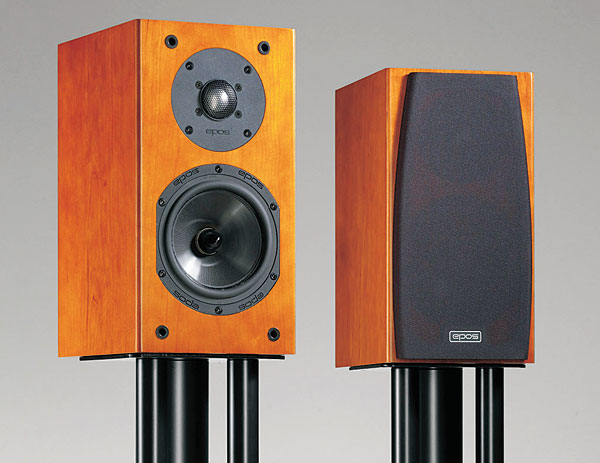
The M5i, basically a two-way bookshelf version of the 21½-way M16i, has the same tweeter, woofer, and footprint as the larger model, less its larger cabinet and second mid/woofer, and incorporates all of the i-series updates included in the M16i. The speakers look very similar; like the M16i, the M5i is available in gorgeous cherry veneer or basic black. The price ($899/pair) is $249/pair higher than the original M5. I placed the M5is on Epos's dedicated stands.

Harbeth P3ESR loudspeaker

Everyone wants something different from a loudspeaker. Some people value midrange neutrality above all, while others will sacrifice some of that accuracy to get extended lows or a speaker that will play immensely loud with only a few watts of power. Some want stereo imaging that is sufficiently delicate, stable, and accurate that the speakers open a transparent window on the recording's original performing space. Some will sacrifice all of the above to get a speaker whose "jump factor" can jerk zombies out of their stupor. And there are those who are prepared to lose just a little bit of everything in order to have a speaker that may not excel in any of these areas, but communicates what they want from their music in the most effective overall manner.


PSB Image B6 loudspeaker

Readers frequently ask me how Stereophile's writers select equipment for review. More often than not, a writer comes up with a review candidate because he's heard it or heard about it, and then suggests it to editor John Atkinson for possible review. JA encourages this behavior—a writer excited about reviewing a component is more likely to produce an article that's interesting and informative. That said, occasionally a review candidate surfaces at Stereophile HQ; in such cases, JA assigns it to one of us.


ProAc Response D Two loudspeaker

ProAc's Response D Two is a stand-mounted, two-way, ported loudspeaker with a a proprietary 1" silk-dome tweeter and woofer using a proprietary 6.5" cone of glass-fiber with a copper phase plug. At 17" high by 8" wide by 10.25" deep, the cabinet is taller and narrower than usual, owing to the fact that the port is centered below its mid/woofer.


DeVore Fidelity Gibbon 3XL loudspeaker

Forty years ago, when I first had money enough to buy serious [ahem] consumer audio, there were a few good turntables available, from Thorens, Garrard, Ariston, some others. Today is the golden age of turntables: ask Mikey, if not antiquarian Artie. And loudspeakers! In 1970, models were few, and most were mediocre. Today, you can have a great loudspeaker for a song.

Klipsch Palladium P-17B loudspeaker

Every audiophile is born sometime, somewhere. My audio birth happened on a family visit to my Uncle John's house, when he played Information Society's "What's On Your Mind (Pure Energy)" through his brand-new Klipsch Heresy IIs. Uncle John did three things at this listening session that turned 12-year-old me into the audiophile I am today: he played music I liked, he played it really loud, and afterward, he took the time to explain how his system worked and why it sounded so good. His Klipsches were powered by Nelson Pass–influenced Nakamichi gear—I'd never before heard speakers play music with such ease or such startling dynamics. I was immediately hooked. In many ways, nothing I've heard since that day has impressed me as much, or been as revelatory of what home audio can do. That single experience set me on a path of caring about re-creating musical performances in my own home.


Advertisement
Advertisement
Advertisement