

Triad Design System Seven satellite/subwoofer loudspeaker

Triad Speakers has been designing and manufacturing three-piece (woofer and two satellites) loudspeaker systems since 1982. The company was formed that year by designer Larry Pexton and has enjoyed steady growth in their market niche. Their original three-piece loudspeaker was a collaboration with Edward M. Long, of "Time-Align" fame, and Ron Wickersham. It was felt that the ideal loudspeaker would have the least cabinet interference, thus the design decision to keep the woofer separate and the midrange/tweeter enclosure small. Triad speakers were selected for inclusion in the Consumer Electronics Show's Innovations 1990 Design and Engineering Showcase, the sixth time the company's products have been selected for this award.
 Cyrus is the name given to the higher-priced line of loudspeakers made by England's Mission Electronics. The entire Mission loudspeaker line includes six products under the Mission label and three under Cyrus. Mission also manufactures a wide range of electronics and CD players. The company has a long history of audio innovations, both in loudspeaker and electronic design. Among Mission's claimed "firsts" are the first polypropylene-cone drive-unit used in a product (1978), first widespread use of MDF loudspeaker enclosures (1981), and first CD player from a specialist manufacturer. Interestingly, Mission also makes IBM-compatible personal computers.
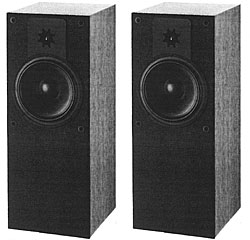 Audio journalists tend to wander the corridors of a CES in a minor state of shell-shock. There are no carnival-barkers outside the rooms enticing one to enter (not yet, at any rate), but the sounds and reputations oozing from the open doorways yield little to the "hurry, hurry, hurry" crowd. The Signet room has always, it seems, been one of the quieter oases, often eschewing sound altogether while contentedly displaying their phono cartridges, cables, and various accessories. On a recent CES hunt, I was therefore intrigued to find them demonstrating two new loudspeakers, of all things, to the milling throngs.
 Now Hear This (NHT) was founded to produce low-cost loudspeakers a breed apart from the mass-market variety often found at the lower price points. Co-founder Ken Kantor has a long history in the hi-fi business as a designer at Acoustic Research, NAD, and as a design consultant to some large Japanese manufacturers. NHT's line ranges from the $180/pair Model Zero to the $1200 Model 100.
 The philosophy promoted by many mainstream stereo magazines (and thus often the belief of the general public) is that one should spend a minimum amount of one's hi-fi budget on electronics and front ends, and a maximum amount on loudspeakers. Since all electronics sound alike and it's the loudspeaker that really produces the sound, the highest overall performance is obtained by putting expensive loudspeakers at the end of a chain of inexpensive electronics. Cables? Don't waste your money.
 In their seminal work on the subject of audio "Bluff your Way in Hi-Fi" (1987), Sue Hudson and
 Ten seconds to ignition. Relax, buckle in, and welcome to Stereophile's Good Times time machine. Flux capacitors fully energized. Ignition. Not to worry, that slight tingling sensation is perfectly normal. Roll back your calendar to...June 28, 1933. We're at the Eighth Annual convention of the Institute of Radio Engineers in Chicago. Harry Olsen is on the podium, describing a new wide-range cone loudspeaker for high-fidelity sound reproduction.