
Subwoofer Reviews

Sort By: Post DateTitle Publish Date

Revel Ultima Rhythm2 powered subwoofer

Powerful, massive, and expensive, Revel's Ultima Rhythm2 subwoofer ($10,000) swept me off my feet when I first saw it in Harman International's suite at the 2013 Consumer Electronics Show. It outsizes, by 49 lbs and 2.6 cubic feet, Revel's previous flagship model, the Ultima Sub30, which I reviewed in the November 2004 issue. Its specs read like no other sub's: 196 lbs; 18" cast-frame woofer; dual 4" voice-coils; 4kW peak power from twin internal amplifiers that generate 1kW RMS; 115dB peak acoustic output; a fully configurable, high-resolution, 10-band parametric equalizer (PEQ); an internal crossover with high- and low-pass outputs; and PC-based setup via USB. The Rhythm2's patent-pending design is said to let just enough air move in and out of the cabinet to prevent any distortion-inducing pressure due to heating of the voice-coils. And its veneer, shape, beveled top edges, and bottom plinth exude the quality found in Revel's top-of-the-line floorstanding speaker, the Ultima Salon2, with which I was familiar.
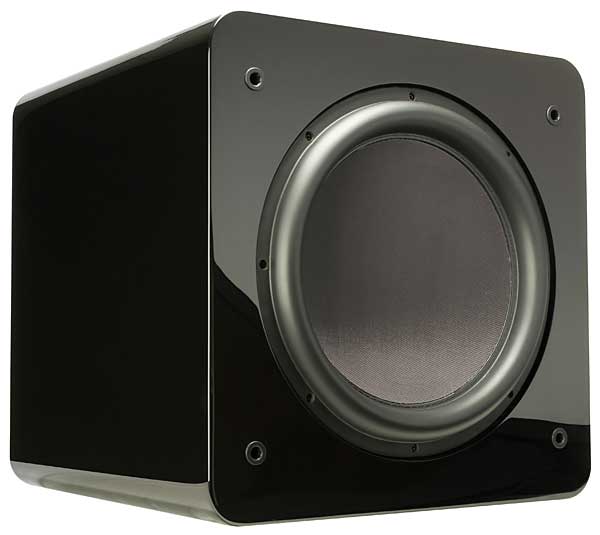
SVS SB13-Ultra powered subwoofer

As an audiophile, I've come to associate the size, weight, and price of a subwoofer as quick'n'dirty indicators of its quality. The subwoofers that have worked best in my large listening room—the Velodyne ULD-18 and DD-18+, Muse Model 18, REL Studio III, JL Audio Fathom f113, and Revel Sub30—each weigh more than 130 lbs and cost more than $2500. With some of my reference recordings, all of them have achieved what Robert Harley described in the April 1991 issue of Stereophile as the goals of a quality subwoofer: "seamless integration, quickness, no bloat, and unbelievable bass extension." Yet are back-busting weight, unmanageable size, and nosebleed cost essential to achieving those goals?

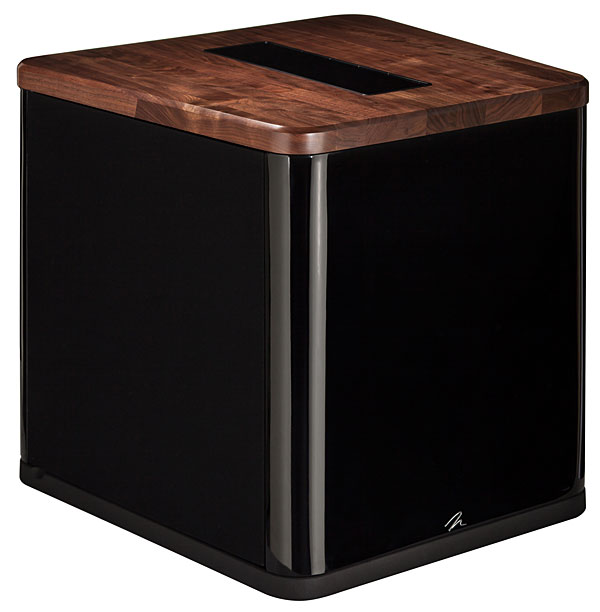
MartinLogan BalancedForce 212 subwoofer

I like big bass, but I cannot lie

Tubby thumpers need not apply

And when a speaker drops in with itty-bitty bass

It puts a frown upon my face

I get bummed . . .


—Sir BassaLot, first audiophile rapper, 1992


Some folks put a pair of bookshelf speakers on stands in their room and are happy as clams. I imagine that they imagine the missing bass and never give it another thought. Not me, and perhaps not you. Some of us want to hear it and feel it, just as we would real instruments. We want sex in the room.

Bowers & Wilkins DB1 subwoofer

Although many high-end audio products are described as revolutionary and as breakthroughs in design when new, most audiophile components now on the market have not changed our way of relating to such products in the way the iPad has done. Once in a while, a new audio product does move in that direction by enabling the audiophile to do install a product and optimize its performance in a different way.

JL Audio Fathom f212 powered subwoofer

It's been over two years since I reviewedhttp://www.stereophile.com/subwoofers/907jl">reviewed; a pair of JL Audio's Fathom f113 subwoofers. Kalman">http://www.stereophile.com/musicintheround/1106mitr">Kalman Rubinson and I both gave the f113 top marks for delivering clean, powerful bass in a wide variety of full-range systems. At the end of the review period, JL Audio's Carl Kennedy told me that they wouldn't send me another subwoofer for review until they had developed one that outperformed the Fathom f113 (footnote 1). To this day, the Fathom f113 tops the subwoofer category in Stereophile's "Recommended Components."


SV Sound PB13-Ultra powered subwoofer

With the popularity of home-theater systems, subwoofers have proliferated. Because multichannel AV receivers are designed to provide a properly filtered, line-level subwoofer, or low-frequency effects (LFE) signal, many subs no longer come with built-in high- and low-pass filters for insertion into two-channel audio systems. However, the PB13-Ultra subwoofer from SV Sound does include these, which is what piqued my interest in it. After Ed Mullen, SV Sound's director of sales, assured me that the PB13-Ultra was capable of reproducing solid 20Hz organ-pedal notes in my listening room, I asked for one to review.


Genelec HTS4B subwoofer

Home theater has dramatically influenced the design of aftermarket subwoofers. Multichannel processors automatically provide a properly filtered low-frequency signal to drive a subwoofer, relieving the need for the sub to be shipped with a passive crossover network or an active electronic crossover. When Genelec offered one of their subwoofers for review, I decided it was important to try to evaluate such a product, even if it meant I'd have to scramble around to find a quality external electronic crossover.


Advertisement
Advertisement
Advertisement