Think Pieces

Sort By: Post DateTitle Publish Date

Bob Katz on Loudspeaker Isolation

(Photo by Mary Kent)

Of late, Stereophile has written a lot about vibration-isolating footers under loudspeakers. The idea of isolating loudspeaker vibrations from floors is controversial. Many (perhaps most) designers believe that dynamic loudspeakers in particular—those with significant moving mass in their cones—should be rigidly connected to the floor as is typically done with spikes. A rigid connection of the speaker to the floor reduces the Newton-1 reactive motion of the cabinet in response to the motion of the cones, heavy woofers in particular. Cabinet motion could be expected to smear the loudspeaker's sound.
A High-Resolution Audio Primer

January's Industry Update included a report on a scientific article presented at last year's AES meeting, in which the authors used test tones and a modest audio system (albeit in an anechoic chamber) to prove that listeners can discriminate between high-rez and CD-rez audio. This is important because scientific evidence of an audible difference between high-rez and CD-rez music is considered weak by some, even as anecdotal evidence grows stronger by the day.


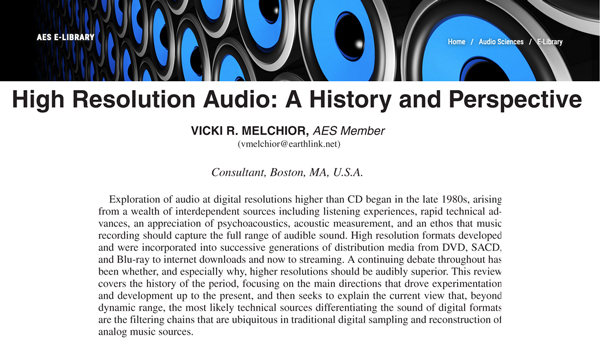
As I pondered this, I recalled a recent paper I'd seen in the Journal of the Audio Engineering Society but hadn't yet read. "High Resolution Audio: A History and Perspective," which the AES has made available free online, does precisely what the title says: reviews the history of digital audio beyond CD-rez and frames the issue of high-rez audio's audible superiority on the basis of the available evidence.

Why Do Any of This At All?

I've just returned home from one of the greatest concerts of my life, and felt absolutely compelled to share my thoughts with you. Yo-Yo Ma performed all six of J.S. Bach's Cello Suites, from memory, over a mesmerizing two-and-a-half hours at Red Rocks Amphitheatre, in Morrison, Colorado. It was a truly special experience.

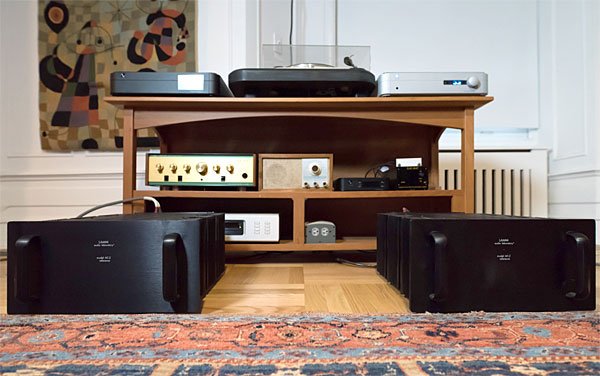
Living with the Lamms

Although I've never tried one, I think "lifestyle" audio systems are a bit of a joke. My in-laws' decade-old Bose Wave Radio sounds good for what it is, although its obvious flaws—boomy, undefined lower mids masquerading as bass, a frustrating lack of sonic and musical resolution, etc.—become grating fairly quickly. These days, there are far more accomplished and expensive lifestyle systems out there, but because I haven't tried them I won't comment on them, except to say that I'm not really interested.

Let Freedom Ring

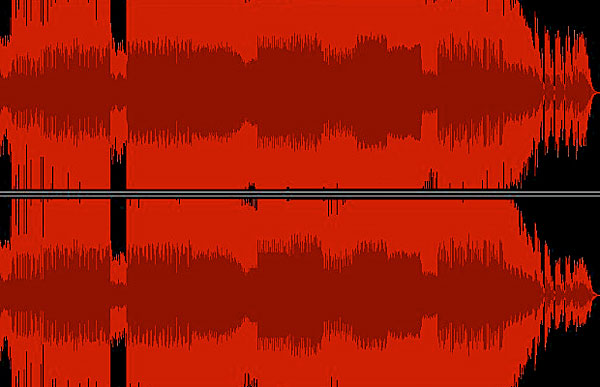
In the 2014 November issue, my good friend Steve Guttenberg ("Communication Breakdown") got his facts mostly right: It's true that most listeners (including myself) accept far more distortion today than we did years ago. Many people have never heard a great stereo system—all they've heard are overdriven boom boxes, cheap stereos, and portable systems, and that's what they expect systems and music to sound like. And distortion is part of the sonic language of such musical genres as hip-hop, rap, and alternative rock.

Just How "Absolute" Is Recorded Sound?

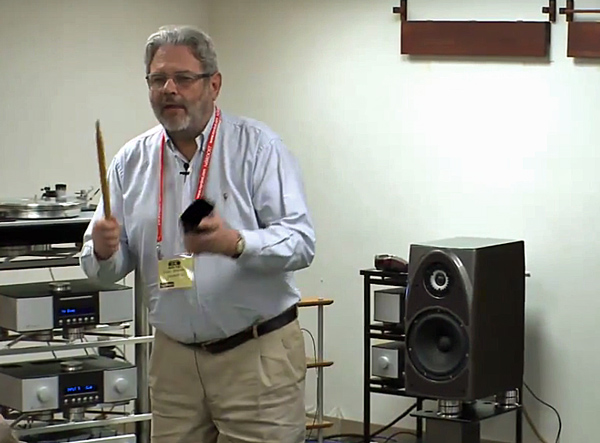
John Atkinson at the 2012 Rocky Mountain Audio Fest


Since I gave this presentation at the Rocky Mountain Audio Fest in October 2012, based on one of the topics in my Richard C. Heyser Memorial Lecture and mentioned in my March 2013 "As We See It," I have repeated it at Music Matters evenings at Definitive Audio in Seattle and Listen-Up in Denver, and at audiophile society meetings in Minneapolis, California's Central Coast, and Connecticut. I will be repeating the presentation at a Music Matters event at Georgia retailer Audio Alternative, Wednesday April 24, at 6pm, at T.H.E. Show Newport Beach, at 12 noon, May 31, and at The Audiophile Society in Brooklyn, NY on June 22.

The Swift Boating of Audiophiles

The "Want to make an easy $1,000,000?" e-mail wasn't a scam from Nigeria but an alert from Paul DiComo, late of Polk Audio and now of Definitive Technology, about a double-blind cable-identification challenge made by The Annoying Randi, a magician and debunker of paranormal events who goes by the name of "The Amazing Randi."


The Great Wall of China

You could sense the frustration in Keith Pray's e-mail. "We are on the same team. I have always respected your wishes and will continue to do so," he had written me. At the request of a possible advertiser, Stereophile's publisher had asked me a question about something appearing in the issue of Stereophile we were preparing. I had responded that not only would I not give him an answer, I felt it inappropriate for him to ask.
Advertisement
Advertisement
Advertisement