Miscellaneous

Sort By:  Post Date TitlePublish Date

Acoustic Research Stereo Remote Control

Prologue: The context for this review is that back in the 1980s, preamplifiers and integrated amplifiers with remote controls didn't exist. In early 1985 I borrowed a sample of Acoustic Research's Stereo Remote Control, which I believe was designed by Ken Kantor (later to find fame with NHT) and set it up in my bedroom. It drove a pair of powered loudspeakers with auto turn-on, and I very quickly grew to appreciate, not just the sound quality, but the convenience of being able to control the system from the comfort of my bed. So what did JGH think of the SRC?—John Atkinson

Book Review: Chairman at the Board

Chairman at the Board: Recording the Soundtrack of a Generation, by Bill Schnee. Backbeat Books, 2021. 219pp. $24.49, hard cover; $21.49, Kindle e-book.

It was September 2012, and Sasha Matson and I were in Los Angeles to record the singers for his jazz opera, Cooperstown. We had already recorded the instrumental backing with engineer Mike Marciano at Brooklyn's Systems Two studio, and the venue for the vocal tracking sessions was Bill Schnee's studio in North Hollywood.

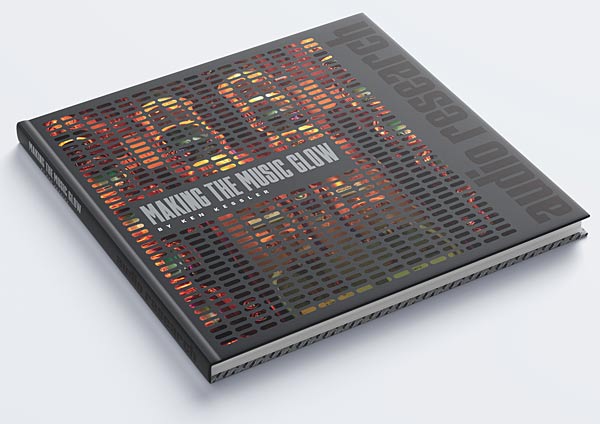
Book Review: Audio Research: Making the Music Glow

Book Review: Audio Research: Making the Music Glow
Written by Ken Kessler, designed by Henry Nolan. 220pp. $150. Available at Audio Research dealers and online at audioresearch.com.

I never met Audio Research Corporation founder William Zane Johnson, who died in 2011. But when he founded his now-legendary company in 1970, I and my ragged troupe of Dynaco modifiers were in the trenches, fighting the sand-warrior hordes during the first transistor onslaught.

FollowUp RoundUp

When Stereophile publishes followup reviews of various kinds in the print magazine, we add the followup as a "child page" to the full review. That means that they don't appear on the website's home page and might get missed. The October 2020 issue included three followups: of the Boulder 2108 phono preamplifier, the Weiss DAC502 D/A processor, and the IsoAcoustics Gaia loudspeaker isolation feet.

Andover Model-One turntable music system

Apart from the Beatles and Hendrix I heard in my audiophile father's basement, one of my earliest rock'n'roll memories involved a multipurpose record player at school. In third grade, six of us were moved as a separate group to a round table to watch a filmstrip in a darker part of a large, open-plan classroom. A clunky old record player in a self-contained carrying case with a half-dozen headphone jacks sat on the table.

VPI Magic Brick

The VPI Magic Brick is an 8lb block of steel laminations, about 5" by 3" by 2", encased in a nicely-finished oak box for aesthetic appeal and for protecting whatever the brick is sitting on from scratches. Placing the Brick over the power transformer of a piece of electronic gear is supposed to improve the sound of your stereo system.

Book Review: Hi-Fi: The History of High-End Audio Design

Hi-Fi: The History of High-End Audio Design, by Gideon Schwartz, Phaidon Press, 2019. 272pp. $84.97, hard cover.

The ongoing evolution of hi-fi can be measured in any number of ways. Most obviously, we see that evolution in the technologies associated with our industry: in big breakthroughs—mono to stereo, tubes to transistors, analog to digital—as well as incremental improvements in materials and manufacturing techniques.

Rocktron CS 5.2.5 Circle Surround decoder

Editor's Note: Published in 1998, this was the final review written by Stereophile's founder, the late J. Gordon Holt in the 37 years he was associated with the magazine. In it he expounds on his passion for experiencing recorded music in surround sound. Our continuing focus on two-channel products and recordings was one of the reasons Gordon eventually resigned, in August 1999John Atkinson

Revox A-77 open-reel tape recorder

The Revox A-77 has extremely good speed regulation, vanishingly low wow and flutter, very low noise, superb tape handling, and the smoothest, widest-range frequency response of any recorder we have ever tested.

The portable version, with built-in monitor amps and speakers, is very compact for a machine with 10½ reel capacity, and is easily carried by one person. Now that the later version is equipped with a flutter-filtering tension arm, our only criticism of the A-77 is its use of three-circuit jacks for the micro phone inputs instead of the XLR-type receptacles that are considered to be "standard" in the US for on-location audio recording.

Advertisement
Advertisement
Advertisement