Phono Preamp Reviews

Sort By:  Post Date TitlePublish Date

Listening #171: Bob's Devices Sky 40 transformer

In contrast with such line-level source components as DACs and CD players, record players generate a lower-voltage signal that requires extra gain from either a standalone phono preamplifier or the phono stage of another, more comprehensive component in one's system—typically, a full-function preamplifier or an integrated amp.

But when the phono cartridge of choice is a moving-coil (MC) type, which generates even less voltage than its moving-magnet (MM) and moving-iron (MI) friends, even more gain is required. This presents the user with an additional choice: he or she can select from among the many standalone phono preamps that offer sufficient gain, or augment an existing phono or full-function preamp or integrated amplifier with a phono step-up transformer, which boosts gain passively, without using tubes or transistors.

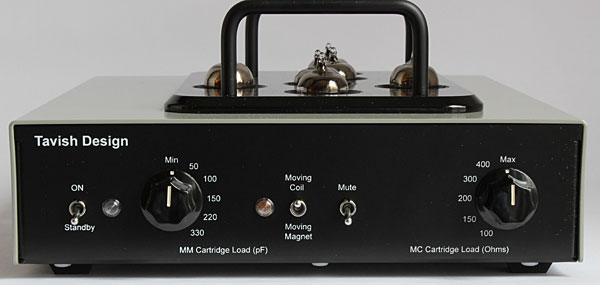
Listening #162: Tavish Adagio phono preamplifier

Though Westchester County, New York, seems a likelier locale for Bikram yoga studios, pet psychologists, and pricey restaurants specializing in "grain bowls" and fermented vegetables, the idea of manufacturing audio gear there is not without precedent. Cartridge manufacturer Micro-Acoustics (Elmsford, NY) thrived there for over two decades. George Kaye and Harvey Rosenberg's New York Audio Laboratories (Croton-on-Hudson, NY) assembled Moscode amplifiers there. Even the notorious loudspeaker manufacturer Fourier Systems (Yonkers, NY and Cocytus, Hell) got their start in the county that Hillary Clinton calls home, as needed.

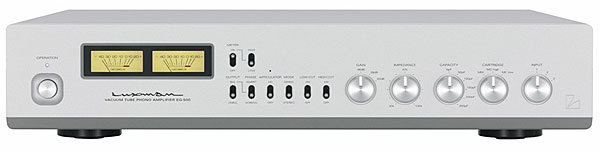
Luxman EQ-500 phono preamplifier

I still remember how difficult it was for me to transition from mass-market to high-end audio. The former, for all its flaws, gave me things to do: switches to flip, buttons to push, knobs to turn, meters to watch. I was in control—and if my attention happened to stray from the music or the liner notes, I still had something to keep me busy. By contrast, the first perfectionist-quality amplifier I bought—an Amber Series 70—was an oblong box with an on/off switch. Where's the fun in that?

Gramophone Dreams #6

I used to get invited to these highly secret audio soirées, held in a basement workshop at the end of a dark, garbage-filled alley in Manhattan's Chinatown. There was no street address—only a wire-glass window in a metal door—and if you didn't know the password (ie, if you weren't carrying some type of audio amplification), you weren't allowed to enter. That said, sometimes nonmembers were allowed to attend, but only when a member needed help carrying monoblocks: There was no parking nearby.

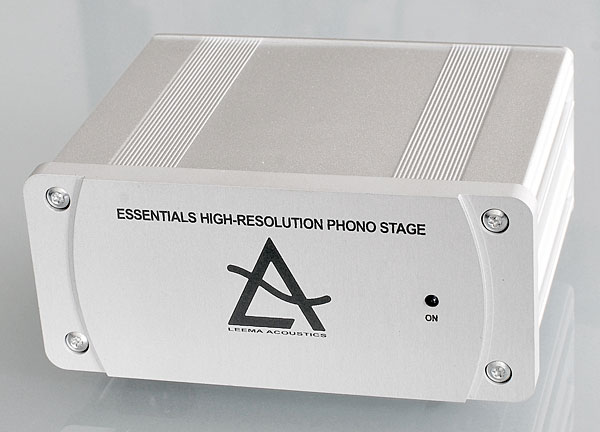
Leema Acoustics Essentials phono preamplifier

"The way that young people will get into high-end audio is not through streaming: It's through the LP."

When that observation was offered during a recent phone conversation, I wrote it down word for word—not just because I agree with it, but because it was so remarkable: The audio-industry veteran who offered it owns a digital front end worth tens of thousands of dollars, and hasn't owned a turntable for at least a dozen years. Nevertheless, as became clear during the remainder of our conversation, he understands the dynamic that keeps vinyl at the top: a confluence of marketing psychology and genuine sonic goodness.

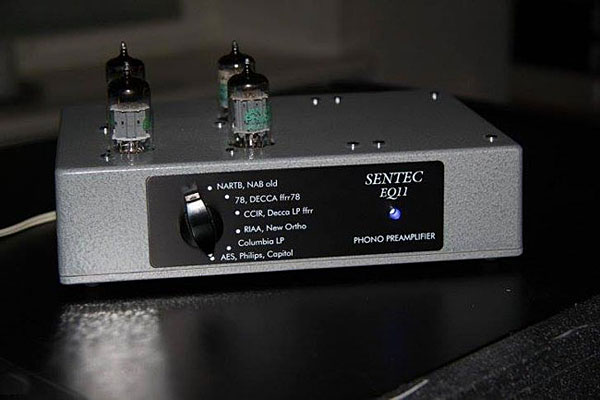
Sentec EQ11 phono preamplifier

With quiet elegance, the Sentec EQ11 phono stage and equalizer entered my expanding world of gramophone dreams. The EQ11 ($2500) is a modestly sized, tubed phono stage with the industry-standard RIAA phono equalization and five other EQ curves. These additional curves are for records pressed by companies that did not fully or promptly comply with the new, supposedly global industry standard introduced by the Recording Industry Association of America (RIAA) in 1954.

Analog Corner #217: Sutherland Engineering Insight phono preamplifier

Veteran phono-preamplifier designer Ron Sutherland has been partial, of late, to battery power. Getting off the grid can produce superb results, as demonstrated by his Hubble phono preamp ($3800), powered by 16 alkaline batteries.

I favorably reviewed the Hubble in the February 2010 issue, and remember loving most everything about it—particularly its drop-dead-quiet backdrops, its solid, weighty bottom end, and its fully fleshed-out instrumental textures. I was less enthused by its somewhat soft, muted high-frequency transients, though of course tastes and associated gear will differ. I need more grit, particularly for rock; you may not.

The Entry Level #41

What I failed to make absolutely clear in my April column is that I really, truly, thoroughly enjoyed all three USB DAC–headphone amps that I auditioned: the Audioengine D3 ($189), the AudioQuest DragonFly v1.2 ($149), and the Cambridge Audio DacMagic XS ($199). Each offered a slightly different perspective on the music, but none could be accused of closing lanes on the George Washington Bridge, dumping several feet of snow on top of our car, or doing anything especially wrong.

Listening #137

Except for a few titles I've combined with the ones in my listening room, and a few others that I intend to sell, the record collection I bought last year remains in three rows of boxes on the floor of our guest room. Because that room is spacious and comfortable, and equipped with a small refrigerator and a flat-screen TV, it is also the place where my 16-year-old daughter and her friends have their slumber parties and Dr. Who marathons. Thus, as you can imagine, I must sometimes explain to our young guests the Tao of collecting records.
Advertisement
Advertisement
Advertisement