In this space in the September 2025 Stereophile—exactly a year ago—I wrote about bicycles. I was researching a bicycle purchase, and the more I read about bikes, the more parallels I saw between bikes and hi-fi, especially economic parallels between that industry and this one. I'll recount some of that here.
At their best, bicycles and hi-fi components have this in common: They are fine machines that are unusual in how people commune with them; enthusiasts spend many hours with them each week. In very different ways, they facilitate intense experiences. Some of us form relationships with them that could be described as intimate, which is quite unusual in a machine. We value them for what they are and for what they do for us, much as we might value a human companion.
Manufacturers and retailers honor this by building machines worthy of our passion and esteem—and charging prices at least proportionate to the value we ascribe to them.
Last year, I didn't end up buying a bike. Now it's Tour de France time again, it's summer, and the weather is lovely, so I've got that bug again. I'm doing my research and shopping for bikes. For the second straight year, this has led me to reflect on what I feel is a very important topic: value in hi-fi.
In July, British bicycle publication BikeRadar ran an op-ed by Warren Rossiter, its senior technical editor for road and gravel bikes. The Tour de France, he wrote, is losing its allure. "The problem I have is that the Tour, and professional cycling more generally, now lacks the products to back up that initial spark of inspiration. When I was a kid (admittedly a long time ago), and right up until the turn of the century, all the major brands had an affordable, entry-level bike wrapped in team colors. Just as young football fans want to wear their favorite team, or national jersey, we as riders wanted to ride bikes that resembled those ridden by our heroes, even if they were nothing like the tech being ridden around France."
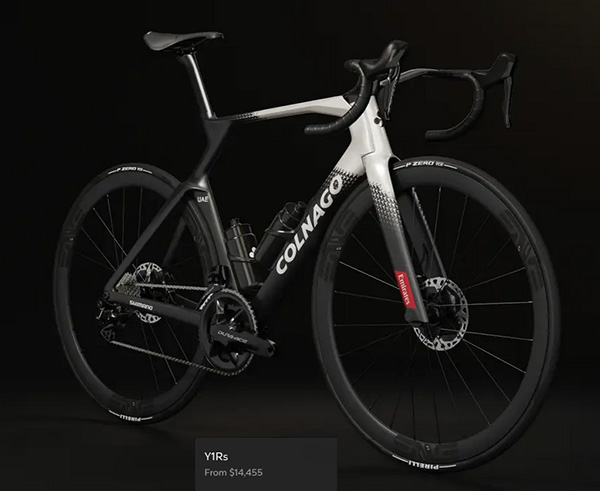
Today, however, you can't do that anymore—and not only because bike companies have stopped selling starter bikes in team colors. They've stopped selling starter bikes altogether. "The starter market, where you can buy a new bike for under £1000/$1000, has been all but abandoned by the big players. Not only that, but we've seen the expansion of premium-only brands in the pro peloton." That is to say, the most visible bikes in the Tour are made by companies that don't sell entry-level bikes. The most expensive bike in this year's Tour, Rossiter noted, was Tadej Pogačar's Colnago Y1Rs, which costs $18,500. Full custom bicycles can cost much more than that. Colnago's Italian-made bikes start around $3000.
What's any of this got to do with the price of beans or hi-fi?
The head of a boutique audio company told me recently that his company once made a product priced below $3000. It didn't sell. On someone's advice—he didn't say whose—he gave it a new name and more than doubled the price. Now it's his best-selling product.
A Swiss company that makes fine watches once accidentally added an extra zero to the watch's price in an ad in a magazine for Swiss watch enthusiasts, and the watch sold out in weeks. Apparently hi-fi isn't unique in this respect. The normal rules of price sensitivity, of supply and demand, no longer apply.
Why is this happening? In September 2025, I wrote that it's about income redistribution: An ever-larger slice of the pie is owned by the very rich, and they don't eat cheap pie. If you want to sell something that's not essential, sell it at a price high enough for rich folks to seriously consider. This is the "premiumization" phenomenon I wrote about a year ago.
But in hi-fi, I've decided, there's something else going on: a drifting away of a whole class of customers. The people who ought to be clamoring for that sub-$3000 product are off clamoring for something else, or maybe not clamoring at all. Those missing customers aren't just hi-fi's entry-level present; they're also hi-fi's high-end future. How do we find them and bring them back?
The answer is not, surely, the hi-fi equivalent of Pogačar-themed bicycles, whatever that might be. The answer, however, does involve making stuff people want. If the missing folks finally wander by and get a glimpse of hi-fi, what do we want them to see? What qualities should these high-value machines possess?
It goes without saying that those machines must make sweet music. But what else? Part of the hi-fi experience is that we must be able to love the machines. They must be worthy of our esteem.
I am no longer an entry-level hi-fi buyer, but I am an entry-level bicycle buyer, despite my advanced age. I want to buy quality but spend as little as possible. Here's what's on my bicycle shortlist.
Road bike shoppers pay big money to shave a few grams off a bicycle's weight. Not me: A steel-frame bike weighs a couple pounds more than its carbon-fiber equivalent—but I'll worry about that once I've shaved a few pounds off my own frame. Besides, there's something vaguely disposable about carbon fiber, despite the high price. As a pure object, I find high-grade steel much more appealing, and the road feel of steel can't be beat (unless it's by titanium, the price of which I can't justify).
Attached to that steel frame, I want Shimano 105 components—shifters, brakes, etc. Shimano 105 isn't fancy. You won't find it in the Tour de France. It's kind of the bottom rung of the real, serious stuff.
If I can get a bike with just those two things—a nice steel frame and Shimano 105 components—for a price that's reasonable for a weekend rider like me, then I'll hand my money over. It's not (or not only) a matter of what I can afford but of what a slightly overweight weekend warrior like me ought to pay for a bike I'll probably ride just a few hours a week in nice weather.
I'm almost out of space, so I'll leave the rest as an exercise for the reader: What characteristics allow you to take real pleasure in an amplifier, turntable, or pair of speakers? What, at a minimum, are the qualities that object must possess for you to buy it and to feel good about owning it? Write to me at jim.austin@stereophile.com.