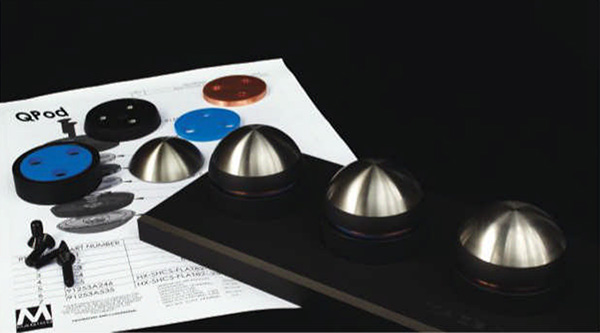
Audiophile young'uns, there actually was a time when cones and pucks and other under-gear accessories we now take for granted did not exist. Then, in the early 1980s, the Mod Squad's Steve McCormack developed and introduced Tiptoes. By today's standards, those aluminum cones were simple and inexpensive—and they worked.
Look what we've come to: Magico's QPod is a complex sandwich of CNC-turned stainless steel, oxygen-free copper, black-anodized aluminum, and a blue elastomer damping material. The result is an equipment footer that converts vibrational energy into heat through a process called shear deformation. The QPods are beautifully made and packaged, and they're expensive: $1310 for a set of three, $1680 for four (footnote 1).
I placed three QPods under my Ypsilon VPS-100 phono preamp, which has one tube, and then under Manley Labs' Chinook phono preamp (four tubes), and listened for differences. With both preamps already sitting on the very effective Harmonic Resolution System platforms, the differences should have been subtle.
They weren't. When the QPods arrived months ago, I put them under the Ypsilon and noted an overall improvement in the sound—not just on the bottom, where I was expecting it, but on top as well: less smear, less brightness (not that the Ypsilon sounds smeary or bright), greater sense of depth, and overall sonic integrity. I left the QPods there until today.
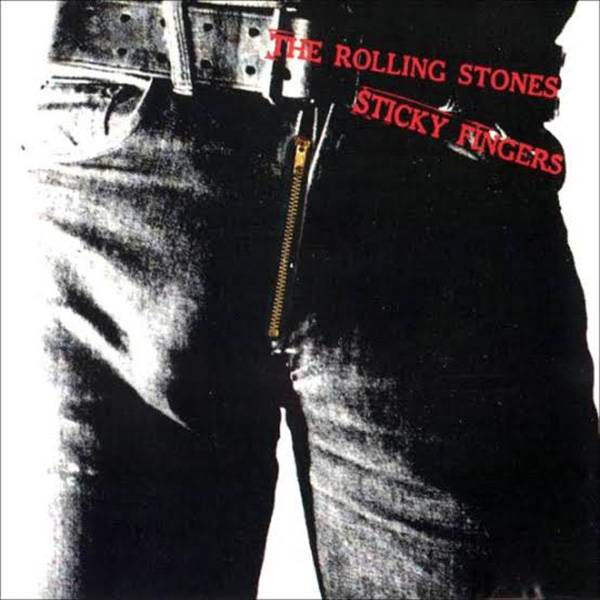 At very high SPLs, I played "Can't You Hear Me Knocking," from MoFi's reissue of the Rolling Stones' Sticky Fingers (LP, Rolling Stones/Atlantic/Mobile Fidelity Sound Lab 060). This edition supposedly has "out-of-control bass." It doesn't. If that's how it sounds, your system simply can't handle the explosive low-end energy. Mine couldn't until very recently, due to changes I'll talk about in a future column.
Then I removed the QPods for the first time in about three months, and played the cut again without changing volume. Get outta here! Before, there was one particular vocal sibilant that grated—now they all did, and that first one sounded worse. Depth—particularly where the center image appeared—was flattened. Bass was still extremely well controlled, but less so.
Reality check: The Ypsilon phono preamp sounded incredible either way. It just sounded better with the QPods under it, and to a degree that surprised me. Now I don't think I can do without the stupid things. I've got some Stillpoint Ultra stainless-steel feet here ($675/set of three), and I'm going to try them soon, but the QPods are going back into my system right now—and not back to Magico's Alon Wolf.
I'm not saying you need to spend $1310 to get this quality of sound, because maybe you don't. But if you do, you'll get results, particularly if your phono preamp is tubed. If the QPods were sold with a money-back guarantee, I don't think many would be returned.
There are less-expensive footers commensurately priced for use in less-expensive systems that you should try before you scoff at the notion that equipment footers make a difference.
At very high SPLs, I played "Can't You Hear Me Knocking," from MoFi's reissue of the Rolling Stones' Sticky Fingers (LP, Rolling Stones/Atlantic/Mobile Fidelity Sound Lab 060). This edition supposedly has "out-of-control bass." It doesn't. If that's how it sounds, your system simply can't handle the explosive low-end energy. Mine couldn't until very recently, due to changes I'll talk about in a future column.
Then I removed the QPods for the first time in about three months, and played the cut again without changing volume. Get outta here! Before, there was one particular vocal sibilant that grated—now they all did, and that first one sounded worse. Depth—particularly where the center image appeared—was flattened. Bass was still extremely well controlled, but less so.
Reality check: The Ypsilon phono preamp sounded incredible either way. It just sounded better with the QPods under it, and to a degree that surprised me. Now I don't think I can do without the stupid things. I've got some Stillpoint Ultra stainless-steel feet here ($675/set of three), and I'm going to try them soon, but the QPods are going back into my system right now—and not back to Magico's Alon Wolf.
I'm not saying you need to spend $1310 to get this quality of sound, because maybe you don't. But if you do, you'll get results, particularly if your phono preamp is tubed. If the QPods were sold with a money-back guarantee, I don't think many would be returned.
There are less-expensive footers commensurately priced for use in less-expensive systems that you should try before you scoff at the notion that equipment footers make a difference.
Footnote 1: Magico, LLC, 3170 Corporate Pl., Hayward, CA 94545. Tel: (510) 649-9700. Email: info@magico.net. Web: magico.net.
At very high SPLs, I played "Can't You Hear Me Knocking," from MoFi's reissue of the Rolling Stones' Sticky Fingers (LP, Rolling Stones/Atlantic/Mobile Fidelity Sound Lab 060). This edition supposedly has "out-of-control bass." It doesn't. If that's how it sounds, your system simply can't handle the explosive low-end energy. Mine couldn't until very recently, due to changes I'll talk about in a future column.
Then I removed the QPods for the first time in about three months, and played the cut again without changing volume. Get outta here! Before, there was one particular vocal sibilant that grated—now they all did, and that first one sounded worse. Depth—particularly where the center image appeared—was flattened. Bass was still extremely well controlled, but less so.
Footnote 1: Magico, LLC, 3170 Corporate Pl., Hayward, CA 94545. Tel: (510) 649-9700. Email: info@magico.net. Web: magico.net.