That list shows what the MP 3100 HV can do: The built-in transport plays CDs and SACDs. There's a Bluetooth receiver, which works well. You can directly connect USB storage media, from either the front panel connection mentioned above or the one on the back. All the usual digital inputs are included. There's over-the-air radio. And there are no fewer than seven options for data delivered over the network to the MP 3100 HV's streaming client.
USB is by far the most versatile connection; it's capable of PCM up to 32/384 (I corroborated up to 24/354.2, the highest-resolution PCM files I own), DSD-over-PCM (DoP) up to DSD128 (also corroborated)—and, with the aforementioned Windows 10 computer and proprietary driver, up to DSD512 natively, no DoP encoding required. (I corroborated this as well, with a borrowed computer.) MP3 and all the usual lossy formats are supported.
Playing discs is easy, except that you have to get up off the sofa. Touch the button decorated with the traditional disc/eject symbol, and the mechanism extends smoothly from the front glass panel. Put the disc in, push the button again to load, then press play (footnote 3).
To play music from a USB stick or drive, just plug it in, front panel or rear, and locate it in the T+A MusicNavigator app on your tablet; you can do it with just the remote, but I wouldn't want to access music that way. It works fine, and navigation is straightforward (with the app).
To set up subscription-streaming services, plug in an Ethernet cable and enter your registration information, username, and password. It's clumsy with the remote control—I never figured out how to type the @ symbol—but quite easy with the app.
Setting the source to "Internet Radio" calls up Airable (formerly Tune In), an Internet-radio aggregator. Users can browse or search thousands of stations of varying streaming quality and widely varying genre, including nearby stations. You can save favorite stations for easy access. "Podcasts" works the same way. If you have a Roon server somewhere in your system, there's no learning curve at all: Just plug a cable into the back of the MP 3100 HV, choose "RoonReady" as the source, and keep using Roon as you always have. But you may want to connect your Roon Server or endpoint to the MP 3100 HV with a USB cable instead of Ethernet, since, as previously noted, USB allows a wider range of data-format choices and higher PCM resolutions.
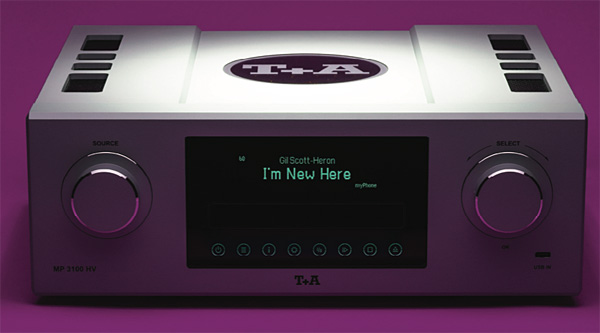 It's safe to say that, with a component as versatile as this one, few people will use all its capabilities, so it's desirable to hide the inputs you don't use, to optimize usability: Who wants to flip through a half-dozen inputs they never use? I don't use Deezer, and DAB radio doesn't exist in the United States, so those needed to go. I don't do podcasts. Right now I just need Ethernet, USB, and AES/EBU—so it was also desirable to remove all of these from my source list. This proved easy, using a combination of front-panel controls and the provided remote. It may also be possible from the Music Navigator app, but I never figured out how to do it that way.
It's probably just nostalgia, but I still get excited about FM tuners. I own a couple, including a nice vintage McIntosh in very good condition. Unfortunately, my tuners live in a closet, because I live on the ground floor of a 12-story building, surrounded by other tall buildings, and it's logistically and legally impossible for me to put an antenna outside. If I can't receive a station with an inside antenna, I can't receive it—period, end of story. Which means that, in the midst of what may be the best radio market on the continent, I can receive hardly any of that goodness in even marginally acceptable quality, with any tuner I've tried. So I'm forced to listen to even my favorite local stations—WKCR and WMFU—over the Internet. I really should give up my fascination with old-fashioned FM radio—or move out of New York City, or get an apartment on a high floor.
I tried the MP 3100 HV's FM radio tuner with a Fanfare FM-2 antenna. It took no time at all to set it up. But all I can say is that it works, and pretty well. I got stations. I didn't do a long-distance–reception shootout with my McIntosh; maybe some other time.
Listening
It's safe to say that, with a component as versatile as this one, few people will use all its capabilities, so it's desirable to hide the inputs you don't use, to optimize usability: Who wants to flip through a half-dozen inputs they never use? I don't use Deezer, and DAB radio doesn't exist in the United States, so those needed to go. I don't do podcasts. Right now I just need Ethernet, USB, and AES/EBU—so it was also desirable to remove all of these from my source list. This proved easy, using a combination of front-panel controls and the provided remote. It may also be possible from the Music Navigator app, but I never figured out how to do it that way.
It's probably just nostalgia, but I still get excited about FM tuners. I own a couple, including a nice vintage McIntosh in very good condition. Unfortunately, my tuners live in a closet, because I live on the ground floor of a 12-story building, surrounded by other tall buildings, and it's logistically and legally impossible for me to put an antenna outside. If I can't receive a station with an inside antenna, I can't receive it—period, end of story. Which means that, in the midst of what may be the best radio market on the continent, I can receive hardly any of that goodness in even marginally acceptable quality, with any tuner I've tried. So I'm forced to listen to even my favorite local stations—WKCR and WMFU—over the Internet. I really should give up my fascination with old-fashioned FM radio—or move out of New York City, or get an apartment on a high floor.
I tried the MP 3100 HV's FM radio tuner with a Fanfare FM-2 antenna. It took no time at all to set it up. But all I can say is that it works, and pretty well. I got stations. I didn't do a long-distance–reception shootout with my McIntosh; maybe some other time.
Listening
In this month's Record Reviews section, Jason Victor Serinus reviews a new album of Brahms songs sung by Irish tenor Robin Tritschler, with Graham Johnson on piano (Hyperion CDJ33129, 24/96 FLAC download). Jason assigns 4.5 stars for sonics—a very high score for Jason, who is a very critical listener. I concur: It's a gorgeous recording. Via the T+A, I heard, within individual notes, a wide range of expressive inflections. The piano's lower register somehow got in my bones even when it wasn't especially loud. This was the kind of experience I often have at a live performance—back before New York City's live-performance venues were closed due to COVID-19—but only in the best cases, with an up-front seat, or at a performance in a small space. On a recent 2L SACD—Skazki, a collection of piano music by Nikolai Medtner performed by Gunnar Sama (2L 156)—I found both the CD and SACD layers very pleasant musically, but they sounded quite different from each other. The DSD layer had more sparkle and clarity, and blacker backgrounds; the CD was muted in comparison, and slightly fuzzy, but was still a very pleasant listen, as if it had been recorded in a slightly less ideal acoustic (which it hadn't, obviously). The CD layer was creamy, while the SACD layer added sparkle to that creaminess, with a little more (realistic) leading-edge percussiveness. Reverberation tails were more extended on the DSD layer. Here again, once I'd dialed in the most realistic volume, that bone-deep piano, that geological bass. I found the SACD layer on this recording very real-sounding (but, interestingly, only after I moved my listening chair back a bit from its usual position). The more I listened to this album, the more I wanted to keep listening to this album.
On "Le Mal de Vivre," from Cecile McLorin Salvant's 2015 album, For One to Love (Mac Avenue MAC 1095, 24/88/2 Qobuz FLAC stream; I also listened on vinyl), Cecile was whispering in my ear, and the bass drum, although not loud, was physical.
"Escondido," from Early Reflections, by the Bennie Maupin Quartet (Cryptogramophone CG 137), is one of the best recordings I know for evaluating upper/midbass resolution. Maupin's bass clarinet, playing alone, sounds natural and expressive, with many small inflections of timbre in each sustained note. The test comes when bass and percussion enter, bass clarinet and upright bass playing in unison. On less-resolving systems, the sounds of the two instruments can be hard to differentiate, or impossible. Not so here. I cannot give all the credit to the T+A DAC—the other components in this system were doing their part—but I've never heard those two instruments as clearly differentiated as they were when I heard them just now. The instruments here were perfectly distinct.
In conclusion
Well-designed modern DACs tend to look similar on the test bench, with apparent variations in just a few areas: reconstruction filters (which in any case can usually be selected by the user) and in the level of the noise (usually well below what we'd expect to be audible). Distortion signatures vary some, too, but except on DACs made with vintage technologies, measured distortion is usually below what most research indicates is detectable. Looking at measurements, then, one would expect digital sources to sound very much the same.
Indeed, as I've commented before, they do tend to clump up, sonically, at least in my experience. And that's hardly a bad thing: It suggests that digital sources are converging on a certain sound—optimal sound, presumably. Perhaps clever designers will prove me wrong, but it seems clear enough to me that there are limits to what an honest digital player can achieve in terms of sonic quality and emotional impact—hard limits set by recording technique, the underlying technology, and our sensory and emotional limits. It would almost be concerning if well-made DACs sounded radically different from one another.
And yet: In the best digital sources I've heard, all that careful engineering yields—I'll just go ahead and write it—a certain magic. Magic via science: It's why I'm in this field. Treble tones glisten like light reflected from the facets of a diamond, and also seem especially relaxed—no digital glare (footnote 4). Bass, while not louder than with other digital sources, has more sturdiness and depth. These characteristics appear to be the cumulative result of attending to all the details. The T+A MP 3100 HV attends to those details and possesses those qualities.
Footnote 3: There's actually one more step, at least: You need to use the source-selector switch to select disc playback. And if it's a hybrid SACD, you select the playback layer before closing the drawer by touching the button labeled "I/II."
Footnote 4: This depends on the recording. No player can completely undo mistakes made in the recording studio.
It's safe to say that, with a component as versatile as this one, few people will use all its capabilities, so it's desirable to hide the inputs you don't use, to optimize usability: Who wants to flip through a half-dozen inputs they never use? I don't use Deezer, and DAB radio doesn't exist in the United States, so those needed to go. I don't do podcasts. Right now I just need Ethernet, USB, and AES/EBU—so it was also desirable to remove all of these from my source list. This proved easy, using a combination of front-panel controls and the provided remote. It may also be possible from the Music Navigator app, but I never figured out how to do it that way.
It's probably just nostalgia, but I still get excited about FM tuners. I own a couple, including a nice vintage McIntosh in very good condition. Unfortunately, my tuners live in a closet, because I live on the ground floor of a 12-story building, surrounded by other tall buildings, and it's logistically and legally impossible for me to put an antenna outside. If I can't receive a station with an inside antenna, I can't receive it—period, end of story. Which means that, in the midst of what may be the best radio market on the continent, I can receive hardly any of that goodness in even marginally acceptable quality, with any tuner I've tried. So I'm forced to listen to even my favorite local stations—WKCR and WMFU—over the Internet. I really should give up my fascination with old-fashioned FM radio—or move out of New York City, or get an apartment on a high floor.
I tried the MP 3100 HV's FM radio tuner with a Fanfare FM-2 antenna. It took no time at all to set it up. But all I can say is that it works, and pretty well. I got stations. I didn't do a long-distance–reception shootout with my McIntosh; maybe some other time.
In this month's Record Reviews section, Jason Victor Serinus reviews a new album of Brahms songs sung by Irish tenor Robin Tritschler, with Graham Johnson on piano (Hyperion CDJ33129, 24/96 FLAC download). Jason assigns 4.5 stars for sonics—a very high score for Jason, who is a very critical listener. I concur: It's a gorgeous recording. Via the T+A, I heard, within individual notes, a wide range of expressive inflections. The piano's lower register somehow got in my bones even when it wasn't especially loud. This was the kind of experience I often have at a live performance—back before New York City's live-performance venues were closed due to COVID-19—but only in the best cases, with an up-front seat, or at a performance in a small space. On a recent 2L SACD—Skazki, a collection of piano music by Nikolai Medtner performed by Gunnar Sama (2L 156)—I found both the CD and SACD layers very pleasant musically, but they sounded quite different from each other. The DSD layer had more sparkle and clarity, and blacker backgrounds; the CD was muted in comparison, and slightly fuzzy, but was still a very pleasant listen, as if it had been recorded in a slightly less ideal acoustic (which it hadn't, obviously). The CD layer was creamy, while the SACD layer added sparkle to that creaminess, with a little more (realistic) leading-edge percussiveness. Reverberation tails were more extended on the DSD layer. Here again, once I'd dialed in the most realistic volume, that bone-deep piano, that geological bass. I found the SACD layer on this recording very real-sounding (but, interestingly, only after I moved my listening chair back a bit from its usual position). The more I listened to this album, the more I wanted to keep listening to this album.
Well-designed modern DACs tend to look similar on the test bench, with apparent variations in just a few areas: reconstruction filters (which in any case can usually be selected by the user) and in the level of the noise (usually well below what we'd expect to be audible). Distortion signatures vary some, too, but except on DACs made with vintage technologies, measured distortion is usually below what most research indicates is detectable. Looking at measurements, then, one would expect digital sources to sound very much the same.
Footnote 3: There's actually one more step, at least: You need to use the source-selector switch to select disc playback. And if it's a hybrid SACD, you select the playback layer before closing the drawer by touching the button labeled "I/II."