Home Entertainment 2006 in L.A. The weather is fine. The restaurants are cool. The company is très neat. I can't wait to schmooze with manufacturers, writers, dealers, and meet, for the first time, writers of letters to the editor of Stereophile. Play some jazz with John Atkinson and Immedia's Allen Perkins—one smokin' drummer since he's been studying with Peter Erskine (Joni Mitchell, Weather Report, Diana Krall). Of course, my prime objective at the Show is to seek out the best-sounding affordable loudspeakers, to keep my review hopper full for the next year.
 This time, the choice is easy. I end up spending quite a bit of time in the two listening rooms occupied by Aperion Audio, an Oregon-based firm that designs and manufacturers 15 models of affordable audio and home-theater speakers, including subwoofers and in-walls. Aperion is making quite nice music in both their two-channel and home-theater demos (where I also get my first glimpse of high-definition DVD video—I'm hooked). The Aperion folks are nice, and their speakers are visually attractive and affordable.
That affordability is largely due to the fact that Aperion is a factory-direct manufacturer. There's no dealer markup; theoretically, the customer pockets the savings. The rub is that customers can't listen to the speakers at a dealer before buying a pair. For this business model to work, the manufacturer needs to ensure that the customer has a way of thoroughly auditioning its products, and to provide a generous return policy and great customer service. Aperion does all of these things in spades—better than any other speaker manufacturer I'm aware of.
All Aperion speakers are available for a 30-day audition with full money-back guarantee, including shipping both ways. Aperion claims a return rate of less than 4%. All of their speakers are warranted for 10 years, and the amplifiers in the powered speakers for three years. Within the first 12 months following purchase, a customer who wants to upgrade to a higher speaker model can return the original and have its full retail price credited toward the new model's purchase. Once an Aperion speaker is purchased, the customer service begins, in the form of a series of "Welcome to the Aperion family" e-mails.
I asked Aperion if I could review their Intimus 533-T ($375 each). The two speakers arrived in oversized and well-braced double boxes—shipping damage seemed unlikely, and indeed, there wasn't any. Inside was a detailed 19-page owner's manual, a pair of cotton gloves for handling the speakers, and an SPL meter for optimizing the level settings in a surround-sound array. When I removed the Aperions from their inner boxes, I noticed that each was encased in a royal blue velvet bag with a gold sash. Cool! The velvet bags that Chivas Regal Royal Salute comes in came to mind. (Never got to try that one. By the time I could afford a bottle, my taste had shifted to single-malts.)
The Design
This time, the choice is easy. I end up spending quite a bit of time in the two listening rooms occupied by Aperion Audio, an Oregon-based firm that designs and manufacturers 15 models of affordable audio and home-theater speakers, including subwoofers and in-walls. Aperion is making quite nice music in both their two-channel and home-theater demos (where I also get my first glimpse of high-definition DVD video—I'm hooked). The Aperion folks are nice, and their speakers are visually attractive and affordable.
That affordability is largely due to the fact that Aperion is a factory-direct manufacturer. There's no dealer markup; theoretically, the customer pockets the savings. The rub is that customers can't listen to the speakers at a dealer before buying a pair. For this business model to work, the manufacturer needs to ensure that the customer has a way of thoroughly auditioning its products, and to provide a generous return policy and great customer service. Aperion does all of these things in spades—better than any other speaker manufacturer I'm aware of.
All Aperion speakers are available for a 30-day audition with full money-back guarantee, including shipping both ways. Aperion claims a return rate of less than 4%. All of their speakers are warranted for 10 years, and the amplifiers in the powered speakers for three years. Within the first 12 months following purchase, a customer who wants to upgrade to a higher speaker model can return the original and have its full retail price credited toward the new model's purchase. Once an Aperion speaker is purchased, the customer service begins, in the form of a series of "Welcome to the Aperion family" e-mails.
I asked Aperion if I could review their Intimus 533-T ($375 each). The two speakers arrived in oversized and well-braced double boxes—shipping damage seemed unlikely, and indeed, there wasn't any. Inside was a detailed 19-page owner's manual, a pair of cotton gloves for handling the speakers, and an SPL meter for optimizing the level settings in a surround-sound array. When I removed the Aperions from their inner boxes, I noticed that each was encased in a royal blue velvet bag with a gold sash. Cool! The velvet bags that Chivas Regal Royal Salute comes in came to mind. (Never got to try that one. By the time I could afford a bottle, my taste had shifted to single-malts.)
The Design
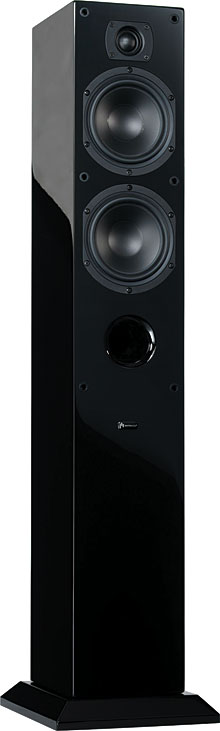
The Intimus 533-T is part of a new trend: affordable floorstanding speakers designed to compete with stand-mounted minimonitors. In a 5.1-channel system, many people don't want large-footprint speakers in the living room. The magnetically shielded 533-T is a so-called 2½-way design, in which the upper of the two 5.25" drive-units handles the midrange but both handle the bass. This is intended to devote more cone area to the bass frequencies, but keeps the cone area small in the midrange for better dispersion and better integration with the tweeter. Aperion claims that this gives the 533-T the soundstaging abilities of a minimonitor. The tweeter is a 1" silk-dome unit. The cabinet is built of 1"-thick high-density fiberboard to maximize rigidity. In Aperion's cherry finish, the 533-Ts were simply gorgeous (high-gloss black lacquer is also offered), and wouldn't be out of place in a living room with traditional furniture.
Aperion suggested I leave the black polyknit grilles on. They'd voiced the 533-T with its grille on because they assumed that that's how most customers will listen to the speaker. I ended up agreeing; removing the grilles didn't seem to reveal any more detail, but did seem to make high-frequency sibilants a bit more prominent than they should have been.
The Sound
As soon as I heard them in my living room, I recalled why I'd so enjoyed the Intimus 533-Ts at HE2006. They reproduced music with a very natural quality and did not call attention to themselves. The speakers seemed to disappear, and there was a sense of organic ease with every recording I cued up—with one minor exception (see below), the 533-T was entirely devoid of coloration. The vocals and instruments on Janis Ian's Breaking Silence (CD, Analogue Productions CAPP 027) were reproduced with considerable midrange detail, and the highs were neither harsh nor rolled. Bass guitars was reproduced in an even manner throughout the instrument's range. Vocalists sounded rich and dimensional, with no sense of excessive presence or muddiness. The angelic vocal choir in the opening tracks of Brian Wilson's Smile (CD, Nonesuch 79846-2) was rich and silky. Transients were appropriately fast, with no sense of being either etched or blunted. The interplay between Chris Jones' fretless bass and Mark Flynn's drums on "Wine Goggles," from my jazz group Attention Screen's La Tessitura (CD, Hojo HOJO110), churned coherently during the more upbeat sections of this uptempo funk rant.
The one minor coloration I noted was in the midbass: the 60–100Hz region seemed to have a slight added warmth. This wasn't a resonance or unevenness, and with no recording did I hear any hint of overhang, or any distortion that distracted from the musical experience. It was just a slight character or personality that I wouldn't be surprised to learn the designers had designed into the 533-T. After all, I'm sure many potential buyers would prefer a bit of midbass warmth to any leanness or thinness in this region. This character didn't detract from my enjoyment of Ray Brown's double-bass solo on "I'm an Old Cowhand," from Sonny Rollins' Way Out West (CD, JVC VICJ-60083). There was no sense of sluggishness or overhang in the solo, and the sound of the instrument's wooden body shone through, despite the subtle warmth added by the Aperions.
Originally, when I'd requested the 533-Ts without one of their matching subwoofers, Aperion had hesitated. "Well, most of our customers use the 533-T in a home-theater system with a subwoofer channel." But the 533-T had sounded balanced when run as a full-range two-channel speaker at HE2006, so I didn't hesitate to decline the offer of a sub. That choice was confirmed when I began to listen to the 533-Ts at home. My very large main listening room has no problem producing bottom-octave response from speakers capable of reaching down that far. But I've found that my room can make smaller, more affordable speakers sound a bit bass-shy. Although the Aperion 533-T is a floorstander, I consider it to be a "small" speaker, given its dainty footprint and limited interior volume relative to most floorstanders at or near its price. That said, the 533-Ts had no problem reproducing convincing and weighty midbass in my room. I don't feel they need a subwoofer.
Still, don't expect earthshaking low-bass performance from the Intimus 533-Ts. The organ-pedal notes in Timothy Seelig and the Turtle Creek Chorale's recording of John Rutter's Requiem (CD, Reference RR57-CD) were resonant, and without overhang, but they didn't shake my room. However, only the very lowest pedal pitches seemed to be missing in action. Kraftwerk's low synth blasts on Minimum/Maximum (CD, EMI ASW6061) were rich and full, with strong, rapid electronic transients.
The 533-T also exhibited wide, natural dynamic contrasts. Even when blasting hard-rock tunes at 95dB or above, these small speakers never sounded small. Once, when the wife and kids were out, I cranked the title track of Hole's Celebrity Skin (CD, Geffen DGCD 25164) up to 11 and was dancing around the room, wailing away on air bass. The Aperions' sound contained not a single bit of strain or coagulation. On other tracks of this disc, the subtle acoustic guitar textures shone through despite the volume levels.
Single instruments closely miked for wide dynamic range really bloomed through the Aperions. Andy Haas's opening shofar blast on "CBU 87 Steel Rain," from his Humanitarian War (CD, Resonantmusic 003), so startled me that I almost fell off my chair.
The ability of the 533-Ts to render gobs of inner detail, room ambience, and wide, deep soundstages made them seem to disappear with well-recorded classical music. Soprano Nancy Keith's solos on the Rutter Requiem was vibrant and airy, and I was able to easily perceive the sound of the reverberant recording venue. (My listening note: "Decay-y-y-y-y-y-y.") The image specificity of a wide, deep stage also shone through on Antal Dorati and the London Symphony's recording of Stravinsky's The Firebird (CD, Mercury Living Presence SR90226).
The one recording that combined all of the Aperion's strengths for me was David Chesky's Violin Concerto, from his Area 31 (SACD, Chesky SACD288, CD layer). The timpani in the opening movement were pitch-perfect and natural-sounding, and the pizzicato double-bass passage was fast, warm, and vibrant, with no trace of overhang. The transients on the celeste were rich, reverberant, and tinkly, the upper partials extended.
The Competition
Transients were appropriately fast, with no sense of being either etched or blunted. The interplay between Chris Jones' fretless bass and Mark Flynn's drums on "Wine Goggles," from my jazz group Attention Screen's La Tessitura (CD, Hojo HOJO110), churned coherently during the more upbeat sections of this uptempo funk rant.
The one minor coloration I noted was in the midbass: the 60–100Hz region seemed to have a slight added warmth. This wasn't a resonance or unevenness, and with no recording did I hear any hint of overhang, or any distortion that distracted from the musical experience. It was just a slight character or personality that I wouldn't be surprised to learn the designers had designed into the 533-T. After all, I'm sure many potential buyers would prefer a bit of midbass warmth to any leanness or thinness in this region. This character didn't detract from my enjoyment of Ray Brown's double-bass solo on "I'm an Old Cowhand," from Sonny Rollins' Way Out West (CD, JVC VICJ-60083). There was no sense of sluggishness or overhang in the solo, and the sound of the instrument's wooden body shone through, despite the subtle warmth added by the Aperions.
Originally, when I'd requested the 533-Ts without one of their matching subwoofers, Aperion had hesitated. "Well, most of our customers use the 533-T in a home-theater system with a subwoofer channel." But the 533-T had sounded balanced when run as a full-range two-channel speaker at HE2006, so I didn't hesitate to decline the offer of a sub. That choice was confirmed when I began to listen to the 533-Ts at home. My very large main listening room has no problem producing bottom-octave response from speakers capable of reaching down that far. But I've found that my room can make smaller, more affordable speakers sound a bit bass-shy. Although the Aperion 533-T is a floorstander, I consider it to be a "small" speaker, given its dainty footprint and limited interior volume relative to most floorstanders at or near its price. That said, the 533-Ts had no problem reproducing convincing and weighty midbass in my room. I don't feel they need a subwoofer.
Still, don't expect earthshaking low-bass performance from the Intimus 533-Ts. The organ-pedal notes in Timothy Seelig and the Turtle Creek Chorale's recording of John Rutter's Requiem (CD, Reference RR57-CD) were resonant, and without overhang, but they didn't shake my room. However, only the very lowest pedal pitches seemed to be missing in action. Kraftwerk's low synth blasts on Minimum/Maximum (CD, EMI ASW6061) were rich and full, with strong, rapid electronic transients.
The 533-T also exhibited wide, natural dynamic contrasts. Even when blasting hard-rock tunes at 95dB or above, these small speakers never sounded small. Once, when the wife and kids were out, I cranked the title track of Hole's Celebrity Skin (CD, Geffen DGCD 25164) up to 11 and was dancing around the room, wailing away on air bass. The Aperions' sound contained not a single bit of strain or coagulation. On other tracks of this disc, the subtle acoustic guitar textures shone through despite the volume levels.
Single instruments closely miked for wide dynamic range really bloomed through the Aperions. Andy Haas's opening shofar blast on "CBU 87 Steel Rain," from his Humanitarian War (CD, Resonantmusic 003), so startled me that I almost fell off my chair.
The ability of the 533-Ts to render gobs of inner detail, room ambience, and wide, deep soundstages made them seem to disappear with well-recorded classical music. Soprano Nancy Keith's solos on the Rutter Requiem was vibrant and airy, and I was able to easily perceive the sound of the reverberant recording venue. (My listening note: "Decay-y-y-y-y-y-y.") The image specificity of a wide, deep stage also shone through on Antal Dorati and the London Symphony's recording of Stravinsky's The Firebird (CD, Mercury Living Presence SR90226).
The one recording that combined all of the Aperion's strengths for me was David Chesky's Violin Concerto, from his Area 31 (SACD, Chesky SACD288, CD layer). The timpani in the opening movement were pitch-perfect and natural-sounding, and the pizzicato double-bass passage was fast, warm, and vibrant, with no trace of overhang. The transients on the celeste were rich, reverberant, and tinkly, the upper partials extended.
The Competition
I compared the Aperion Intimus 533-T ($750) to the Monitor Audio Silver RS6 ($1000), the Amphion Helium2 ($1000), and the Nola Mini ($695 when last offered). (All prices per pair.) The Monitor Audio Silver RS6 exhibited much more inner-midrange and high-frequency detail than the Intimus 533-T. It was also capable of reproducing deeper bass and stronger high-level dynamic contrasts. The Amphion Helium2 was also more detailed in the midrange and highs than the Aperion. However, the Amphion's lower midrange was not as rich, and the Aperion had more extended bass and superior high-level dynamic contrasts.
The Nola's midrange was as rich as the Aperion's, but revealed more inner detail. The Nola also exhibited more extended bass and better high-level dynamic contrasts, and its tweeter seemed more revealing of inner detail.
The End
I'm delighted to have reviewed the wonderful Aperion Intimus 533-T. It has many strengths, negligible weaknesses, and is a superb value. It's visually attractive, and would fit many different décors. Finally, it's not really an "audiophile" speaker—it just sits there, plays music, and plays it well. So if you're a man in the street who wants a pair of speakers to play a wide range of music, and if your significant other likes the Intimus 533-T's looks, why not buy a pair online? With a 30-day, no-risk return policy, how can you lose? If you want deeper bass, you can always add a subwoofer. Well done, Aperion!
This time, the choice is easy. I end up spending quite a bit of time in the two listening rooms occupied by Aperion Audio, an Oregon-based firm that designs and manufacturers 15 models of affordable audio and home-theater speakers, including subwoofers and in-walls. Aperion is making quite nice music in both their two-channel and home-theater demos (where I also get my first glimpse of high-definition DVD video—I'm hooked). The Aperion folks are nice, and their speakers are visually attractive and affordable.
That affordability is largely due to the fact that Aperion is a factory-direct manufacturer. There's no dealer markup; theoretically, the customer pockets the savings. The rub is that customers can't listen to the speakers at a dealer before buying a pair. For this business model to work, the manufacturer needs to ensure that the customer has a way of thoroughly auditioning its products, and to provide a generous return policy and great customer service. Aperion does all of these things in spades—better than any other speaker manufacturer I'm aware of.
All Aperion speakers are available for a 30-day audition with full money-back guarantee, including shipping both ways. Aperion claims a return rate of less than 4%. All of their speakers are warranted for 10 years, and the amplifiers in the powered speakers for three years. Within the first 12 months following purchase, a customer who wants to upgrade to a higher speaker model can return the original and have its full retail price credited toward the new model's purchase. Once an Aperion speaker is purchased, the customer service begins, in the form of a series of "Welcome to the Aperion family" e-mails.
The Intimus 533-T is part of a new trend: affordable floorstanding speakers designed to compete with stand-mounted minimonitors. In a 5.1-channel system, many people don't want large-footprint speakers in the living room. The magnetically shielded 533-T is a so-called 2½-way design, in which the upper of the two 5.25" drive-units handles the midrange but both handle the bass. This is intended to devote more cone area to the bass frequencies, but keeps the cone area small in the midrange for better dispersion and better integration with the tweeter. Aperion claims that this gives the 533-T the soundstaging abilities of a minimonitor. The tweeter is a 1" silk-dome unit. The cabinet is built of 1"-thick high-density fiberboard to maximize rigidity. In Aperion's cherry finish, the 533-Ts were simply gorgeous (high-gloss black lacquer is also offered), and wouldn't be out of place in a living room with traditional furniture.
As soon as I heard them in my living room, I recalled why I'd so enjoyed the Intimus 533-Ts at HE2006. They reproduced music with a very natural quality and did not call attention to themselves. The speakers seemed to disappear, and there was a sense of organic ease with every recording I cued up—with one minor exception (see below), the 533-T was entirely devoid of coloration. The vocals and instruments on Janis Ian's Breaking Silence (CD, Analogue Productions CAPP 027) were reproduced with considerable midrange detail, and the highs were neither harsh nor rolled. Bass guitars was reproduced in an even manner throughout the instrument's range. Vocalists sounded rich and dimensional, with no sense of excessive presence or muddiness. The angelic vocal choir in the opening tracks of Brian Wilson's Smile (CD, Nonesuch 79846-2) was rich and silky.
Transients were appropriately fast, with no sense of being either etched or blunted. The interplay between Chris Jones' fretless bass and Mark Flynn's drums on "Wine Goggles," from my jazz group Attention Screen's La Tessitura (CD, Hojo HOJO110), churned coherently during the more upbeat sections of this uptempo funk rant.
The one minor coloration I noted was in the midbass: the 60–100Hz region seemed to have a slight added warmth. This wasn't a resonance or unevenness, and with no recording did I hear any hint of overhang, or any distortion that distracted from the musical experience. It was just a slight character or personality that I wouldn't be surprised to learn the designers had designed into the 533-T. After all, I'm sure many potential buyers would prefer a bit of midbass warmth to any leanness or thinness in this region. This character didn't detract from my enjoyment of Ray Brown's double-bass solo on "I'm an Old Cowhand," from Sonny Rollins' Way Out West (CD, JVC VICJ-60083). There was no sense of sluggishness or overhang in the solo, and the sound of the instrument's wooden body shone through, despite the subtle warmth added by the Aperions.
I compared the Aperion Intimus 533-T ($750) to the Monitor Audio Silver RS6 ($1000), the Amphion Helium2 ($1000), and the Nola Mini ($695 when last offered). (All prices per pair.) The Monitor Audio Silver RS6 exhibited much more inner-midrange and high-frequency detail than the Intimus 533-T. It was also capable of reproducing deeper bass and stronger high-level dynamic contrasts. The Amphion Helium2 was also more detailed in the midrange and highs than the Aperion. However, the Amphion's lower midrange was not as rich, and the Aperion had more extended bass and superior high-level dynamic contrasts.
I'm delighted to have reviewed the wonderful Aperion Intimus 533-T. It has many strengths, negligible weaknesses, and is a superb value. It's visually attractive, and would fit many different décors. Finally, it's not really an "audiophile" speaker—it just sits there, plays music, and plays it well. So if you're a man in the street who wants a pair of speakers to play a wide range of music, and if your significant other likes the Intimus 533-T's looks, why not buy a pair online? With a 30-day, no-risk return policy, how can you lose? If you want deeper bass, you can always add a subwoofer. Well done, Aperion!